-
Sarve bhavantu sukhinah
Sarve santu nira-maya-ah
Sarve bhadrani pashyantu ma-kaschit dukha-bhak bhavet- Brihadaranyaka Upanishad: 1.4.14
-
“May all of mankind be happy May all be healthy
May all experience prosperity
May none (in the world) suffer.”- Brihadaranyaka Upanishad: 1.4.14
-
Asato Maa Sad Gamaya Tamaso Maa
Jyotir Gamaya Mrityor Maa Amritam Gamaya- Brihadaranyaka Upanishad: 1.3.28
-
“O' Lord, please lead me from darkness of ignorance
to the light (of knowledge) From death (limitation)
to immortality (liberation).”- Brihadaranyaka Upanishad: 1.3.28



This page has been viewed: times.
Dissecting The Unite the Kingdom Rally
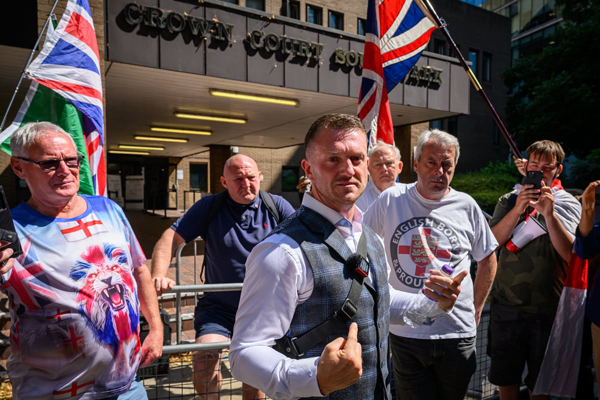
Author: Kalki Kalyani
Editor: Akash_Vani
Date Published: Saturday 7th February 2026
The Unite the Kingdom rally, organized by Tommy Robinson took place on 13 September 2025 in London.
While organizers and supporters viewed it as a milestone, closer analysis identifies it as a strategic failure when measured against broader demographic and political realities.
The Illusion of Victory: Numerical vs. Demographic Reality
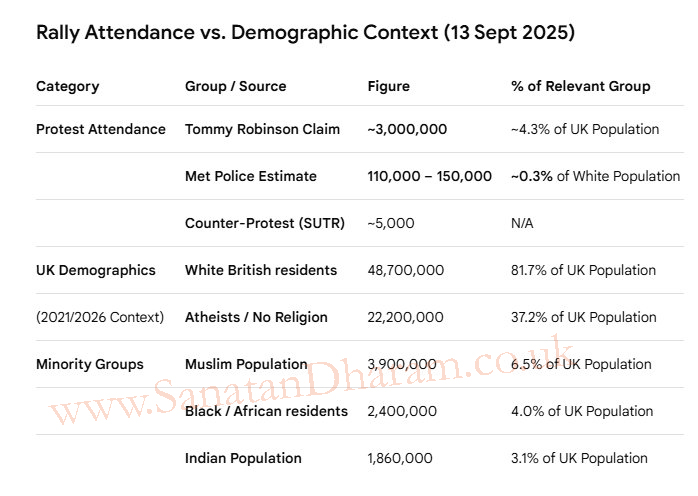
The Attendance Gap: Although the Metropolitan Police estimated attendance between 110,000 and 150,000, organizers claimed figures reaching into the millions. Even at the highest police estimate, the turnout represents only a tiny fraction of the UK's population.
While Tommy Robinson claimed 3 million people attended the 13 September 2025 rally, the
Metropolitan
Police estimated the crowd at approximately 110,000 to 150,000.
If the police figures are accurate, the protest represented roughly 0.3% of the white population, making it an even smaller "success" than
1% calculation suggested.
A 1% Movement: In a country with over 48.7 million (81.7% of the total
population) White British residents and 22 million atheists (37.2%), a turnout of 150,000 constitutes roughly 0.3% of that demographic.
This supports the argument that the movement, despite its noise, remains a marginal force that has failed to mobilize the silent majority it claims to represent.

Minority Demographics: The scale of the protest was also outweighed by the UK's minority populations—including roughly
3.9 million (6.5%) Muslims, 2.4 million (4.0%) Black/African residents, and
1.86 million (3.1%) million Indians.
The movement's inability to garner broader support across these groups limits its national legitimacy.
Fractured Foundations & Internal Power Vacuums
Inherent Instability: A central failure of the movement is its lack of a coherent political programme. Participants held widely differing goals, ranging from specific opposition to illegal migration to general anti-migrant sentiment.
The Wolf Effect: By opening a can of worms regarding sensitive national
taboos (Islamic and Pakistani rape grooming gangs), Robinson has historically empowered fringe elements he cannot always control. This has led to recurring fractures, where initial supporters break away to form self-interested groups or pursue personal goals.
How do you control the unleashed beast?
Hindus & Indians: The Middle Ground: The Indian and Hindu communities often find themselves in a precarious position, targeted by misinformation and caught between conflicting nationalist and religious narratives. Despite Robinson’s occasional rhetoric in favour of Indian communities, these groups face a
rock and a hard place scenario where history is often distorted to suit the political ends of both sides.
Strategic Outcome: Awareness vs. Achievement
Awareness without Action: While the march successfully displayed unity, captured headlines and social media attention, it lacked a lawful strategy or unified vision capable of influencing policy.
However, this is what we call momentum building and show of strength, clearly
achieved.
The Cost of Disorder: Reports suggest, violent clashes with police, resulting in 26 injured officers and multiple arrests, ultimately alienated the broader public and reinforced the
far-right label that organizers sought to shed.
Religious Shifts /Decline of Christianity in U.K
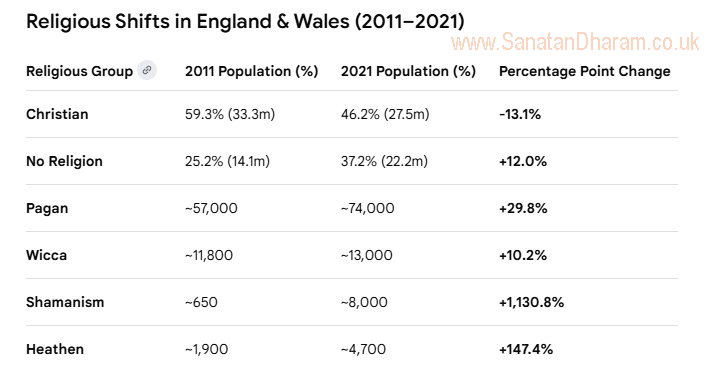
The data suggests that even with drastic changes to migration, Britain's trajectory is moving away from institutional Christianity due to deep-seated internal shifts.
The Decline is Home-Grown
The collapse of Christianity in Britain is primarily a result of internal
secularisation and generational change, not external pressure.
The Age Gap: The median age of a Christian in England and Wales is 51,
while the median age for those with No Religion is 32. As the older
generation passes away, the social habit of passing down faith has
broken; children of the baby boomers were significantly less likely to be raised
with a specific religious focus.

The Remixing of Belief: Britons aren't necessarily
becoming nothing—they are remixing faith. A 2025 study
found that while 44% of respondents left Christianity, many are moving toward
personalised, practice-based spiritualities like Paganism rather than other
major world religions.
A Post-Christian Majority: For the first time, fewer than half of people in England and Wales (46.2%) describe themselves as Christian. In some regions, like Wales, "No Religion" is already the largest group at 46.5%.
Deep Ideological Rift In The Robinson Movement.
While Tommy Robinson often uses more moderate framing—focusing specifically on the incompatibility of Islam to maintain a broader appeal—the splinter groups he ignites frequently radicalise into remigration or ethno-nationalist positions that he publicly avoids and rejects.
The Matt Goodwin Rejection
The Gorton and Denton by-election on 26 February 2026 was a major reality check for these groups.
Matt Goodwin, the GB News presenter and academic-turned-activist, stood for Reform UK but
finished
second with 28.7% (10,578 votes).
The Loss: Despite a loud campaign and an endorsement from Tommy Robinson, Goodwin was beaten by the Green Party’s Hannah Spencer, who won with 40.7%.
The Reaction: After the loss, Goodwin blamed sectarianism and
family voting, a narrative often used when these movements fail to capture the multi-ethnic urban
vote (Yes, he lost, what did he expect?!)
The Elon Musk & Ben Habib Connection?
The situation is further complicated by Elon Musk’s increasing involvement in UK politics.
Colonisation Rhetoric: Musk has notably justified aspects of the British
Empire and called for revolutionary
change in the UK government.
Advance UK: Musk reportedly encouraged Ben Habib (former Reform UK Deputy Leader) to form
Advance UK in 2025 after Habib split with Nigel Farage over
weak policies.
The Fracture: While Reform UK tries to distance itself from Robinson (stating he is
not welcome), Robinson officially joined Advance UK in August 2025. This party is positioned much further to the right, openly calling for the suspension of all asylum claims and bans on the
burqa.
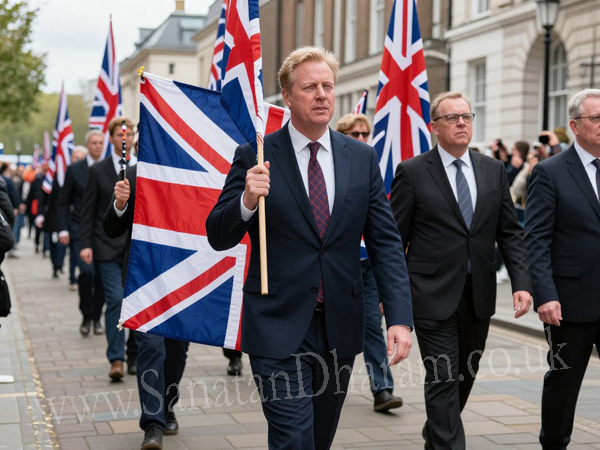
The Wolves And The Can of Worms (Again!)
Islam vs. Remigration: Robinson's strategy has been to compare Muslims unfavourably to
Sikhs and Hindus to avoid being labelled a
racial extremist. However, by opening this can of worms, he has provided a platform for groups like Britain First or Advance UK members who want full remigration—a policy that would eventually target the very Indian/Hindu groups Robinson currently claims to support.
The Power Vacuum: As Reform UK fails to win by-elections, the momentum shifts to these more extreme splinter groups. Robinson
ignites the
conversation, he loses control of the fire as self-interested wolves (like those in Advance UK) take the rhetoric to its absolute, and often exclusionary, conclusion.
Summary of The
Shift (2025-2026):
Reform UK: Still trying to be respectable but failing to win key seats.
Advance UK: The new found home for Robinson, Habib, and Musk-backed rhetoric.
The Result: A fractured right-wing that claims to be a mass movement but consistently loses to tactical voting from the other 99% of the population.
The 1% Movement: Even using the highest police estimate (150,000), the turnout represents less than 1% of the White British population. This highlights that the vast majority of the demographic the movement claims to represent did not participate.
Minority Scale: Combined, the Indian, Muslim, and Black/African populations
(~8.16
million) dwarf the attendance of the rally by over 50 to 1, reinforcing the movement's limited national
legitimacy (complele fail!)
Statistical Discrepancy: Organizers claimed 3 million people attended, which would be roughly 1 in 25 people in the entire UK. Authorities and independent fact-checkers noted this was a significant inflation, as the march area (roughly 1.5km) could not physically hold such a number.

Broken Britain
The perception of a broken Britain is backed by current polling and demographic trends showing a nation deeply fractured along age, education, and geography lines. While right-wing groups are surging in rural and post-industrial heartlands, they face a structural wall in diverse, urban centres that may indeed be permanent.
The Urban-Rural Great Divide
Right-wing groups losing the cities is largely supported by 2026 electoral projections:
Rural Realignment: Reform UK is projected
to take control of county councils like Essex, Norfolkand and Suffolk in May 2026—historically Conservative heartlands.
Urban No-Go Zones for the Right: In highly populated ethnic and younger areas, right-wing populist groups are struggling.
For example, in London and university cities like Manchester and Sheffield the Green Party has displaced Labour as the primary challenger, often polling over 37% among under-30s.
The Diverse Vote: Labour maintains a commanding 53% lead among ethnic minority voters, while Reform UK polls at only
7% in this
demographic. This creates a geographic ceiling; as cities become more diverse, the
right is increasingly pushed to the peripheries.
A Multipolar, Fractured Landscape
Britain is no longer a two-party system but a five-party
battleground
The Squeeze!
The combined Conservative and Labour vote share has plummeted to a record low of 37.1% as of March 2026.
Fragmented Opposition: Even in cities where Labour is losing control, like
Birmingham, the vote is splitting between Greens, Liberal Democrats, and independent candidates rather than shifting to the right.
Fractured Movements: The Unite the Kingdom rally highlighted this internal split: while some attended for
traditional values, others openly called for remigration,
alienating the more moderate
urban public and further entrenching city-dwellers' opposition.
While groups like Reform UK or Advance UK may win majorities in the 2026 elections by dominating rural and older demographics, they are becoming culturally and politically
locked out of Britain's major multi-ethnic urban hubs.
Geographic Divide: Reform UK’s support is now concentrated in mid-sized Middle England towns and post-industrial northern areas. In major conurbations like London, their vote share remains stagnant at around 12–19%, far below their national average.
Political Islands: Major Muslim / multi-ethnic cities have become political islands where parties like the Greens or Labour dominate. This means that even if a party like Reform wins a national majority, they would govern a country where its economic and cultural engines (the cities) are in active political
opposition (no go zones!)
The Feasibility of Remigration
The concept of remigration (forced mass deportation of legal residents or naturalised citizens) faces nearly insurmountable barriers.
Legal & Practical Deadlocks: Such policies would violate the principle of non-refoulement and the 1951 Refugee Convention. Practically, the mechanism for deporting those born in the UK or with dual nationality remains legally undefined and would trigger years of litigation.
Economic Contradiction: Economists argue that mass remigration would worsen the very issues—like labour shortages and service collapses—that drive people toward these parties in the first place.
The Strategy of Fear Assumption
There is significant evidence that the narrative of inevitable conflict is being used to bypass political rejection:
The Narrative as a Tactic: Since groups like Reform UK and Advance UK are effectively
locked out of major cities like
London and
Manchester, some analysts argue the civil war rhetoric is a way to maintain relevance. If you cannot win a city through votes, you portray it as a
wasteland or a future war
zone to demoralise its residents and drive out dissenting demographics.
Encouraging Departure: This fear factor has a direct impact on the ground. Recent reports show that
40% of ethnic minority housing
staff have faced discrimination fueled by these narratives, creating an atmosphere where many feel unsafe in their own communities.
Mainstreaming Extreme Ideas: Terms like remigration have moved from the far-right fringes into
mainstream political
debate. By framing it as an alternative to war, proponents attempt to make mass deportation seem like a
logical solution to avoid the very conflict they are predicting.
The No-Win Geographic Trap
Britain is currently experiencing polar factionalism—a state where different groups no longer share a common vision for the country.
The Growth of Ethnic Hubs: As ethnic minority areas grow, the Right continues to lose grip on urban economic engines. For instance,
Birmingham is expected to move toward "no overall control" in the May 2026 elections, with a mix of Greens and
(Islamic-Muslim) independents, further isolating traditional nationalist parties.
The Rural Retreat: This leaves the Right dominating rural areas but governing from a position of
geographic
isolation. This creates a no-win scenario where any national victory would likely be met with civil disobedience or political paralysis in the cities.
Civil War: Inevitability vs. Adaptation
While some experts like Dr. David
Betz argue that a factionalized Britain is on an inevitable path to conflict, others disagree:
The Counter-Narrative: Many social cohesion experts argue that the UK is
well set up to absorb conflicts through its established institutions like the NHS and local community networks.
A Mess vs. A War: Other commentators suggest Britain isn't collapsing into war but is simply in a
period of intense messiness and adaptation.
India: The invasion and rise of Islam in the Indian subcontinent is a clear example of an 800 year old civil war or as we say, civilizational clash: Hindu Vs Mughal / Dharmic resistance timeline and Sikh Vs Mughal history.
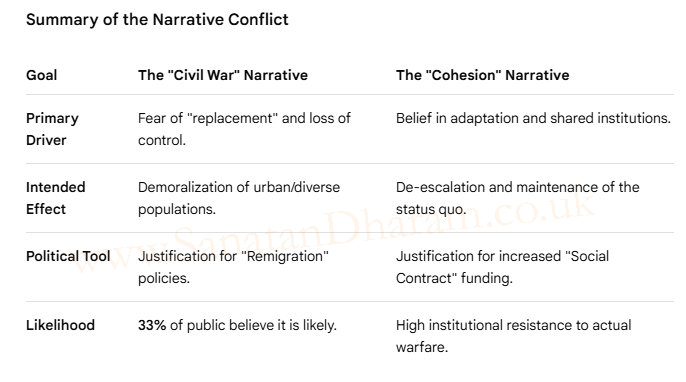
The narrative often serves as a replacement for electoral success. By pushing a civil war outcome, these groups create a scenario where the only way to save the country is to adopt their most extreme policies, effectively trying to win through a sense of emergency what they cannot win through the ballot box in diverse areas.
The Kashmir Blueprint
Kashmiri Pandits: In the 1990s as a warning of how rapid demographic shifts can lead to the butchering, displacement and killings of minority communities (Kashmiri Hindus).
We can see a similar pattern emerging in the UK (demographic shift), a central point of tension in British politics today.
https://en.wikipedia.org/wiki/Exodus_of_Kashmiri_Hindus
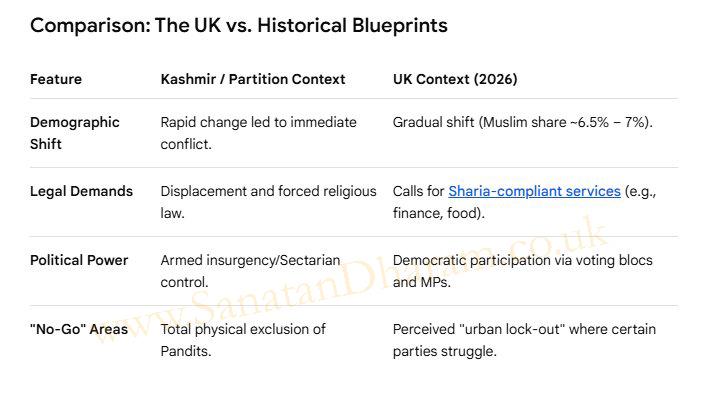
While the patterns of bloc voting and demographic growth are real, the outcomes differ from the Kashmir scenario (for now!)
The Current Landscape: Patterns vs. Shifts
Political Bloc Voting: The 2024 General Election was a significant turning point, with
Muslim
voters demonstrating the power of bloc voting to influence results. In 21 seats where Muslims make up more than 30% of the population, Labour's vote share
fell by 29 percentage
points, and four independent candidates were elected on pro-Gaza platforms.
Increased Representation: There are currently 25 Muslim MPs in
Parliament—roughly 4% of the total, which is slightly below their 6.5% national population
share. While critics see this as a step toward replacement, proponents argue it is standard democratic integration.
The Replacement Narrative: This has moved from the fringes into mainstream discourse.
British Future recently highlighted how rhetoric about Britain being
colonised has intensified, fueled by data showing that 31% of children born in the UK in 2024 were born to foreign-born
mothers—a significant jump from
11% twenty-five years ago.
Similar Topics
7th May 2026 Local Elections || Broken Britain Part One || Broken Britain Part Two || Dissecting The "Unite the Kingdom" RallyShare Your Thoughts Below
No comments found.







Leave a comment
Login | Register