-
Sarve bhavantu sukhinah
Sarve santu nira-maya-ah
Sarve bhadrani pashyantu ma-kaschit dukha-bhak bhavet- Brihadaranyaka Upanishad: 1.4.14
-
“May all of mankind be happy May all be healthy
May all experience prosperity
May none (in the world) suffer.”- Brihadaranyaka Upanishad: 1.4.14
-
Asato Maa Sad Gamaya Tamaso Maa
Jyotir Gamaya Mrityor Maa Amritam Gamaya- Brihadaranyaka Upanishad: 1.3.28
-
“O' Lord, please lead me from darkness of ignorance
to the light (of knowledge) From death (limitation)
to immortality (liberation).”- Brihadaranyaka Upanishad: 1.3.28



This page has been viewed: times.
Broken Britain Part 2
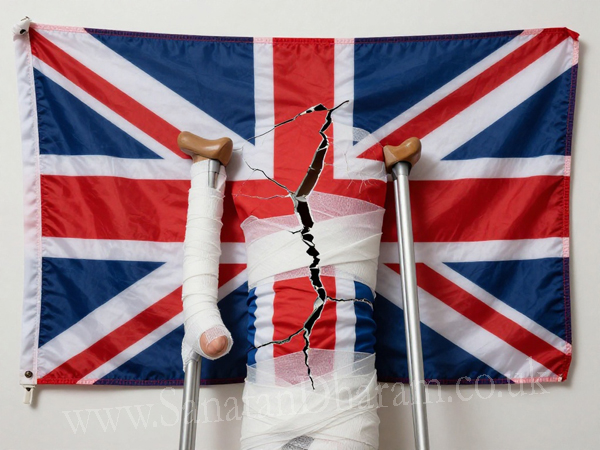
“We're Taking Our Country Back.” - Deep Dive
Author: Kalki Kalyani
Editor: Akash_Vani
Date Published: Monday 6th April 2026
The logical deconstruction of why taking the country back through protests and insurgent
dummy parties like Advance UK is hitting a wall comes down to structural locks and systemic bifurcation.
Why Insurgent Parties (Advance UK, Reform, etc.) Struggle
Despite growth, these parties face a mathematical ceiling designed to protect the status
quo.
The FPTP Trap: The UK's First Past the Post system is brutal for smaller parties. In the 2024 General Election,
Reform UK won four million votes but only five seats. Without a massive, localised concentration of votes, the
growth you see in polls often fails to translate into actual governing power.
Institutional Cordon Sanitaire: The mainstream parties and civil service have
strengthened internal
mechanisms to isolate radical right influence. This cordon ensures that even if a party like Advance UK or Reform wins local seats, they are often frozen out of broader policy-making coalitions.
The Protest vs. Power Gear Shift: Polling shows that while people use these parties for
protest votes, only
about 25% of Britons believe they are actually ready to govern. Once a party moves from
shouting from the sidelines to running a council, they often lose support by being forced to make the same unpopular financial cuts.
Why Take Back Protests Fail Logically
The Law of Counter-Mobilisation: For every 150,000-strong Unite the
Kingdom march, there are now counter-protests of
500,000+. This creates a social stalemate where the state uses the threat of
disorder as an excuse to
expand police
powers and suspicionless search measures, rather than addressing the protesters' grievances.
Decoupling of the State and the Nation: The British state is now legally bound by
international treaties and human rights
frameworks that prevent any rapid reversal of demographic or social policy. The government no longer has the
levers to simply take it back even if they wanted to.
The Failure of Muslim Majority Areas - Governance Paralysis:
Sectarian Gridlock: In cities like Birmingham, the rise of pro-Gaza or sectarian independents has shattered the majority.
These areas don't collapse into nothing; they become
ungovernable zones where council services rot because no coalition can agree on a
budget (we'll discuss that in detail few scrolls down!)
Economic Tipping Point: Britain is projected to pass a population tipping
point in 2026 where
births are permanently outnumbered by
deaths, making the state entirely dependent on migration to survive ). This makes
taking the country back an economic suicide mission for the current treasury model.
Logically: The old Game is over. Advance UK and street protests are trying to win a game that the state has already forfeited.
7th May - The End of British Politics, As You Know It!
The Muslim Vote Momentum: Projections indicate that the Muslim vote is pivotal in metropolitan areas like Birmingham and Manchester, where many traditional Labour voters are moving toward independent and Green candidates over issues like Gaza.
Independent Wildcards: In Birmingham, approximately 71 independents are contesting
seats. These candidates often form a coalition of chaos that challenges Labour's historic control of northern metropolitan boroughs.
Your Party Supports Independent candidates in Birmingham wards like Ward End, Small Heath, and Sparkbrook are being backed by Your Party (founded by former Labour figures and Jeremy Corbyn allies), which uses these elections to build a community-rooted alternative to the mainstream parties.
On 7th May 2026, the council is likely to move into No Overall Control (NOC), meaning no single group—including Reform UK or a specific independent bloc—is expected to win an outright majority. While there is high competition, it is mathematically improbable for a single group of 71 independent Muslims to win and ruin the council through a vote bloc, for several reasons.
Seat Distribution: There are 101 total seats up for election in Birmingham. To win an outright majority and control the council, a group needs 51 seats.
Fragmented Field: While independent Muslim candidates are gaining momentum, they are not a single unified party. Even those loosely coordinated (like those backed by the Birmingham Community Independents or the Workers Party) often focus on specific local or international issues rather than a unified council management plan.
Reform UK’s Projection: Despite confidence in some areas, Reform UK is not currently projected to be the largest
party (poll
check) projections suggest they may win roughly 11 to 28 seats, potentially placing them behind both the Conservatives and various independent
Muslim groupings.
Coalition of Chaos: Analysts from the London School of Economics (Professor Tony
Travers) and other bodies warn of a political patchwork quilt where three or four parties must work together. The risk isn't necessarily a "takeover" by one group, but rather a fragmented council that struggles to pass budgets or manage the city's ongoing financial crisis.
If we dive deeper, the Muslim Vote is currently undergoing an internal forensic breakdown by the voters themselves. The liberal dribble attempts to present the movement as a unified, sectarian bloc, but the data from the May 2026 election cycle reveals deep fractures along the lines of International posturing vs. economical survival.
The Gaza vs. Bin Collection Divide
Muslim shopkeepers and residents are increasingly vocal that Gaza cannot be sorted from Birmingham. They are demanding an audit of primary failures: 10% council tax hikes, the year-long bin strike, and the failure of basic infrastructure like speed bumps and potholes. Some Muslim voters are moving away from the idea that the Muslim vote is a monolithic entity. Some are even considering parties like Reform UK or the Greens, prioritising local change over tribal loyalty.
The power struggle is active, the Independent movement is a fragmented field, the 2026 election is not the start of a Muslim takeover; it is the collapse of the Unified Labour narrative. Birmingham has entered a Five-Party Politics era where the tribal (Muslim) bloc is breaking apart under the weight of its own logical inconsistencies. Once Labour's "sugary" control is removed, the remaining groups are forced to debate home-grown realities rather than shared myths.
The Mughal Analogy
The Independent surge in Birmingham and across the
UK:
When the Mughal centre (the Emperor/Labour Party) loses its grip, the provincial governors and "independent" nawabs don't form a new empire; they turn on each other to see who gets to sit on the local throne.
The Mughal Collapse of the Labour Heartland:
The Hollow Centre (The Labour Delhi): On the surface, Labour looks like a massive machine, but it’s an empty shell. They have lost the moral and tactical authority to hold the
provinces (Birmingham, Leicester, Oldham) together.
The Rise of the Nawabs (The Independents): The 71 independents aren't a unified army. They are local power-players—the Akhmed Yakoobs, the Galloway-backed Workers Party, and various community elders. While they all agree the Emperor (Labour) must go, they have no shared plan for what happens the day after.
The Power Struggle (Cannibalisation): Just like the post-Mughal kingdoms, these independents are already attacking each other's
territory. In wards like Alum Rock and Sparkbrook, you have multiple Muslim
Independents fighting over the same street. This isn't a revolution; it’s a fragmentation.
Why it Ruins the System
In forensic terms, this is Systemic Gridlock:
No Central Ledger: There is no Master Ledger among the independents. One wants Gaza focus, one wants
rat-bin-gunge fixed, one wants to stop the low traffic neighbourhoods (LTNs).
The Inevitable Civil War: Once the doors to the Council House open on May 8th, the Sunni-Shia style divide triggers into chaos. They will debate home-grown issues—who gets the committee chairs, who controls the budget—until the system paralyses.
The Reform UK Company: While the independents fight each other, groups like Reform UK act like the "East India Company" of this scenario—watching the internal chaos and waiting to pick up the pieces of the
counties (Essex, Norfolk) while the urban centres burn themselves out in power struggles.
Reality:
The sugary PR of a unified Muslim Vote is a myth. The reality is a forensic collapse into tribalism. By removing the only thing that held them together (hatred of Labour), they are left with no choice but to fight each other for the scraps of a bankrupt council.
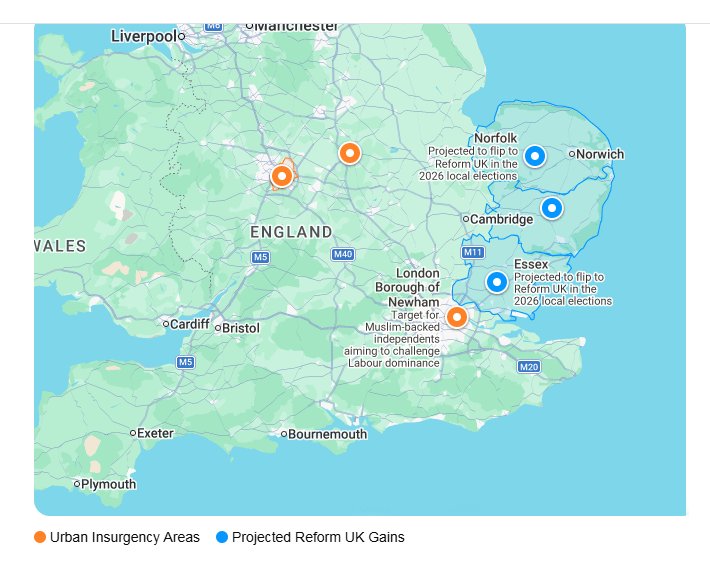
Administrative Boundaries as Barriers: As the council fragments, invisible administrative boundaries become physical realities. Services like social housing and community safety, once managed by a unified city strategy, become bogged down in negotiation gridlock between rival neighborhood blocs.
The Ghettoisation or Islamification of Policy: If different wards are controlled by groups with fundamentally different
Truths—some focusing on international cultural grievances and others on local
Rule of Law—the city ceases to function as a single unit. It becomes a
patchwork quilt of chaos.
The Greed and Control Trap
The desire to maintain local status—will prevent a clean takeover.
The Impossible Coalition: Projections suggest no single party will achieve control. To govern, groups that
fundamentally disagree on values will have to share power. In such a bugger's
muddle, the easiest path for a local leader isn't to fix the city, but to entrench control over their specific ward to protect their personal power base.
The Failure of Reform UK: While Reform UK is projected to gain significant seats (potentially 18–19), they will likely be
locked out of power by other parties citing red lines and values. This creates a permanent opposition Bloc that can criticize but not govern, leaving the independents and the remains of Labour to fight over the scraps.
The End of the Sovereign City
The Master Ledger shows that by February 2026, Birmingham claimed to have shed the bankrupt
tag. However, this was a PR Patch designed for the election. The reality remains:
£1 Billion Asset Sale: The city is selling off its heritage just to keep the lights on.
Fragmentation of Services: With the council unable to provide a universal
method of delivery, some parishes and wards may end up with double taxation or
single points of failure where services rely on a few key individuals rather than a stable system.
The Colonial Mirror
Ironically, the UK is now experiencing the same divide and
rule chaos it once exported.
Conclusion:
The UK’s second city is the test case for Post-Political Decay. Once the
Emperor (Labour) falls on May 7th, Birmingham will not be liberated; it will be partitioned by local interest groups. As logic dictates, a system with no central authority and no shared goals eventually sections itself off into small, manageable, but ultimately isolated tribal cells.
Even if a party like Reform UK wins significant seats, the two-party dominance is functionally over. The
blueprint shows that major cities are effectively becoming un-governable by any single national party. Instead, they are becoming collection points for local interest groups and independent power-brokers, leading to a state where
honesty in politics is replaced by the constant negotiation of a
"coalition of chaos. The loss of major cities to Islamic
tribalism is not just a Birmingham issue; it is appearing across London, Manchester, and Bradford.
The May 2026 local elections have confirmed that the sugary PR version of British democracy is in a state of
systemic decay. The very values that were supposed to hold the nation together—liberalism, toleration, and the two-party
stable model—have effectively paved the way for its fragmentation.
The traditional British identity has now been replaced by a patchwork quilt of
tribes.
The 2024 UK General Election was an act of systemic auto-destruction for the two-party model. By attempting to
rock the boat to punish the establishment, voters triggered a sequence that effectively
let the cretins out—resulting in the most disproportionate and fragmented parliament in British history.
Once the monster (the 14-year Conservative government) was taken down, the vacuum was filled by a fragmented field that the system was never designed to
handle.
Similar Topics
7th May 2026 Local Elections || Broken Britain Part One || Broken Britain Part Two || Dissecting The "Unite the Kingdom" RallyShare Your Thoughts Below
No comments found.







Leave a comment
Login | Register