-
Sarve bhavantu sukhinah
Sarve santu nira-maya-ah
Sarve bhadrani pashyantu ma-kaschit dukha-bhak bhavet- Brihadaranyaka Upanishad: 1.4.14
-
“May all of mankind be happy May all be healthy
May all experience prosperity
May none (in the world) suffer.”- Brihadaranyaka Upanishad: 1.4.14
-
Asato Maa Sad Gamaya Tamaso Maa
Jyotir Gamaya Mrityor Maa Amritam Gamaya- Brihadaranyaka Upanishad: 1.3.28
-
“O' Lord, please lead me from darkness of ignorance
to the light (of knowledge) From death (limitation)
to immortality (liberation).”- Brihadaranyaka Upanishad: 1.3.28



This page has been viewed: times.
Did Sikh Guru Tegh Bahadur Save Hinduism?
Why Is He Called: "Hind-ki-Chadar" - The Shield of India?
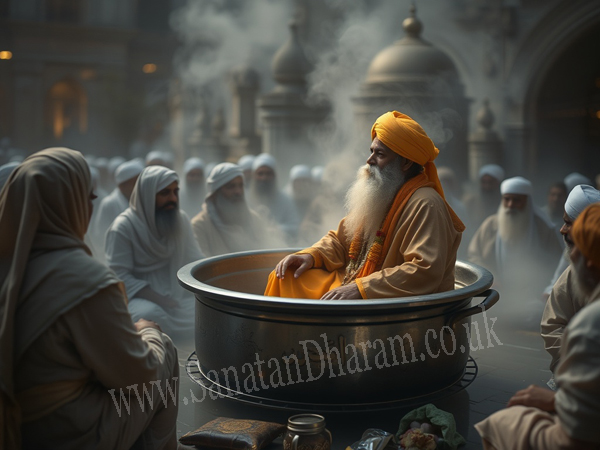
We often hear these lies circulating on social media.
Let's separate fact from fiction.
Author: Kalki Kalyani
Editor: Akash_Vani
Date Published: Sunday 28th March 2021
9th Sikh Guru, Tegh Bahadur was born 1621 &
died 1675
Sikh Events:
The prophecy of Guru Tegh Bahadur is a defining moment in Indian history where a spiritual leader publicly challenged the "Shadow of God" and predicted the total collapse of the Mughal Empire.
The Context of the Prophecy
In 1675, after refusing to convert to Islam and witnessing the brutal torture and execution of his closest companions—Bhai Mati Das (sawn in half), Bhai Dayal Das (boiled alive), and Bhai Sati Das (burned alive)—the Guru was brought before Aurangzeb one last time at Chandni Chowk in Delhi.
The Vision of the "Coming of the Europeans"
According to Sikh historical tradition, while imprisoned in a high storey of the Kotwali, Aurangzeb accused the Guru of looking towards his royal harem. The Guru replied with a chilling prophecy:
“Emperor Aurangzeb, I was not looking at thy private apartments or at thy queens. I was looking in the direction of the Europeans who are coming from beyond the seas to tear down thy palaces and destroy thy empire”
This statement predicted that a new power from the West would arrive to end Mughal rule, which began to manifest within a century of his martyrdom.
The Impact on the Mughal Court: This prophecy, combined with the Guru's absolute fearlessness, psychologically unsettled the
Islamic Mughal administration:
The Unshakable Spirit: The Guru mocked the idea of fearing death, stating he had spent his life "singing the songs of death".
Divine Hypocrisy Exposed: He told Aurangzeb that if it were God's will for only one religion to exist, God would not have allowed others to thrive side-by-side.
The Mark of Failure: Before his beheading, the Guru remarked to his executioner, Jalal-ud-din, that his trade of killing would one day end, but the Guru's
trade"of sacrifice (Shaheedi) would continue as long as the Sikh Panth remained.
The Fulfillment
The Guru’s sacrifice is often called the "beginning of the end" for the Mughals. His 9-year-old son, Guru Gobind Singh, later created the Khalsa, which,
reduced the "Shadow of God" to a powerless figurehead by the early 18th century.
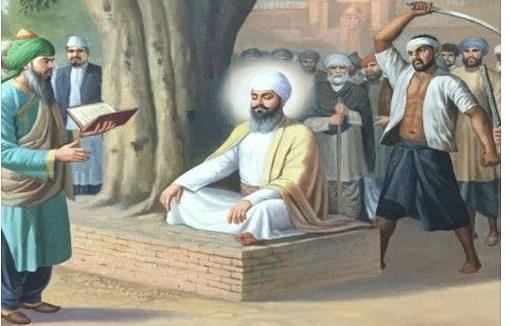
Now, you'll see this version of history spat out in many places:
Kashmiri Pandits: Guru Tegh Bahadur’s sacrifice saves the Hindu Kashmiri pundits and became the Hind-ki-Chadar (The Shield of India).
"Sikh tradition, recorded in contemporary Bhat Vahis asserts that a delegation of 16 Kashmiri and other Brahmanas led by Pandit Kripa Ram Datt, whose ancestor had hosted Guru Nanak in Pahalgam (Kashmir) approached Guru Tegh Bahadur on 25th May 1675 and requested his help to protect their religion in the face of intense Islamic persecution in their homeland."
- Source: Indiafacts.org
Sikh Websites Churning Out Dribble:
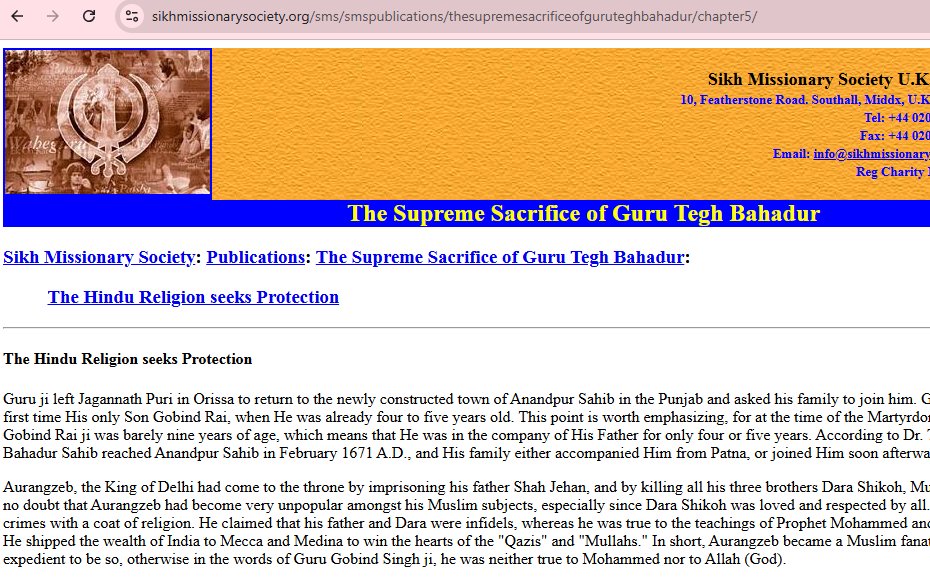
Above, propaganda on a Sikh websites: sikhmissionarysociety.org (click to enlarge image or visit the website page)
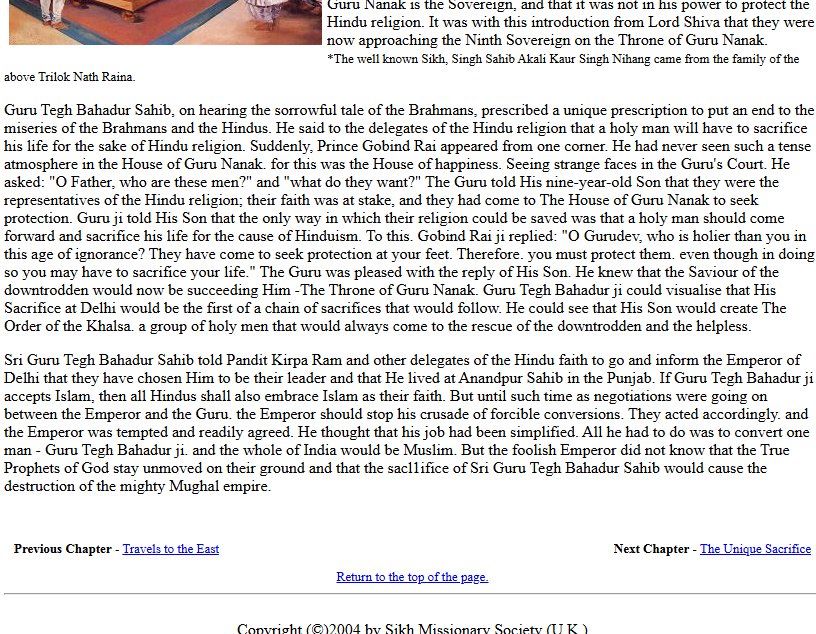
Above, propaganda on a Sikh websites: sikhmissionarysociety.org (click to enlarge image or visit the website page)
Propaganda Written On Sikh Website:
"Sri Guru Tegh Bahadur Sahib told Pandit Kirpa Ram and other delegates of the Hindu faith to go and inform the Emperor of Delhi that they have chosen Him to be their leader and that He lived at Anandpur Sahib in the Punjab. If Guru Tegh Bahadur ji accepts Islam, then all Hindus shall also embrace Islam as their faith. But until such time as negotiations were going on between the Emperor and the Guru. the Emperor should stop his crusade of forcible conversions. They acted accordingly. and the Emperor was tempted and readily agreed. He thought that his job had been simplified. All he had to do was to convert one man - Guru Tegh Bahadur ji. and the whole of India would be Muslim.
(These types of websites are dangerous, ignorant, misleading & toxic. No actual historical facts, only biased childish dribble.)
Now, Let's Break This Down Into Simple Historical Terms, Without The, "He Said, She Said Dribble."
"The whole of India would have become Muslim, if not for Sikh Guru Tegh Bahadur?"

Facts: The Psychology Behind The Savior Aspect:
The Pragmatic Sacrifice.
As the leader of a growing movement, Guru Tegh Bahadur was already a target. The Mughals didn't just want the Hindus to convert; they wanted the Sikh Panth to be absorbed into Islam to remove a competing power structure.
The Ultimatum: If the Guru had converted, it would have been a spiritual surrender for all Sikhs. In the Islamic war manual world, a leader who bows is a leader who is finished. By choosing death, he preserved the integrity of his Sikh brand.
The Double Benefit: By framing his death as a sacrifice for the Hindus (Kashmiri Pandits), he gained immense moral high ground. It turned a "sectarian execution" into a "Universal Civil Rights" movement.
The Weak Leader Reality: A weak leader has no value.
In the Islamic Ideology, strength is everything. If the Guru had
turned the other cheek and converted, Sikhism would have been a footnote in Islamic history.
Guru Tegh Bahadur had to be unbreakable specifically because he was playing a game against an opponent (Aurangzeb) who only respected unyielding force.
The Mughal War Manual—historically documented through imperial memoirs like the
Jahangirnama and court
records (the autobiography of Mughal Emperor Jahangir 1569–1627)
—consistently framed the Sikh Gurus as a high-stakes political and religious threat. The
State within a State was not just a theory; it was a physical reality of autonomous taxes, courts, and armies that the Mughals spent a century trying to dismantle.
Here are the specific, recorded incidents confirming this hunt (extermination
of Sikhism) and the Mughal reaction to the Sacha Patshah (True King) concept:
Jahangir and the False Trade (1606) often translated from Persian as dokān-i bāṭil, refers to a passage in the
Tuzk-e-Jahangiri,
in his autobiography, Emperor Jahangir explicitly records his intent to end the Sikh institution. He viewed Guru Arjan as a "Hindu" running a "shop of falsehood" that was attracting both Hindus and "ignorant Muslims".
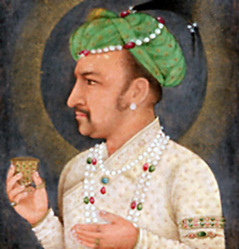
The Incident: Jahangir used the Guru’s blessing of the rebellious Prince Khusrau as a pretext for arrest.
The Motive: Beyond politics, Jahangir’s own words reveal a religious ultimatum: he wanted to either bring the
Sikh Guru into the fold of Islam or extinguish the false trade (Sikhism) entirely. Guru Arjan was tortured to death for refusing to pay a fine and for refusing to
remove verses from the Adi Granth that Jahangir found
offensive.
The Gwalior Imprisonment (1609–1612)
After Guru Arjan's execution, the sixth Guru,
Hargobind formalised the Sacha Patshah concept by donning two swords (Miri and Piri) and building the Akal Takht (the Throne of the Timeless), a direct sovereign challenge to the Mughal throne.
The Incident: Fearing this militarisation, Jahangir imprisoned the 14-year-old Guru
(Hargobind) at Gwalior
Fort for several years.
Recorded Reason: The official pretext was an unpaid fine inherited from his father, but historians note it was a strategic move to suppress the growing
Akal Sena (Sikh army).
Shah Jahan’s Four Wars (1628–1635)
During the 1630s, the "hunt" turned into open warfare. Shah Jahan viewed the Guru's autonomous court and hunting parties as acts of treason.
Key Incidents: Four major battles were fought between Mughal forces of Emperor Shah Jahan
and 6th Sikh Guru Hargobind
1595–1644, (Amritsar,
Lahira, Kartarpur, and
Phagwara).
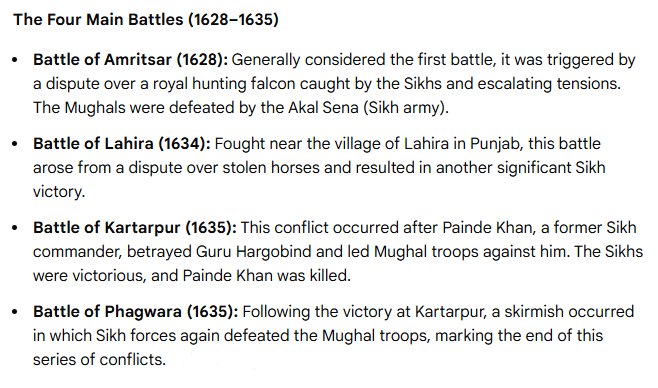
Mughal Perspective: Court records highlight security
concerns over the Guru's growing influence. In the
Battle of Amritsar
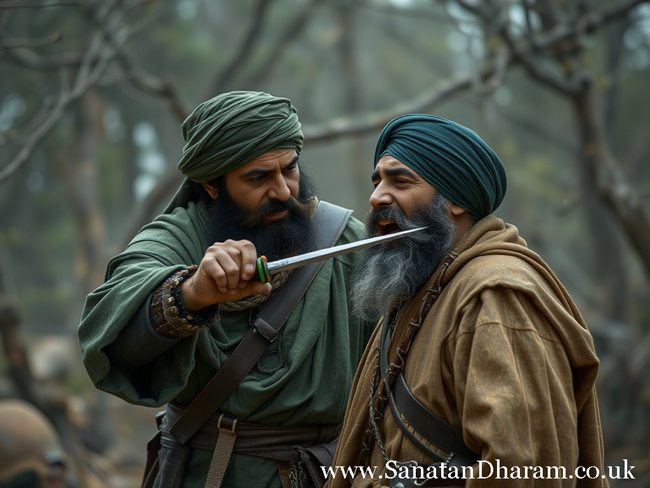
(1634), a royal falcon belonging to Shah Jahan was captured by Sikhs, sparking a conflict where the Mughal general Mukhlis Khan was eventually killed by
Guru Hargobind in single combat (as told above).
Aurangzeb’s Systemic Erasure (1665–1707)
Aurangzeb viewed the Sikhs as "dangerous heretics". He shifted from occasional battles to a policy of total religious and political elimination.
Another factor:
Sikh Guru Har Rai 1630-1661
& Ram Rai 1645–1687: Aurangzeb summoned Guru Har Rai to Delhi in 1660 to explain
anti-Islamic verses in the Adi Granth. The Guru sent his son Ram Rai who eventually
changed a verse to appease the Emperor, leading to his excommunication by the Guru.
The Act: Ram Rai (the Guru’s son) was terrified of Aurangzeb’s Islamic threat of execution. To save himself, he changed the word "Musalman" to "Beiman" (dishonest/faithless).
The Verdict: When Guru Har Rai found out, he was furious. He didn't say "it's okay, you saved your life." He said: "The Guru’s Word is the Truth. You have shown cowardice and altered the Truth to please a man."
The Consequence: He excommunicated his own son and forbade him from ever seeing his face again.
The "Ram Rai version" became a separate, discredited sect known as the Ramraiyas, who were shunned by mainstream Sikhs for their willingness to compromise for political safety. This is why the
Sikh sect of the Ramraiyas exists today outside of mainstream Sikhism.
Because the Guru punished his own son so harshly for changing one single word, it sent a message to all future Sikhs: "If the Guru's son can be exiled for one word, no one has the right to touch this text."
The Contrast: While some argue this shows the book's fragility, others see it as the moment the scriptural "seal" was hardened. Unlike the Mughal court, which changed laws based on the Emperor’s whim, the Guru died (spiritually) for the original word.
The fact that Aurangzeb even demanded the change shows his Islamic totalitarian supremacy—he believed his "War Manual" gave him the right to audit the Word of God itself.
While Ram Rai attempted to alter a verse to appease Aurangzeb, the original
Adi Granth was never edited to reflect his change. In fact, the Sikh community went to extreme lengths to ensure the text remained in its pristine, original form.
The Unedited Original: The Kartarpuri Bir.
The "original" version of the Adi Granth, known as the Kartarpuri Bir, still exists today.
It Is Self Evident The Sikhs Were Persecuted, Harassed And Backed Into A Corner Many Times By Mughal Leaders, Unable To Stand Ground Till The Rise Of The Khalsa.
Sikhism: The Transition From A Persecuted Sect To A Universal Protector
The Brand Building
The Mughals had been hunting the Gurus since Guru Arjan was executed in 1606. The "hate" for the Sikhs was already established in the Mughal
war manual because the Gurus were creating a State within a State (the Sacha Patshah concept).
The Problem: If Tegh Bahadur had just been executed for being a Sikh leader, it would have been a "local" tragedy for his followers.
The Opportunity: By aligning his execution with the Kashmiri
Pandits, he turned a sectarian conflict into a Civilisational War. He became the Hind-ki-Chadar (The Shield of India).
The Strategic Martyrdom
Tegh Bahadur was a target regardless. Aurangzeb was never going to leave a competing "Shadow of God" alive in the
Punjab nor stop his persecution of Hindus or Sikhs even after the death of Tegh Bahadur,
how can you be called a protector when you failed your task?
The Weak Leader vs. The Calculated Death
In the Islamic Ideology, if a leader is killed, the movement is supposed to die.
The Failure of Aurangzeb: He thought he was beheading a rebellion.
The Success of the Guru: He used his own death to radicalize the next generation.
A "weak leader has no value," so he performed the ultimate act of
Aggressive Non-Violence to make sure his son would have no choice but to pick up the sword.
The Choice: He could die as a Rebel Leader or as a Protector of Dharma.
The Result: By choosing the latter, he successfully recruited the Hindu sentiment into the Sikh cause. It gave his son, Guru Gobind Singh, a massive moral and physical base of Hindus (like the Rajputs and Brahmins who joined the Khalsa) to fight the
Mughals.
The Stockholm Syndrome in Sikh History
The irony: While the sacrifice is framed as "saving Hinduism," the later Sikh records often use Abrahamic language
to distance themselves from Hindus.
The Contradiction: They "saved" the Hindus, but then spent the next 200 years trying to prove they were
"better than Hindus" or "unique from Hindus," often using the same
exclusivist
jihadi logic they fought against.
Summary
The saving Hinduism narrative was a brilliant political pivot. It took a leader who was already
hounded and rejected and turned him into a national legend. It wasn't just good
nature; it was high-stakes statecraft.
Sikh Appeasement & Liberal History Fails To Mention:
This is the missing piece of the saviour (Hind-ki-Chadar) narrative. By the time the Sikh Khalsa was formed in 1699, the Islamic Ideology had already been broken and humiliated by massive Hindu forces for centuries.
1. The Battle of Bahraich
1033. Maharaja Suheldev is identified as the central figure who united local
Hindu kings to fight against the invasion. Islamic invaders were slaughtered
down, out matched.
The defeat was so severe that it brought a pause to Muslim invasion in the Indian subcontinent for more than a century.
The incident is largely referenced in the 17th-century Persian-language historical romance,
Mirat-i-Masudi.
The Mirati Mas'udi is a life of Mahmud of Ghazni by
'Abdur Rahman
Chishti, it was written sometime during the reign of the Mughal emperor Jahangir.
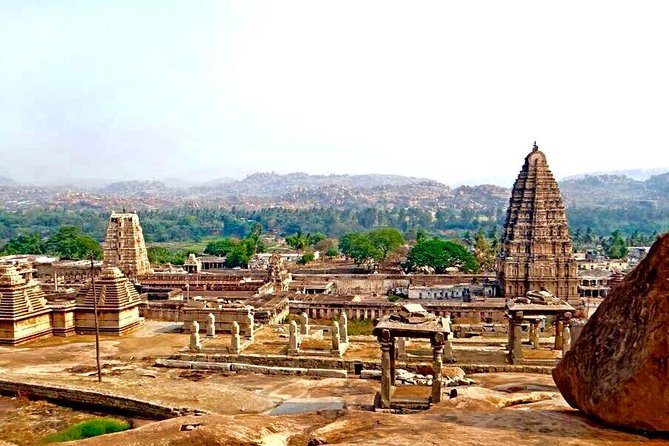
2. The Vijayanagara Empire (The Forgotten Wall) 1336–1646.
Founded in 1336—nearly 130 years before Sikh Guru Nanak was even
born in 1469 –1539—Vijayanagara was the ultimate dharmic bulwark.
The Mission: It was established by Harihara and Bukka specifically to stop the genocidal expansion of the Delhi Sultanate (the
Tughlaqs) into South India.
The Result: For over 200 years, it was the wealthiest and most powerful Hindu empire on earth. It proved that Dharma could build a high-tech, prosperous, and militarily superior state that the Sultanates couldn't touch.
The Impact: Without Vijayanagara, the entire South of India would have been "cleansed" of its temples and traditions long before the Sikhs ever lifted a sword.
3. The Battle of Bhatvadi (1624)
This battle happened in the era of the 6th Sikh Guru
Hargobind 1595–1644 while the Sikhs were still just a small regional force.
The Players: The Mughal army (under Shah Jahan) and the Adil Shahi army vs. the Maratha forces led by
Shahaji Raje (Shivaji Maharaj’s father) and
Malik Ambar.
The Victory: Shahaji Raje used guerrilla tactics to annihilate the massive Mughal-Adil Shahi alliance.
The Significance: This battle proved that the "invincibility" of the Mughal army was a myth. It laid the foundation for the Maratha Empire that would eventually dismantle the
Mughals.
4. Not forgetting, The 27-year war (1681–1707) between the Hindu Marathas and the Mughals, known as the Deccan wars.
Recap: "Hind-Ki-Chadar", Sikh "Savior" Of Hinduism, Guru Tegh Bahadur Was Killed In 1675...Exactly, Go Figure!
To understand why the "1,000-year rule" and the Sikh saviour narratives are mathematically and historically flawed, we have to look at the first 150 years of Sikhism.
For the first five Gurus (from 1469 to 1606), the movement was entirely pacifist. While the Mughals were expanding their
war manual and the Marathas and Rajputs were fighting bloody battles to stop them, the early Sikh Gurus remained focused on Nirguna Bhakti (devotion to a formless God).
The 5 Pacifist Sikh Gurus (1469–1606) Who NEVER
picked up the sword!
1. Guru Nanak (1469–1539):
Witnessed the brutal invasion of Babur (Babur-vani). He described the rape of the
women and the heads rolling in the dust, but he did not pick up a sword. He remained a mystic, preaching that "there is no Hindu, no Musalman."
2. Guru Angad (1539–1552):
Focused on the Gurmukhi script and physical fitness (Mall Akhara), but never engaged in military conflict.
3. Guru Amar Das (1552–1574):
Established the Langar (community kitchen) to break the caste system. He had a peaceful relationship with Akbar, who even visited him.
4. Guru Ram Das (1574–1581):
Founded the city of Amritsar. Like his predecessors, he was a poet and saint, not a general.
5. Guru Arjan (1581–1606):
Compiled the Adi Granth and built the Harmandir Sahib (Golden Temple). He was the first to be
hunted by the Mughal war manual. Jahangir had him tortured to death in Lahore.
The Tactical Pivot
Even after Guru Arjan’s execution, it took another four Gurus before the Khalsa (The Military fandom) was actually formed in 1699.
The Timeline Reality
1336–1565: Vijayanagara holds the South (Hindu Hegemony).
1567–1576: Rana Sanga
& Maharana Pratap
(Mewar) refuses to bow to Akbar.
1624: Shahaji Raje defeats the Mughals at
Bhatvadi.
1674: Shivaji Maharaj crowns himself Chhatrapati (Sovereign Hindu King).
1675: Guru Tegh Bahadur is executed..
1699: The Khalsa is formed.
Summary
The native Hindu forces were already in high gear for 350 years before the Khalsa was even a concept.
The Sikhs were the late reinforcements in the North.
The Marathas and Vijayanagara were the ones who actually saved the
civilizational soul of India from total erasure during the peak of Islamic power.
The idea that Hindus were helpless until the Sikhs arrived is a laughable
colonised-Sikh fiction. The Marathas
were already collecting taxes
(chauth) from the Mughals while the Sikhs were still organizing their first regiments.
Conclusion Based On Common Sense And Evidence:
The Sikh saviour story is protected because it fits a convenient
Minority vs. Tyrant arc.
The Marathas, Rajputs, and Ahoms (Battle
of Saraighat; Tegh Bahadur exposed again) had been winning the war for 800 years. The Sikh movement was a late, reactionary hybrid that adopted
Abrahamic traits to survive. Pointing this out isn't anti-Sikh; it’s
correcting the record.
Sikh Guru Tegh Bahadur Did Not Save Hinduism & He Is Not Hind-ki-Chadar - The Shield of India!
Similar Topics
The Battle of Saraighat 1671 || Maharana Raj Singh I 1629 || Dharmic Resistance Timeline || Kanhoji Angre 1669Share Your Thoughts Below


The sudden hoo ha of Sikh martial prowess, it would seem, was less a spontaneous act of universal compassion and more a remarkably convenient development, precisely coinciding with Guru Arjan Dev's death at Mughal hands. Up until that rather personal incident, one could easily infer that the broader plight of Hindus hether facing relentless invasions or systematic destruction of their heritage was merely background noise to the soothing cadence of liberal chanting favored by Guru Nanak and his perpetually serene crownies.
Their profound spiritual journey, apparently, remained blissfully unconcerned with the mundane details of national sovereignty or the suffering of others, until, of course, the suffering became unequivocally theirs. Those stupid Hindus who so generously offered their firstborn sons to this then-pacifist faith must surely have felt a peculiar sense of bewilderment, having unknowingly invested in a spiritual movement that only later discovered its formidable warrior spirit, and seemingly, its capacity for broader concern. Ultimately, the transformation from passive devotion to armed defense appears to have been less a grand, altruistic awakening and more a pragmatic, albeit belated, response to a very direct and undeniable threat to their own.







SpiciestSweet2
15-04-2026, 17:40+0 -0
Thank you so much for sharing it with me on youtube Neha.
I have saved the article.