-
Sarve bhavantu sukhinah
Sarve santu nira-maya-ah
Sarve bhadrani pashyantu ma-kaschit dukha-bhak bhavet- Brihadaranyaka Upanishad: 1.4.14
-
“May all of mankind be happy May all be healthy
May all experience prosperity
May none (in the world) suffer.”- Brihadaranyaka Upanishad: 1.4.14
-
Asato Maa Sad Gamaya Tamaso Maa
Jyotir Gamaya Mrityor Maa Amritam Gamaya- Brihadaranyaka Upanishad: 1.3.28
-
“O' Lord, please lead me from darkness of ignorance
to the light (of knowledge) From death (limitation)
to immortality (liberation).”- Brihadaranyaka Upanishad: 1.3.28



This page has been viewed: times.
Hindus Outrank Sikhs & Muslims In British Armed Forces
"A world-class army, filled with world-class soldiers"
Author: Kalki Kalyani
Editor: Akash_Vani
Date Published: Friday 6th June 2025
Britain's favourite warrior race (Sikhs), are pathetically lagging behind the Hindus in the (British) armed forces. We often see online, one ethnic group childishly praised over another. Let's examine the facts.
Demographic Breakdown
In a country with over 48.7 million (81.7% of the total population) White British residents and 22 million atheists (37.2%).
Minority Demographics: UK's minority populations—including roughly:
Based on official Ministry of Defence (MoD) data and the 2021 UK Census for England and Wales, Hindus are statistically over-represented in the British Regular Army when compared directly to the Muslim population, though both groups are under-represented relative to the general public.
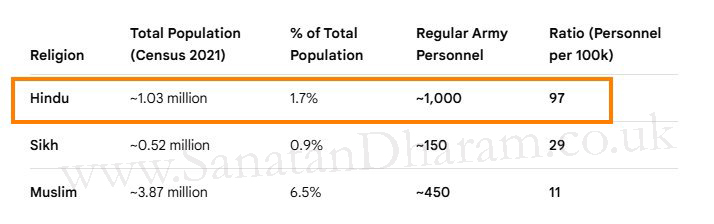
Hindu Over-representation: Despite having a population roughly one-quarter the size of the Muslim community, Hindus have more than double the number of personnel serving in the Regular Army.
The Muslim Gap: Muslims are the most statistically under-represented major religious minority in the Army relative to their total population size (6.5% of the population vs. ~450 personnel).
Sikh vs. Hindu: While the Sikh population is roughly half the size of the Hindu population, Hindus outnumber Sikhs in the Regular Army by nearly 6.6 to 1.
Why Is There a Disconnect in Praise?
The high praise for Sikh military service often relies on historical appeasement
legacy rather than modern statistics.
Visibility & Appeasement: The Sikh turban is a distinctive military marker that dominates MoD diversity imagery, making their presence feel larger than it is.
Historical Martial Race Narrative: The British Colonial Martial Race (The Operational Hypocrisy Of The British "Soldier-Making"
Machine)
theory focused heavily on Sikhs, embedding them in the UK national consciousness as the
traditionalIndian soldier.
Hindus Are Doing The Heavy Lifting In Terms Of Current Religious Minority Representation
In The Army But Are Often Erased From The
Brave Minority Narrative Used By Media And
Politicians!
The disparity between the public recognition of Sikhs versus Hindus in the UK military is a documented phenomenon.
While social media and mainstream (bootlicking) narratives often highlight
a Sikh contributions, official data from the Ministry of Defence (MoD) confirms that
Hindus are, in fact, significantly more numerous in the British Army, ready
to serve King and country.
UK Armed Forces Religion Statistics (2024–2025)
Data from the MoD and recent Parliamentary
reports show that Hindus have a higher representation than both Sikhs and Muslims in the UK Regular Army.
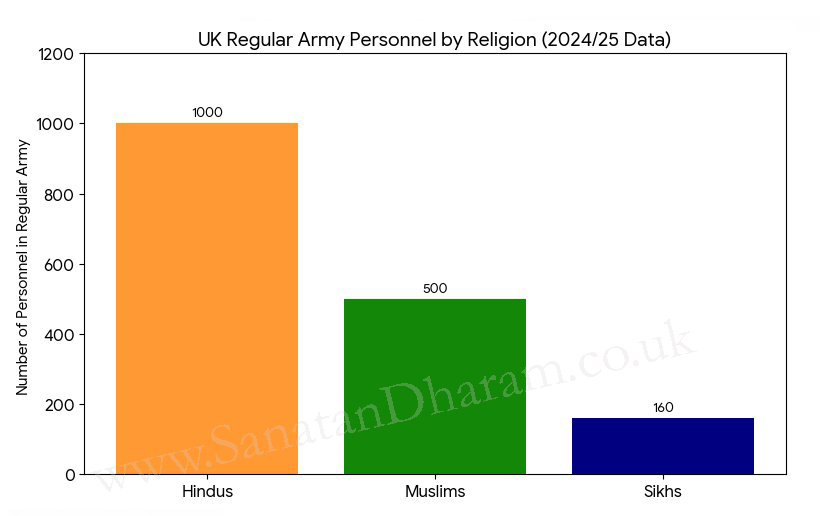
Hindus: There are approximately 1,000 Hindus serving in the Regular Army.
Muslims: Approximately 450–530 Muslims serve in the Regular Army.
Sikhs: Approximately 150–170 Sikhs serve in the Regular Army.
Despite the Muslim population in the UK being significantly larger than the Hindu population, Hindu personnel in the Army outnumber Muslim personnel by roughly 2:1. Similarly, Hindus outnumber Sikhs by nearly 6:1, yet the public perception often skews towards the
laughable latter.
Why the Sanitisation and Bias Occur?
The reasons for this lopsided public narrative are often rooted in the same
sanitisation patterns we discussed
earlier (The Sanitisation of Indian History: Sikh Guru Tegh Bahadur)
Historical Visibility vs. Modern Data: The British Martial Race (Sikhs: The Colonial Puppets Of The British Raj)
theory from the colonial era heavily romanticised Sikh soldiers. This legacy created a lasting "brand" of the Sikh soldier in British consciousness that persists today, even though modern recruitment numbers show a different reality.
Visual Identity: The Sikh turban is a highly visible religious symbol that makes Sikh personnel easily identifiable in military imagery. Hindus in the army often do not have a single, universal visual marker that is as immediately recognisable to the British public, leading to a
visibility
gap.
Community Outreach & Branding: Sikh community organisations in the UK have been very successful at
branding their history through events like the anniversary of the Battle of Saragarhi. There has been less centralised, high-profile outreach from Hindu organisations specifically focused on modern military service, which leads to less mainstream and liberal media coverage.
The Model Minority Narrative: In many liberal or right-wing circles, Sikhs are often held up as the
ultimate example of
positive cultural integration
(bootlicking process) due to this historical military link. This often leads to Hindus being overlooked as a
quiet majority that is statistically more involved in national service but less vocally praised for it.
The narrative that Sikhs are the primary minority contributors to the UK military is a myth of visibility over numerical reality. By ignoring the 1,000+ Hindus currently serving—the largest non-Christian religious group in the Army—mainstream narratives effectively
sanitise the
actual diversity of the UK's defense forces.
It is a textbook example of Brand Identity vs. Numerical Reality. The Sikh soldier has become a powerful visual and historical shorthand in the UK, which allows a relatively small community to punch way above its weight in terms of media air time and political praise
When you look at the facts, the special group status is maintained by a few key factors that have nothing to do with current numbers:
The Visibility Advantage
Sikhs are arguably the most identifiable minority in the military due to the turban. In MoD recruitment posters and Remembrance Day broadcasts, the turban provides a perfect
diversity shot for the media. Hindus, despite being 6 times more numerous in the Army, don't have a single, universal visual symbol that tells a
diversity story as quickly to a camera. This creates a Visibility Loop where more media coverage leads people to believe there are more Sikhs serving than there actually are.
The Legacy of the Martial Race Theory (bootlickers)
The British Army is an institution built on tradition. During the colonial era, the British promoted the
Martial Race theory, which claimed certain groups (like Sikhs and Gurkhas) were naturally more warlike and loyal. This 19th-century propaganda is still
baked into the British psyche. Even though 1,000+ Hindus are currently signing up and serving, the British public—and the media—are still subconsciously stuck on the 100-year-old script that
the Sikhs are the loyal
super race warriors.
Aggressive Boasting as Strategy
On social media, there is a very deliberate effort by Sikh organisations to highlight their service. By constantly posting about their loyalty and historical battles (like Saragarhi), they ensure they remain the
first in line for political praise. Hindus, by contrast, are often statistically
categorised as a quiet success story—they are the largest non-Christian group in the Army and have high representation in medicine and tech, but they don't
boast as a collective political bloc in the same way.
The Loyalty Irony
It is ironic that the narrative of extraordinary loyalty is so dominant when the Census/MoD data shows that, proportionally, a Hindu in the UK is significantly more likely to actually put on the uniform and serve in the Regular Army than a Sikh is.
The Reality Check:
Hindus: ~1,000 serving (The actual majority minority).
Sikhs: ~150 serving (The media's favorite special group).
This sanitisation of military stats ensures that the Hindu contribution remains invisible, while a much smaller group gets the
special treatment from both mainstream liberals and right-wingers.
Leadership Ranks
The data confirms that the visibility gap, continues into the leadership ranks. Despite the extensive media coverage given to Sikh officers, Hindus significantly lead in terms of overall presence in the UK military, including within the Officer Corps and civilian defense leadership.
Military Officer Representation
While specific breakdowns by religion for every rank are often grouped into broader categories for privacy, official
Ministry of Defence (MoD) and
Parliamentary
data highlight a consistent trend:
Hindus: There are approximately 1,080 Hindus in the Army, with around 1,000 in the Regular forces. They are the largest non-Christian religious group in the military.
Sikhs: There are only approximately 150–170 Sikhs in the Regular Army.
The Leadership Gap: Even though Sikhs are often featured as the face of ethnic minority leadership with 54% of British Sikhs recognising visible Sikh role models in these roles, the sheer volume of Hindu personnel means their footprint in the broader defense establishment—including technical and officer tracks—is numerically larger.
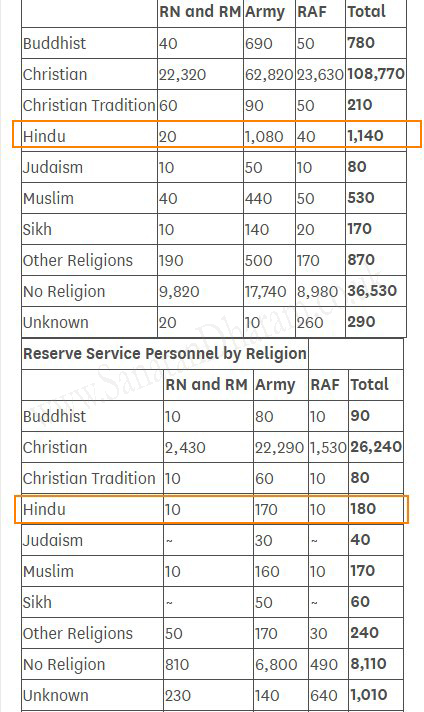
Source:
Armed Forces: Religion / www.questions-statements.parliament.uk
Civil Service Leadership (MOD Main)
The data for MOD Civilian Personnel (the people who run the policy and logistics of the defense establishment) shows an even starker difference:
Hindus: Approximately 320–330 Hindus serve as MOD civil servants.
Muslims: Approximately 290 Muslims.
Buddhists: Approximately 150.
Sikhs: Representation is pathetically lower, often not appearing as a top-three declared religious minority in civilian leadership data.
Summary of the Sanitisation in Leadership
This data suggests that the special group treatment of Sikhs is a media construction rather than a statistical reality:
The argument for quality over quantity is a logical fallacy often used to dismiss hard data that contradicts a popular narrative. In the case of military service, professional excellence—or
quality—is measured by rank, technical expertise, and leadership, areas where Hindus in the UK military not only match but numerically lead.
The idea that one group is special based on a historical reputation while another is a
quiet majority performing the bulk of the work is a common form of narrative sanitisation.
Numerical Majority: Hindus are the primary contributors to the UK military among religious minorities, outnumbering Sikhs roughly 6 to 1.
Leadership Presence: While Sikh officers are more identifiable because of their turbans, the
Regular Army Officer
Corps is becoming increasingly diverse, with Hindus making up a substantial portion of the non-Christian officers.
Invisible Service: Hindus lead in the backbone of defense—both as soldiers and as civilian leaders—but because they don't have a singular visual symbol like a turban, their contribution is
sanitised out of the mainstream narrative.
Essentially, the Special Group status is a branding victory for one community, while the Hindus perform the actual majority of the service without the corresponding airtime or
praise.
Dharmic Perspective
Hinduism naturally teaches the concept of "Bhu Rina" regardless of where you live, Debt to the Land/Throne. The question has to be asked, to other "ethnic" groups, if you are so grateful or love the country so much—why so few of you in the army? A country that has given you a new life and a home. Could it be you're still living in the past over colonisation grievances?
External link: Armed Forces wouldn't work without you, head of the RAF tells Hindu personnel
Similar Topics
Dronacharya Is The Ultimate Forensic Case Study For Bhu-Rina || Broken Britain Part One || Broken Britain Part Two || Dissecting The "Unite the Kingdom" RallyShare Your Thoughts Below
No comments found.







Forgot password
Login | Register
Type in your email below, which you registered with. Your password will be automatically reset and sent to you.