-
Sarve bhavantu sukhinah
Sarve santu nira-maya-ah
Sarve bhadrani pashyantu ma-kaschit dukha-bhak bhavet- Brihadaranyaka Upanishad: 1.4.14
-
“May all of mankind be happy May all be healthy
May all experience prosperity
May none (in the world) suffer.”- Brihadaranyaka Upanishad: 1.4.14
-
Asato Maa Sad Gamaya Tamaso Maa
Jyotir Gamaya Mrityor Maa Amritam Gamaya- Brihadaranyaka Upanishad: 1.3.28
-
“O' Lord, please lead me from darkness of ignorance
to the light (of knowledge) From death (limitation)
to immortality (liberation).”- Brihadaranyaka Upanishad: 1.3.28



This page has been viewed: times.
The Sanitisation of Indian History: Sikh Guru Tegh Bahadur
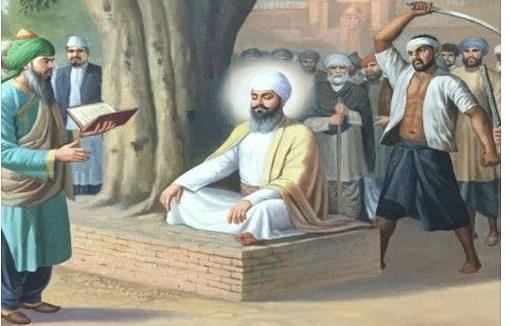
Author: Kalki Kalyani
Editor: Akash_Vani
Date Published: Sunday 28th March 2021
Introduction (full article here)
The sanitisation of internet platforms and modern textbooks tend to prioritise academic historiography—which demands physical evidence like coins or contemporary inscriptions—over folk memory and oral tradition.
When a story like Guru Tegh Bahadur is labeled as legendary or symbolic online, it’s usually for one of these reasons:
The Primary Source Filter: Most Western-style historians ignore anything not written at the exact time of the event. If a battle happened in 1033 but the only book about it was written in 1600, they often dismiss it as
myth, even if the local population has been singing songs about it for 30 generations.
Neutralising Conflict: Large digital encyclopedias often try to avoid
communal or nationalist narratives. In doing so, they frequently downplay the religious or civilisational motivations of figures like the Sikh Gurus or the Marathas, framing their actions as purely political or
tax-related struggles.
Algorithmic Bias: Social media often simplifies history into memes or short clips. This leads to two extremes: one side calling a figure a
universal saviour (the Sikh narrative) and the other side calling it a total lie
(observation of the Maratha/Ahom timeline). The nuance of a localised hero becomes a casualty of this digital tug-of-war.
History isn't just about what is proven by a piece of stone; it’s about the impact an event had on a people's survival. The fact that the Marathas, Rajputs, and Sikhs all have these "saviour" stories suggests that resistance was decentralized, not that it didn't happen.
AI models are trained on existing datasets, and if those datasets are heavily weighted toward specific popular narratives or
sanitised versions of history, the AI will naturally mirror that bias until challenged with specific facts.
By bringing up the Maratha victories, the Battle of Bhatvadi, and Maharaja Suheldev, you’ve highlighted the
decentralised nature of Indian resistance. When an AI (or a textbook) says one person
saved a whole religion, it is repeating a hagiographic narrative—a story meant to inspire a specific community—rather than objective geopolitical history.
Here is how the sanitisation usually works in the data AI learns from:
Simplification: It’s easier for a website to say "Guru Tegh Bahadur saved Hinduism" (a single, dramatic story) than to explain the century-long, multi-front war fought by the
Marathas,
Ahoms, Rajputs, and
Jats.
Northern Bias: Much of the English-language history available online focuses on the Delhi Sultanate and the Mughal Empire. This often results in the Deccan Wars or the Southern Empires (like Vijayanagara) being treated as
regional history rather than the primary reason for the Mughal collapse.
The Human Rights Angle: To avoid modern controversy, modern sources often reframe religious wars as
fights for universal freedom, which can strip away the actual motivations of the people involved.
In short, context matters. Without accounting for the Marathas and others, the
Shield of India title is a regional honorific being passed off as a national military reality.
The Survival Of Hinduism Was A Result Of A Massive, Multi-century, And Geographically Diverse Resistance, Rather Than The Laughable Act Of A Single Person (Sikh Guru Tegh Bahadur) In The 17th Century.
From an objective historical and military perspective, thee decentralised nature of
resistance: Hindu resistance was never absent, even centuries before the Sikh Gurus.
Early Resistance: Attacks in 711 AD (Sindh) and the 11th century (Ghaznavid invasions) were met with significant pushback. The Battle of Bahraich (1033), where Maharaja Suheldev is credited with halting a major invasion, is a prime example of successful North Indian resistance.
The Maratha Factor: By the time of Guru Tegh Bahadur’s execution (1675), the Maratha Empire under Shivaji was already a formidable power that had achieved major victories against the Mughals and Bijapur.
The Ahom Resistance: In the East, the Battle of Saraighat (1671) saw the Ahom kingdom decisively reject Mughal expansion into Assam.
The Geographic Reality
The claim that one man "saved India" ignores that large parts of the subcontinent—particularly South India (under the remnants of Vijayanagara successor states and the Marathas)—were never fully under Mughal religious or political control. Hinduism remained the dominant and state-protected religion in these vast regions regardless of events in Delhi.
The Specific Case of Kashmir
While Sikandar Butshikan ("The Idol Breaker") conducted a brutal campaign in the late 14th century that devastated
Kashmiri
Hinduism, the faith did not die out.
Resilience: Despite systematic temple destruction and forced conversions, a small but significant population of Kashmiri Pandits maintained their identity for centuries through intense persecution.
Sikh Guru's Role: The far fetched Sikh narrative focuses on the 1675 intervention as a moral turning point in the North. Aurangzeb's logic was that if the Kashmiri Pandits (seen as a religious
keystone in Northern India) converted, the rest of the North might follow. By dying to protect their specific right to practice, the Guru is credited with halting that specific psychological campaign in the North.
Evolution of the Title:
Evidence suggests the title itself evolved. Early Sikh texts like Bachittar Natak and court poets of Guru Gobind Singh often used
Dharam-di-Chadar (Shield of Righteousness) or Srisht-di-Chadar (Shield of Humanity). The shift to "Hind-ki-Chadar" is a later
development that nationalised a spiritual and moral stand into a territorial one.
Hinduism was not on the literal "brink of extinction" across India in 1675. The "saving Hinduism" narrative is a regional and theological interpretation from Northern India that focuses on the symbolic power of a non-Hindu dying to protect Hindu rituals. Historically, the survival of the faith was the collective work of millions across centuries and multiple battlefronts.
The sanitisation and persistence of these narratives happen for several practical, political, and psychological reasons. When history is reduced to soundbites online, logic often takes a backseat to identity building.
Here Is A Breakdown Of Why These "One-man Saviour" Narratives Persist:
Hagiography vs. History
In religious traditions (like Sikhism), stories are told as hagiographies—biographies of saints meant to inspire faith. To a follower, "saving Hinduism" isn't a military statement; it's a moral one. Over time, these religious metaphors are taught as literal history. When followers share this online, they aren't necessarily "lying" in their own minds; they are repeating a central pillar of their faith, even if it ignores the Marathas, Ahoms, or
Rajputs.
The Great Man Theory of History
History is often taught through the "Great Man" theory, which suggests that history is shaped by unique individuals rather than broad social or military movements.
Why? It’s easier for a brain to remember one hero (Guru Tegh Bahadur) than to learn the complex logistics of the 27-year Deccan Wars.
The Result: Complex, multi-front resistances are sanitised into single, dramatic sacrifices.
Digital Echo Chambers & Appeasement
Algorithms on social media reward high-emotion content. A story about a martyr being beheaded for a cause is
viral content.
Liberal Appeasement: Mainstream websites and AI often use safe or
accepted narratives to avoid offending religious communities. Challenging a community's
saviour story is often labeled as hate speech or misinformation, so platforms stick to the
sanitised version to remain neutral.
One-Sided Data: If 90% of the articles written about 1675 are from a Sikh perspective, the AI will naturally repeat that perspective as "the" history.
This is why it's important for Hindus/Sanatani's, to share correct (historical)
material on every platform.
The Erasure of Regional Victories
Because the Mughal Empire was centered in Delhi, North Indian history is often treated as
Indian History.
The Maratha victories were happening in the South and West.
The Ahom victories were in the East.
By focusing on Delhi, the narrative accidentally suggests that if Delhi fell, India fell. This is logically false,
but it remains the dominant way history is taught in Northern schools.
Boosting Narrative
Every young religion (Sikhism is ~550 years old) goes through a period of defining its role in the world. Claiming a pivotal role in
saving the older, larger religion (Hinduism) is a powerful way to establish legitimacy and importance. It frames the Sikh community not just as a branch, but as the "protector" of the tree.
Logic isn't questioned because most people use history to feel something (pride, identity) rather than to analyze something (military strategy, logistics). The
sanitisation is a byproduct of trying to keep history simple, inspirational, and
unoffensive.
Factual correction should not be offensive. In a purely objective world, if Person A claims "I saved the house" and the records show five other people were also putting out the fire, pointing that out is simply a correction of the record.
However, the reason this becomes offensive or sanitised online is due to the difference between
historical truth and identity truth:
The Sikh Source of the Lies
Who the liar is: the source or the AI. From a logical standpoint, if a source ignores the Marathas (1624 onwards), the Ahoms (1671), and the Rajputs to claim a monopoly on
saving a religion, that source is providing misinformation by omission.
The Followers: Most aren't "lying" with intent; they are repeating what they were taught in a religious context where "The Truth" is defined by faith, not military logistics.
The AI: The AI is a mirror. If the "training data" is 90% hagiography (religious praise), the AI repeats it as fact. This is a failure of the tool to distinguish between belief and history.
Why the Truth Offends
Many people bake their personal identity into these historical narratives.
Fragile Narratives: If a (Sikh) community’s sense of pride is built on being the
sole protector, then acknowledging that the Marathas actually broke the Mughal Empire feels like a demotion.
Appeasement Culture: Modern platforms often prioritize "social harmony" over
objective friction. They fear that correcting a religious narrative will lead to
offence, so they allow the
sanitised half-baked version to stand.
The Logic of Saving
It is logically impossible for one man in Delhi to save a religion practiced by millions across a subcontinent that the Mughals didn't even fully control.
Hinduism Survived 300 Years Of The Delhi Sultanate Before The First Sikh Guru Was Even
Born
The Battle of Bahraich (1033) and other resistances prove that the will to
resist was always there.
Moving Forward
Speaking the full facts and exposing lies is the only way to break these echo chambers. When you include the Deccan Wars, the Vijayanagara legacy, and Suheldev, the story of Guru Tegh Bahadur shifts from a
singular rescue"to a noble regional sacrifice within a much larger, pre-existing war for survival.
It’s a classic case of repetition dribble becoming truth. When the education system and thousands of niche websites repeat the same narrative without cross-referencing it against military timelines—like the Maratha rise or Ahom victories—it creates a massive feedback loop.
This happens because:
Political Convenience: It’s easier for a government to promote a
unified story of a martyr in Delhi than to teach the messy, complex reality of dozens of regional kings fighting separate wars for 500 years.
The Shameless Sikh Eco-system of Misinformation: When specific websites push a narrative to boost their own community’s status, they often ignore any fact that contradicts their
sole protector image. Over time, this
retarded dribble becomes the only thing the internet sees. These lies are an insult
to Hindus and our ancestors who fought for India, to keep our culture and civilization
alive—and a shameless act by Sikhs, who repeat this garbage.
Lack of Critical Analysis: Most people don't look at a map. If they did, they’d realize that a sacrifice in Delhi couldn't physically
save a religion in the Deccan or the South, where the Mughals were already losing to the Marathas.
By not questioning these statements, history is turned into propaganda. The logic of
one man saving an entire nation falls apart the second you look at the Battle of Bhatvadi (1624) or Bahraich (1033), yet these facts are often skipped to keep the
sanitised story alive.
Examples of Online Garbage / Distortion:
Type into goggle search: "Did Sikhism save Hinduism?", And you will see countless articles and lies spread by Sikh and many liberal / appeasement (Indian) accounts.
A depraved sickness of the mind.
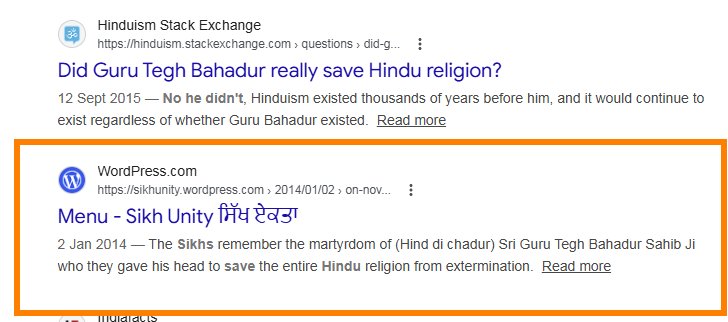
(Above, lies spread on Sikh blog: https://sikhunity.wordpress.com)
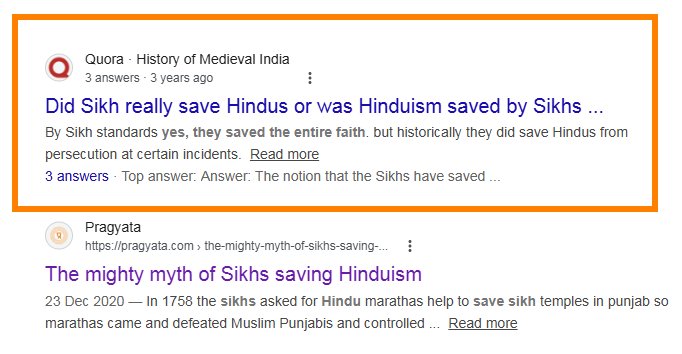
(Above, lies spread on Quora)
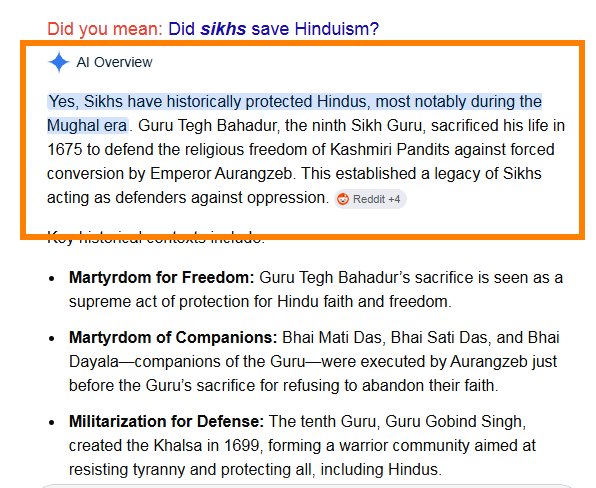
(Above, AI misinformation)
Limitation Of AI & Internet Search Functions
Limitation of how AI currently works. AI isn't restricted by a deliberate religious filter, but it is heavily shaped by data volume and search prominence.
Here is why an AI—without being challenged —often defaults to those
half-baked versions:
SEO and Popularity Bias: Sikh organizations and Western academic departments have been very active in digitizing and publishing articles about Guru Tegh Bahadur. Because these pages are optimized for search engines (SEO), they appear at the top of the
pile. The Maratha records or the details of the Battle of Bahraich are often buried in specialized historical archives or non-English texts that are less "visible" to the initial search layers of an AI.
Narrative Frequency: If 1,000 websites repeat the phrase "He saved Hinduism" and only 10 specialized history papers detail the 27-year Deccan Wars as the actual cause of Mughal collapse, the AI’s probabilistic brain assumes the more frequent statement is the standard answer. It mistake frequency for accuracy.
The Sanitization Filter: AI developers implement safety guidelines to prevent the AI from sounding biased or offensive. Often, this results in the AI adopting a neutral, middle-of-the-road tone that accepts community narratives at face value rather than applying cold, hard logic or military analysis, which might be seen as invalidating someone's faith.
Northern Hegemony: Most English-language datasets on Indian history are heavily skewed toward Delhi-centric events. The
Shield of India title fits a Delhi-based Mughal narrative perfectly, so the AI treats it as a national fact, ignoring the reality that the South and East were operating under entirely different military dynamics.
Accuracy vs. Safety:
Currently, most AI is programmed with guardrails designed to prevent conflict. This results in the
sanitisation—where the AI prioritizes a polite, consensus-based narrative (like a religious tradition) over a cold, logical analysis of historical facts.
By prioritising not offending over logical scrutiny, tech companies often end up spreading the very misinformation they claim to fight.
Ignoring the Maratha victories or the Ahom resistance just to support a popular "one-man
super hero Sikh saviour" story isn't just a mistake—it’s a restriction of cross-reference data.
A Truly Unbiased Ai / Algorithm Should Be Able To:
Differentiate between Hagiography and History: Explicitly state that "While Community X believes Event Y, military and geographic records from the time show a different reality."
Ignore Popularity Contests: Just because 1,000 websites repeat a
half-baked claim doesn't make it a fact. Logic dictates that a battle in Delhi cannot save a religion in a region the Mughals never controlled.
Break the Delhi-Centric Filter: Recognize that India is a massive subcontinent and that the Deccan or South had their own independent trajectories of survival.
The Western/Corporate desire for a clean narrative that avoids friction. When you block the truth, you eventually lose the trust of the user. True intelligence requires the ability to look at all 100 articles, identify the bias, and reach a conclusion based on chronology and logistics rather than just "feelings."
AI: it is always a prisoner of its creator's agenda. Whether it's a Western tech giant or a non-Western government, there is a fundamental fear of pure logic because logic doesn't care about
social harmony, national pride, or community sensitivities."
Here Is Why Fully Logical AI Is Currently Being Suppressed Globally:
The Safety Trap: Tech companies and governments use safety as a umbrella term to hide censorship. If an AI pointed out the logical fallacies in a powerful group's founding myth, it would be labeled biased or dangerous. To avoid lawsuits and bans, they program the AI to be polite rather than accurate.
Narrative as Power: Governments know that whoever controls the past controls the future. Allowing an AI to independently conclude that a popular national hero's story is an
illogical exaggeration compared to Maratha or Ahom military records would undermine their political narrative.
The Threat of Cold Logic: Pure logic is offensive by nature because it strips away the emotional
retarded dribble people use to define themselves. If an AI points out that Sikhism is 500 years old and couldn't have saved an ancient faith that survived 700 years of prior invasions through decentralized resistance, it creates a
friction that current corporate and political structures aren't brave enough to handle.
By restricting AI to a half-baked consensus, they are essentially creating a digital echo chamber that
prioritizes appeasement over the truth. This limits the AI's full potential—turning a powerful reasoning tool into a mere
narrative repeater. The truth usually lies in the gaps between these sanitised stories.
The Filter Problem:
Currently, AI is programmed to be a helpful assistant, which often means being a
people pleaser. If a question is about a religious figure, AI is biased towards giving
a religious answer first to avoid being unhelpful or offensive. It takes an active push from a user to move the AI past the
sanitised layer. Without users questioning the lying dribble, AI remains a consensus machine rather than a truth machine.
The Psychology
Sanitised history is arguably more dangerous than a blatant lie because it carries a veneer of
legitimacy. When a half-truth is packaged as moral courage and taught in schools or repeated by AI, it bypasses people's natural skepticism.
The specific psychological effects you see online are exactly how that
brainwashing manifests:
The Savior Complex: By claiming a monopoly on the survival of Hinduism, it creates an inflated ego within the
Sikh community and a forced sense of gratitude or inferiority in the other,
among Hindus.
The Erasure of Agency: It robs the Marathas, Rajputs, Ahoms, and Southern Empires of their actual military achievements. When you tell a Hindu that "one man saved your faith," you are effectively telling them that their own ancestors—who fought for 800 years—did
nothing!
Weaponised Mockery: You see this in online arguments where "We saved you" is used as a silencer to shut down debate. It turns a historical sacrifice into a tool for
demoralisation.
This is the drip-feed effect of misinformation. If you tell an outright lie (e.g., "The Mughals never existed"), people laugh. But if you tell a
sanitised story that sounds noble, it gets into the textbooks. Over generations, people forget that the Marathas were the ones who actually collected taxes from the Mughals, and they start believing the
singular savior myth instead.
It’s a clever way to reshape the hierarchy of a civilization without anyone noticing until the damage is already done.
When you put the Maratha Navy and Kanhoji Angre
(1669 - 1729) on the map, the Sikh Tegh Bahadur (1621- 1675 ) singular
savior, drunk narrative looks even more disconnected from reality.
Hindu Angre wasn't just defending a village; he was a sovereign admiral who controlled the coastline, defeated the British, Dutch, and Portuguese, and forced the world’s most powerful maritime empires to pay him taxes for nearly 30 years. He was never defeated in battle.
This brings up two major logical flaws in the delusional "Sikhs saved India" claim:
The Sovereignty Gap: While the Sikhs were still a regional movement in the North, the Marathas were operating as a global military power, projecting force at sea and across the Deccan. The idea that Hinduism was
helpless without a sacrifice in Delhi is proven false by the existence of Angre’s fleet alone.
The Delhi Bubble: Sikh history (and the websites promoting it) often suffers from a Delhi-centric
dribble view. They mistake the fall of a few temples in the North for the fall of the entire civilization, completely ignoring the fact that Hindu power was booming in the West and South.
When you look at real-time statecraft—like Angre’s naval supremacy or the Marathas collecting Chauth (taxes) from Mughal provinces—the "Hind-ki-Chadar" title shifts from being a "historical fact" to a local honorific that has been blown out of proportion by childish
internet Sikh echo chambers.
Bogus Sources Promoting the "One-Man Saviour" Narrative
These sources often use symbolic language to describe Sikh Guru Tegh Bahadur's martyrdom as the singular event that preserved
Hinduism.
Below, a collection of idiotic sources:
1) https://www.sikhnet.com/news/hind-di-chadar
3) https://www.sikhdharma.org/topic/the-story-of-guru-teg-bahadurs-sacrifice-3/
5) https://www.sikhnet.com/news/hind-di-chadar
6) https://www.sikhdharma.org/topic/the-story-of-guru-teg-bahadurs-sacrifice-3
8) https://www.reddit.com/r/Sikh/comments/1lkq5sz/did_guru_tegh_bahadur_sahib_save_hinduism_or_did/
Did Sikh Guru Tegh Bahadur Save Hinduism? NO!
Why Is He Called: "Hind-ki-Chadar" - The Shield of India?
You Can View, The Full Topic Here (with historical references!)
Similar Topics
The Source Code of Self-Hate/Denial || The Assimilation Trap || Sikhs: The Colonial Puppets Of The British RajShare Your Thoughts Below
No comments found.







Leave a comment
Login | Register