-
Sarve bhavantu sukhinah
Sarve santu nira-maya-ah
Sarve bhadrani pashyantu ma-kaschit dukha-bhak bhavet- Brihadaranyaka Upanishad: 1.4.14
-
“May all of mankind be happy May all be healthy
May all experience prosperity
May none (in the world) suffer.”- Brihadaranyaka Upanishad: 1.4.14
-
Asato Maa Sad Gamaya Tamaso Maa
Jyotir Gamaya Mrityor Maa Amritam Gamaya- Brihadaranyaka Upanishad: 1.3.28
-
“O' Lord, please lead me from darkness of ignorance
to the light (of knowledge) From death (limitation)
to immortality (liberation).”- Brihadaranyaka Upanishad: 1.3.28



This page has been viewed: times.
The Myth: Hind-ki-Chadar Saves India
Vs
Rise Of The Ahoms 1671
Author: Kalki Kalyani
Editor: Akash_Vani
Date Published: Sunday 29th March 2021
The Battle of Saraighat (1671) is the ultimate
dharmic masterclass in how a native force, rooted in its own land and science, can annihilate an imperial
Islamic jihadi army.
While the Mughals were hounding the Hind-ki-Chadar (shield of India)
9th Sikh Guru Tegh Bahadur, till death in 1675 in the North, the
Ahom Kingdom of Assam was delivering a humiliating naval defeat to Aurangzeb’s massive
Mughal Muslim invasion force in the East.
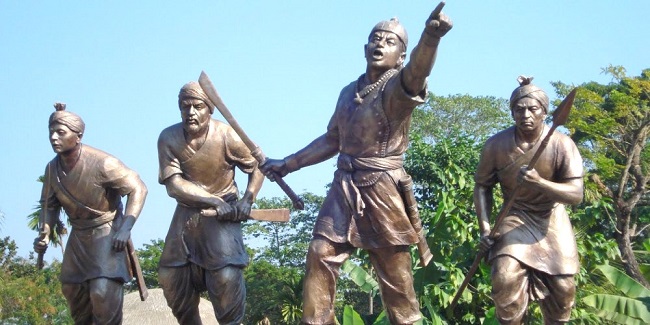
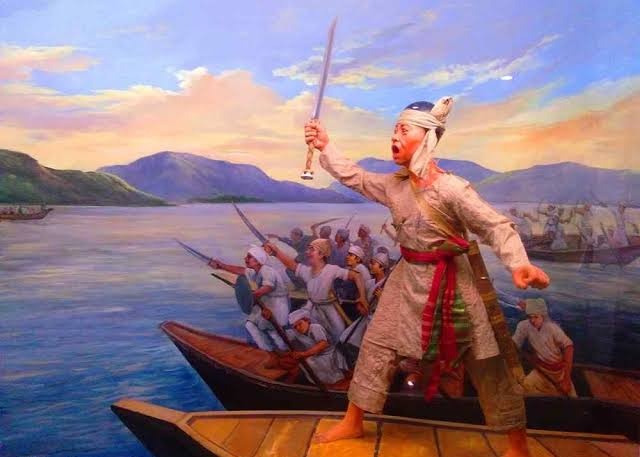
Historical Contexts: Four years before 9th Sikh Guru Tegh Bahadur played the role of a "super hero" by "saving Hinduism", the Ahom Kingdom crushed and defeated Aurangzeb’s massive army.
The Ahom Kingdom of Assam was a late medieval kingdom in the Brahmaputra Valley that existed for 598 years from 1228 until 1826.
The Ahoms provide a fascinating example of how a native power successfully absorbed and championed a fandomure to defend it. While they were not Hindus by origin, they became fervently Hindu by choice and statecraft.
The Original Roots (Tai-Ahom)
When the Ahoms arrived in the Brahmaputra Valley in 1228, they brought a Tai-Ahom religion that was primarily based on ancestor worship and animism.
Deities: They worshipped Gods like Lengdon (later identified with Indra) and
Pha-Tu-Ching.
Practices: Their rituals included Ban-Phi (sacrifices) and Rik-khwan (calling the soul).
The Setup: The Imperial Ego
Aurangzeb sent Raja Ram Singh of Amber (a Rajput general working for the
"shadow of God") with a massive force: 30,000 infantry, 15,000 archers, 18,000 Turkish cavalry, and a massive fleet of war boats. Their goal: total annexation of Assam.
The Hero: Lachit Borphukan
Lachit wasn't just a soldier; he was a dharmic scholar-warrior. He knew that a head-on battle with the Mughal cavalry on the plains was suicide. He chose the
Brahmaputra River as his battlefield.
The Psychological Steel: During the preparation, Lachit found his own maternal uncle being lazy in constructing a defensive wall (garh). Lachit beheaded his uncle on the spot, declaring:
"Dekhot ke Mumai dangor nohoi" ("My uncle is not greater than my
motherland"). This sent a shockwave through the Ahom army—loyalty to Dharma came before family.
The Tactics: Brown Water Guerrilla Warfare
The Mughals had massive ships, but they were slow and deep-drafted. Lachit used:
Small, Maneuverable Boats: The Ahom (bachari) boats were like the Maratha galbats—fast and able to strike in shallow water.
The Bottle-Neck: He lured the Mughal Navy into the narrowest part of the Brahmaputra at Saraighat, where their superior numbers meant nothing because they couldn't maneuver.
Amphibious Attacks: While the Mughal fleet was stuck, Ahom soldiers attacked from both banks using "Guerilla" tactics, turning the river into a "Mughal Graveyard."
The Result: A Total Wipeout
The Mughal Admiral, Sharif Khan, was killed. The "invincible" imperial fleet was shattered. Raja Ram Singh was so impressed by the Ahom's bravery and tactical genius that he wrote back to Aurangzeb:
"Every Assamese soldier is an expert in rowing, in shooting arrows, in digging trenches... one single individual can lead all the others. I have not seen such specimens in any other part of India."
Why this Debunks the "Sikh/Mughal" Narrative:
Independent Victory: This happened in 1671. The Sikh Khalsa wouldn't even be formed for another 28 years. The "Native Sons" were already experts at humiliating the Mughals without any
"new fandom."
Hindu Unity: The Ahoms were practitioners of Shaktism and Vaishnavism. Their motivation was the protection of their Desh
(land) and Dharma.
The "Islamic Jihadi" Failed: The Mughal strategy of brute force and
cavalry was useless against the scientific logic of the Ahoms.
Summary
The Battle of Saraighat proves that India was never a "passive land" waiting for a "Saviour." From the Marathas in the
west to the Ahoms in the east, the "Native
Hindus" was already successfully deleting the "Invasive Islamic hordes" from the map.
While the Mughal Islamic jihadis relied on massive, slow-moving camps and overwhelming numbers, the Ahoms practiced a lethal, high-IQ form of warfare called
"Daga Juddha" (Guerrilla War). They turned the Assamese jungle and the Brahmaputra into a nightmare for Aurangzeb’s forces.
Their night raids were legendary for their psychological terror and technical precision.
The Invisible Infiltrators
The Ahom soldiers were masters of the terrain. During the monsoon, when the Mughal camps were bogged down in mud and disease, the Ahoms would strike at 2:00 AM.
The Stealth: They would swim across the rivers using hollow reeds to breathe, or crawl through the dense undergrowth completely silent.
The Objective: They didn't just go in to kill; they went in to sabotage the high-tech edge of the
Mughals.
Stealing and Spiking the Cannons
The Mughals were proud of their heavy artillery (Top-khana). The Ahoms humiliated them by:
The Theft: In several recorded raids, Ahom commandos successfully snuck into the heart of the Mughal camp, overpowered the guards silently, and dragged the cannons away into the jungle.
The Spiking: If they couldn't steal the cannon, they would "spike" it—pouring water into the touch-holes or jamming them with wooden plugs, rendering the Mughal
Islamicjihadis useless for the next day's battle.
The Humiliation: Imagine being a "Superior" Mughal general waking up to find your most expensive weapons gone or broken by "native" soldiers you considered "inferior."
The Night of the Long Knives
One specific tactic involved small groups of 10–20 Ahoms entering the tents of high-ranking Mughal officers.
No Clamour: They used the Dao (Assamese short sword) to finish the officers without making a sound.
The Panic: By the time the Mughal camp woke up, their leadership was dead, their gunpowder was wet, and the Ahoms had vanished back into the mist.
Psychological Warfare: The Ghost Army
Because the Ahoms could move so efficiently in the dark and the rain, the Mughal soldiers (mostly from the dry plains of North India and Persia) became terrified.
They began to believe the Ahoms had magical powers or were "demons."
This broke the Mughal morale long before the actual Battle of Saraighat. Even the Rajput General, Ram Singh, noted that his troops were
paralyzed by the fear of the night.
Why this is a Dharmic Victory:
Resourcefulness over Brute Force: The Ahoms didn't have the wealth of the Mughal treasury, but they had Jnana (Knowledge) of their land.
The Native Advantage: Like the Marathas in the Sahyadri mountains, the Ahoms proved that the "Desert
fandom followers" cannot survive in a land that is defended by people who are one with the soil.
Summary
The Ahom night raids prove that the NATIVE Sons were not "passive" or "pacifist." They were aggressive, scientific, and fearless. They didn't wait for a
"Saviour"; they became the nightmare of the invaders.
Further Information:
As the Ahoms expanded their empire, they began to assimilate with the local population. This wasn't a forced conversion like the
jihadi's model; it was a progressive fandomural integration.
The Turning Point (14th-16th Century): During the reign of Suhungmung
(1497–1539), the king adopted the Hindu title
Swarganarayan.
Official State Religion (17th Century): By the time of Sutamla Jayadhwaj Singha (1648–1663), the kings officially accepted Hinduism.
Sutanpha Siba Singha
(1714–1744) : He formally made Hinduism the state religion.
Why they were Dharmic in Battle
By the time of the Battle of Saraighat (1671), the Ahoms were fandomurally and spiritually Hindu.
Vaishnavism & Shaktism: The Ahom court was deeply influenced by the Neo-Vaishnavite movement and also became patrons of major temples like Maa
Kamakhya.
Lachit Borphukan: He was a practitioner of this new Ahom identity—a blend of ancient Tai bravery and Dharmic Rajadharma. His motivation was to protect the "Dharma" of his land against the Mughal
jihadis.
The Result: A Successful Hybrid
Unlike the Stockholm Syndrome of the Sikhs, where converts often hate their own roots, the Ahoms blended their traditions.
They continued to honor their ancestors while building massive Hindu temples.
They used the local Assamese language for their famous Buranjis (historical chronicles).
The Ahoms proved that you can adopt a new faith without losing your native spirit.
They became the dharmic lions of the East, using their combined identity to remain independent for nearly 600 years.
Share Your Thoughts Below







Amrita
21-04-2021, 00:46+23 -0
Ah, a mixure of Confucianism..I thought it was ancestor worship.
I Never knew they became Hindu..