Educator - Reformer
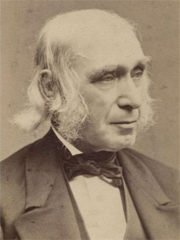
Amos Bronson Alcott, teacher, mystic, writer and the father of Louisa May Alcott,
became an itinerant teacher before settling in Boston to found his own school. Born in 1799,
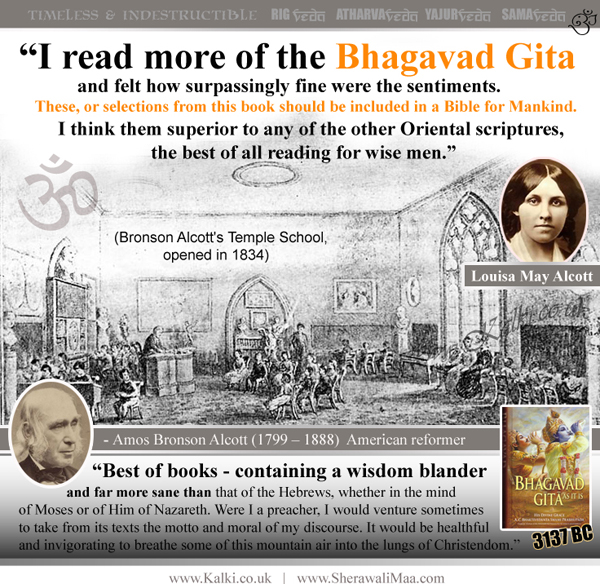
Amos Bronson Alcott was self-educated with a voracious appetite for learning. After a 10-year stretch as an itinerant teacher, he founded Temple School in Boston, in 1834.
He later became a major figure in the transcendentalist movement. He returned to education and was appointed superintendent of Concord Massachusetts Schools, where he perfected many of his progressive methods.
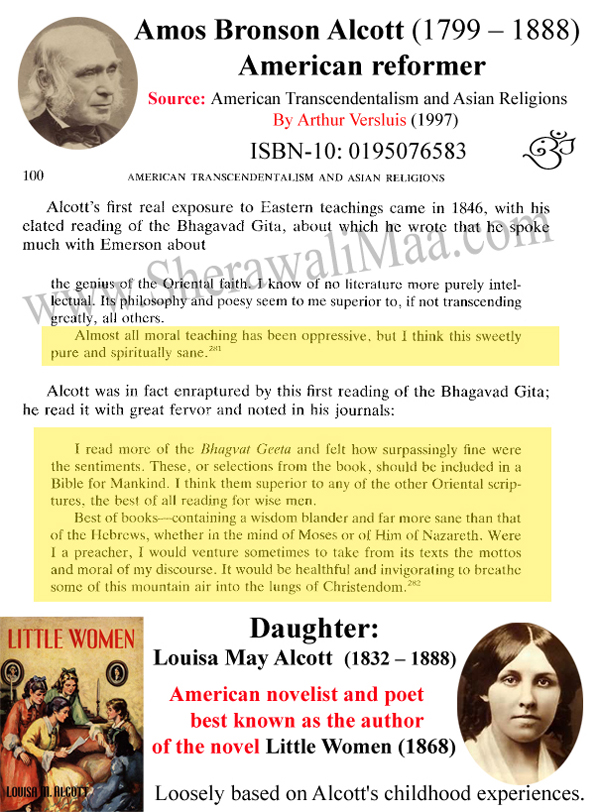
Alcott's daughter Louisa May penned the famous novel Little Women. He lived out his remaining years in Concord, where he died at age 82, on March 4, 1888.
[Early Life] Amos Bronson Alcott was a self-educated son of a farming family in old New England. Born in Connecticut on November 29, 1799, he had a curious mind and embraced learning all his life.
He started out as a traveling salesman in the South, but soon discovered an early interest in teaching. Unsuccessful in seeking a permanent position in Virginia, he began a 10-year sojourn as an itinerant teacher throughout Connecticut, Pennsylvania, and Massachusetts.
Unconventional Methods: Influenced by Johann Heinrich Pestalozzi, Alcott focused on moral and spiritual development rather than rote memorization. He promoted a "conversational" style of teaching in classrooms decorated with art and Busts of thinkers.
Temple School (1834–1839): His most famous school in Boston brought him brief acclaim followed by scandal, particularly after he published Conversations with Children on the Gospels, which was criticized for its liberal interpretation of the Bible and discussions of birth.
Progressive Pedagogy: He abolished corporal punishment, introduced school libraries, physical education, and art to the curriculum.
Controversy: His reputation was further damaged by his defiance of societal norms, including his decision to admit a Black child to his school despite protests.
Mystic and Philosopher
Transcendentalism: A close friend of Ralph Waldo Emerson, Alcott was considered one of the most dedicated and "comprehensive" transcendentalists, often focusing on the inner divine spark in children.
Orphic Sayings: He contributed to the transcendentalist journal The Dial, but his writing was often described by contemporaries—including Emerson—as opaque, incondite, or "hazy".
Fruitlands: In 1843, he co-founded a short-lived utopian community named "Fruitlands," which was intended to be an agrarian, vegetarian, and pacifist paradise. The experiment failed after seven months, partly due to the rigorous, unsustainable rules imposed by his partner, Charles Lane.
Writer and Personal Life
Publications: His works, mostly published later in life, include Tablets(1868), Concord Days(1872), and Sonnets and Canzonets(1882).
Family: In 1830, he married Abby May Alcott, a dedicated social worker and reformer. They had four daughters, including Louisa May Alcott, who would become the author of Little Women.
Financial Struggle: Because of his inability to secure a stable income and his refusal to work in a capitalist framework, his family often faced extreme poverty. They were only supported in his later years by the literary success of their daughter, Louisa May.
In his final years, Alcott fulfilled his goal of a successful school by opening the Concord School of Philosophy and Literature in 1879. He passed away in 1888, just two days before his daughter Louisa.