• Sarve bhavantu sukhinah
    Sarve santu nira-maya-ah
    Sarve bhadrani pashyantu ma-kaschit dukha-bhak bhavet

    - Brihadaranyaka Upanishad: 1.4.14

  • “May all of mankind be happy May all be healthy
    May all experience prosperity
    May none (in the world) suffer.”

    - Brihadaranyaka Upanishad: 1.4.14

  • Asato Maa Sad Gamaya Tamaso Maa
    Jyotir Gamaya Mrityor Maa Amritam Gamaya

    - Brihadaranyaka Upanishad: 1.3.28

  • “O' Lord, please lead me from darkness of ignorance
    to the light (of knowledge) From death (limitation)
    to immortality (liberation).”

    - Brihadaranyaka Upanishad: 1.3.28


Click the images below for individual content

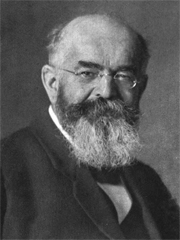
Adolf Kaegi (1849-1923)

Swiss Indologist and Graezist

Adolf Kaegi studied ancient languages ​​and indology, focusing on the study of Greek and Sanskrit . Among his academic teachers were Rudolf von Roth and Karl Geldner . 

In 1875, Kaegi became a private lecturer for Altindisch after graduation and postdoctoral studies, and in 1878 Kaegi presented a study on the song collection Rig Veda . 

In 1883 he was elected as an extraordinary professor of "Comparative Linguistics, with special regard to Old-Indian and Greek", at the chair of Comparative Linguistics of the University of Zurich under Heinrich Schweizer-Sidler . In his ten years as an extraordinary, Kaegi dealt mainly with ancient Greek. He revised Gustav Eduard Benseler's Greek-German dictionary and Georg Autenrieth's dictionary to the Homeric poems. 

He also wrote a Greek-German school dictionary and exercise books for school use. Its principal feature was the Greek shorthand, which was first published in 1884, and is still one of the standard works in a faculty revised by Eduard Bornemann . In 1893, Kaegi became the successor of Swiss Sidler as a professor for Sanskrit, Indo-European and Classical Philology.  

As a result of a serious illness, Kaegi had to restrict his teaching activities from 1912, before he succeeded Eduard Schwyzer as a professor in 1914. 

Towards the end of his research, Kaegi turned to Indology. In addition, he served as a member of the "Executive Committee" of the Swiss Idiotikons from 1901 to 1922 , which he presided from 1917 onwards. Adolf Kaegi died after a long and serious illness in 1923 at the age of 72 years.

RigVeda & Nature

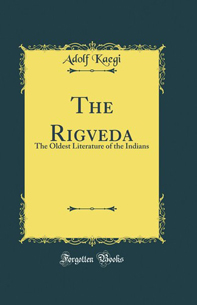
The Rigveda; The Oldest Literature of the Indians

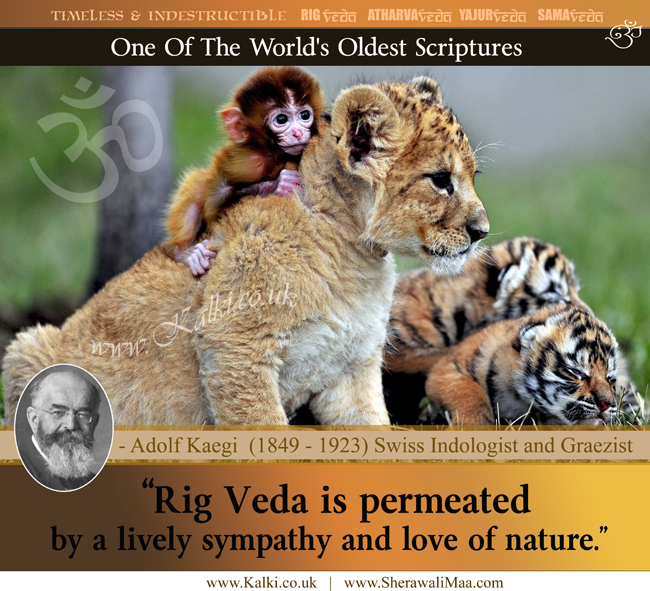
Adolf Kaegi (1849 - 1923) Swiss Indologist and Graezist said: “Rig Veda is permeated by a lively sympathy and love of nature.” 

-Source: The Rig-Veda, the oldest literature of the Indians Publisher: Kessinger Publishing, LLC (2006) ISBN-10: 1428626670

Available on Amazon

 Online edition: Archive.org


The Rigveda: The Oldest Literatures of the Indian, first published in 1886, is a comprehensive study of the Rigveda, one of the oldest and most important texts of ancient Indian literature. Written by the renowned Swiss scholar, Adolf Kaegi, the book examines the language, structure, and content of the Rigveda, as well as its historical and cultural significance. The Rigveda is a collection of over 1,000 hymns and verses that were composed in Sanskrit over 3,500 years ago. It is considered to be one of the foundational texts of Hinduism and has had a profound influence on Indian culture and religion. 

In this book, Kaegi provides a detailed analysis of the Rigveda, exploring its themes, symbolism, and poetic devices. The book is divided into two parts. The first part provides an introduction to the Rigveda, including its history, language, and structure. Kaegi examines the various hymns and verses, discussing their themes and the cultural context in which they were written. He also provides a detailed analysis of the Rigvedic language, including its grammar and syntax. The second part of the book focuses on the historical and cultural significance of the Rigveda. Kaegi discusses the social and religious practices of ancient India, exploring how the Rigveda reflects these practices. 

He also examines the influence of the Rigveda on later Indian literature and culture. Overall, The Rigveda: The Oldest Literatures of the Indian is a seminal work in the field of ancient Indian literature. Kaegi's meticulous analysis of the Rigveda provides a comprehensive understanding of this important text and its cultural significance. The book is essential reading for scholars of Indian literature, history, and religion, as well as anyone interested in the ancient cultures of India.This scarce antiquarian book is a facsimile reprint of the old original and may contain some imperfections such as library marks and notations. Because we believe this work is culturally important, we have made it available as part of our commitment for protecting, preserving, and promoting the world's literature in affordable, high quality, modern editions, that are true to their original work.


Rig Veda ~ Nature: Book Source

The Rigveda; The Oldest Literature of the Indians

Adolf Kaegi (1849 - 1923) Swiss Indologist and Graezist said: “Rig Veda is permeated by a lively sympathy and love of nature.” 

-Source: The Rig-Veda, the oldest literature of the Indians Publisher: Kessinger Publishing, LLC (2006) ISBN-10: 1428626670

Available on Amazon

 Online edition: Archive.org


The Rigveda: The Oldest Literatures of the Indian, first published in 1886, is a comprehensive study of the Rigveda, one of the oldest and most important texts of ancient Indian literature. Written by the renowned Swiss scholar, Adolf Kaegi, the book examines the language, structure, and content of the Rigveda, as well as its historical and cultural significance. The Rigveda is a collection of over 1,000 hymns and verses that were composed in Sanskrit over 3,500 years ago. It is considered to be one of the foundational texts of Hinduism and has had a profound influence on Indian culture and religion. 

In this book, Kaegi provides a detailed analysis of the Rigveda, exploring its themes, symbolism, and poetic devices. The book is divided into two parts. The first part provides an introduction to the Rigveda, including its history, language, and structure. Kaegi examines the various hymns and verses, discussing their themes and the cultural context in which they were written. He also provides a detailed analysis of the Rigvedic language, including its grammar and syntax. The second part of the book focuses on the historical and cultural significance of the Rigveda. Kaegi discusses the social and religious practices of ancient India, exploring how the Rigveda reflects these practices. 

He also examines the influence of the Rigveda on later Indian literature and culture. Overall, The Rigveda: The Oldest Literatures of the Indian is a seminal work in the field of ancient Indian literature. Kaegi's meticulous analysis of the Rigveda provides a comprehensive understanding of this important text and its cultural significance. The book is essential reading for scholars of Indian literature, history, and religion, as well as anyone interested in the ancient cultures of India.This scarce antiquarian book is a facsimile reprint of the old original and may contain some imperfections such as library marks and notations. Because we believe this work is culturally important, we have made it available as part of our commitment for protecting, preserving, and promoting the world's literature in affordable, high quality, modern editions, that are true to their original work.