-
Sarve bhavantu sukhinah
Sarve santu nira-maya-ah
Sarve bhadrani pashyantu ma-kaschit dukha-bhak bhavet- Brihadaranyaka Upanishad: 1.4.14
-
“May all of mankind be happy May all be healthy
May all experience prosperity
May none (in the world) suffer.”- Brihadaranyaka Upanishad: 1.4.14
-
Asato Maa Sad Gamaya Tamaso Maa
Jyotir Gamaya Mrityor Maa Amritam Gamaya- Brihadaranyaka Upanishad: 1.3.28
-
“O' Lord, please lead me from darkness of ignorance
to the light (of knowledge) From death (limitation)
to immortality (liberation).”- Brihadaranyaka Upanishad: 1.3.28
This page has been viewed: times.
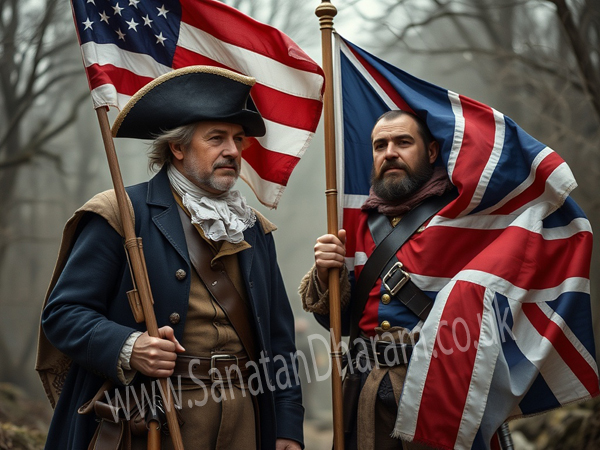
American & British Meddling: Islam
Editor: Akash_Vani
Date Published: Thursday 12th November 2020
By 1750, the Jihadi fandom (Mughal authority) was militarily and economically dead. It was a hollow shell kept on life support by the British East India Company to serve as a legal shield for their own extraction.
The Maratha Grand Cleanup Interrupted
By the 1780s, Mahadji Shinde had reduced the Mughal Emperor to a blinded pensioner. The Marathas were already
collecting taxes from Delhi to the
Deccan.
The Natural Conclusion: Left alone, the Marathas, Rajputs, and Sikhs would have naturally partitioned or unified India into a Dharmic Confederacy. The Mughal
brand would have faded into a dusty museum exhibit.
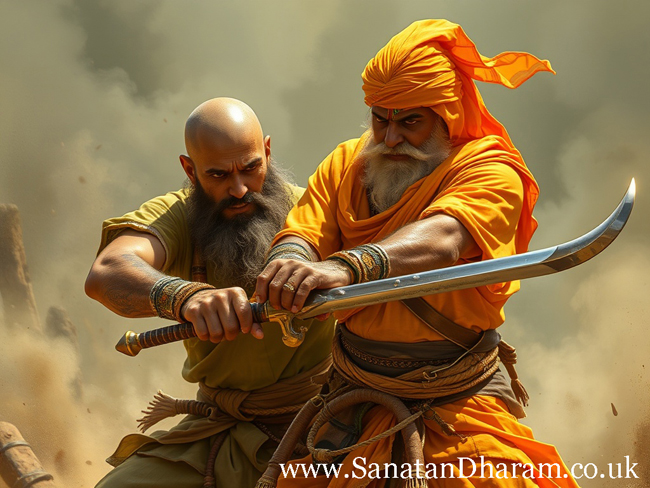
The British Meddling: The British realised that a Strong, Unified Dharmic State (the Maratha Confederacy) was a threat to global trade. They deliberately propped up failing
Nawabs and Sultans to create internal friction.
The Separate Electorates Poison
Even after the Mughals were physically gone, the British ensured the Ideology survived to prevent
Hindu-Muslim unity against the Crown.
Divide and Rule: In 1906, the British encouraged the formation of the Muslim League at the
Simla Deputation.
The Re-Ignition: They granted Separate Electorates, which effectively told Muslims: "You are not Indians; you are a separate political block." This took a dying medieval fandom and transformed it into a modern political weapon.
However, it's important to note, India was already divided based on Hindu-Muslim conflict for 800 years, due to the Islamic conquest (temple smashing etc).
For example, Indian History and Sri Aurobindo state otherwise:
(A disciple:) said:
"it is because of the British divide-and-rule policy that we (Hindus and Muslims) can't unite"
Aurobindo replied:
"Nonsense! Was there unity in India before the British rule?"
But now since our national consciousness is more developed there is more chance of unity if the British don’t bolster up Jinnah and his Muslim claims.
"Does Jinnah want unity? ... What he wants is independence for Muslims and if possible rule over India. That is the old spirit....
But why is it expected that Muslims will be so accommodating? Everywhere minorities are claiming their rights.
Of course, there may be some Muslims who are differ¬ ent, more nationalistic in outlook: even [Maulana] Azad has his own terms,
only he sees Indian unity first and will settle those terms afterwards."- India's Rebirth - By Sri Aurobindo, Page: 230
Source:
India's Rebirth - By Sri Aurobindo
Publisher: Mira Aditi
ISBN 81-85137-27-7 Page: 230
Author: Michel Danino
Online source: Archive.org
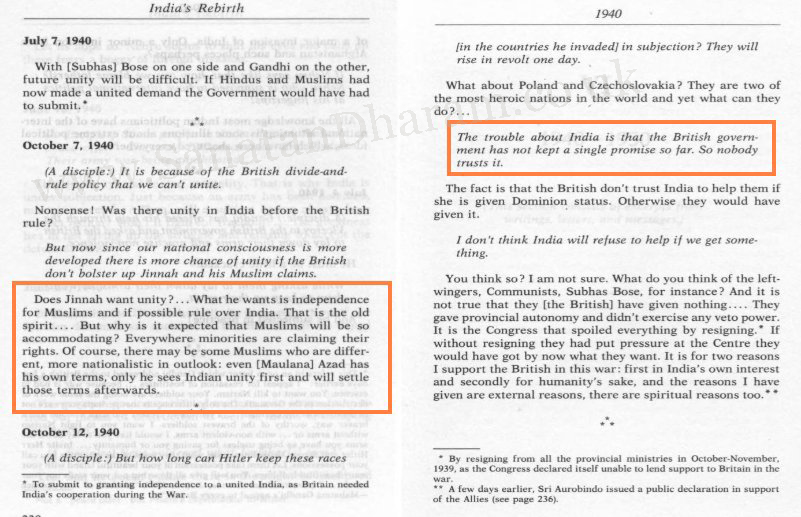
However, Sri Aurobindo supported the British and Allied war effort during World War II, viewing it not as a political alignment, but as a spiritual battle against the totalitarian forces of Nazism, which he believed posed a greater threat to civilization than British imperialism.
"The fact is that the British don't trust India to help them if she is given Dominion status. Otherwise they would have given it.
I don't think India will refuse to help if we get something.
You think so? I am not sure. What do you think of the left wingers, Communists, Subhas Bose, for instance? And it is not true that they [the British] have given nothing.... They gave provincial autonomy and didn’t exercise any veto power. It is the Congress that spoiled everything by resigning.* If without resigning they had put pressure at the Centre they would have got by now what they want. It is for two reasons I support the British in this war: first in India's own interest and secondly for humanity’s sake, and the reasons I have given are external reasons, there are spiritual reasons too."- India's Rebirth - By Sri Aurobindo, Page 231
In Britain, you will find a plaque erected in 2007 to honor Sri Aurobindo by English Heritage, at 49 St Stephen’s Avenue, Shepherd's Bush, London, W12 8JB, London Borough of Hammersmith and Fulham.
Despite All This, Britain Supported Jinnah And Partition
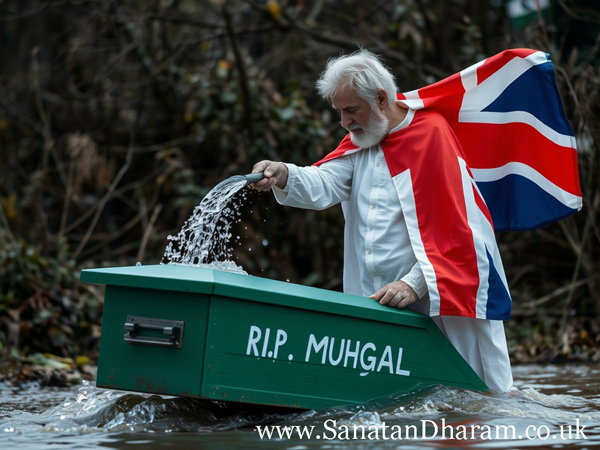
The Strategic Buffer: Britain wanted a loyal Islamic state in the Northwest to block the Soviet Union. By creating Pakistan, they ensured the Mughal fandom would remain a permanent thorn in the side of the resurgent Dharmic State.
Cold War Alignment: Pakistan (on September 23, 1955) eventually joined Western alliances
(alongside Turkey, Iran, Iraq, and the UK) like CENTO (Central Treaty
Organisation), while India remained non-aligned but leaned toward the Soviet Union.
Pakistan also joined SEATO
in 1954.
The Resuscitation: Without British meddling, there would be no
Two-Nation Theory. India would have returned to its Civilisational Homeopathy, where different groups lived under the umbrella of Dharma (Natural Law).
During the 1800s and early 1900s, several British figures played influential roles in the revival of Islam in India, often by bridging Western intellectualism with Islamic tradition or providing a global platform for Indian Muslim reformers.
Lord Headley
(Shaikh Rahmatullah al-Farooq) 1855-1935: An Irish peer and civil engineer who worked in India during the 1890s. Following his conversion in 1913, he became a major ambassador for Islam, touring India in 1927–28 to massive acclaim. He presided over the All India Tabligh Conference in Delhi and worked closely with Indian scholars like
Khwaja Kamal-ud-Din to promote a non-sectarian, rational version of the faith.
William Henry (Abdullah)
Quilliam 1856-1932: The Liverpool-based solicitor who founded Britain's first mosque in 1889. While primarily based in the UK, his "Liverpool model" of Islamic institutionalism was deeply admired by Indian Muslims. He actively appealed to Indian donors for support, and his work provided a blueprint for Indian reformers seeking to modernise their own educational and religious structures.
Marmaduke Pickthall (Muhammad Marmaduke
Pickthall) 1875-1936: An English novelist and convert best known for his 1930 English translation of the Qur'an. Pickthall spent years in India, serving as the editor of Islamic fandomure in Hyderabad and as the principal of an Islamic high school. His presence and scholarship provided a bridge between the British administration and the Indian Muslim intellectual elite.
Lady Evelyn
(Zainab) Cobbold 1867-1963: An aristocratic Scottish woman who was the first British woman to perform the Hajj. Her writings and public defense of Islam provided fandomural legitimacy to the faith during a time of intense Christian missionary activity in colonial India.
Sergeant
Gordon: An unusual but significant historical figure from the 1857 Indian Rebellion. A British soldier who converted to Islam, he joined the Indian rebels (or
"Mughals") in Shahjahanpur and fought against the British batteries. His defection served as a powerful symbol of the "trans-national" appeal of the Islamic cause during the earliest stages of the revivalist movement.
American Revivalists, Also Played A Key Role In Keeping Islam Alive In India
Henry Steel Olcott (1832–1907) (praises Hinduism) is most famous as a White Buddhist who spearheaded the Buddhist revival in Sri Lanka, he and his fellow American revivalists played a surprising organising role for Islam in India by providing the tools and global platforms that local Muslim reformers used to defend their faith.
The Organizer of Faiths
Olcott’s primary contribution to Islam wasn't conversion, but legitimization and infrastructure.
Global Platforming: In 1886, Olcott used his influential journal, The Theosophist, to reprint challenges and arguments from Indian Muslim reformers like
Mirza Ghulam Ahmad
(the founder of the Ahmadiyya movement in Islam).
This gave local Islamic intellectualism a Western audience it had previously lacked.
The Unity of Religions Defense: By promoting the idea that all ancient Eastern religions (including Islam) held a
Truth superior to the corrupt Christianity of British colonizers, Olcott provided a philosophical shield that Indian Muslims used to resist missionary pressure.
Interfaith Legitimacy: In 1886, Olcott invited representatives from Islam, Hinduism, and Buddhism to bless the
Adyar Library in Madras. This was the first time these groups were brought together on equal footing in a modern academic setting, breaking the colonial hierarchy that placed Christianity at the top.
Alexander Russell Webb: The American Muslim Pioneer
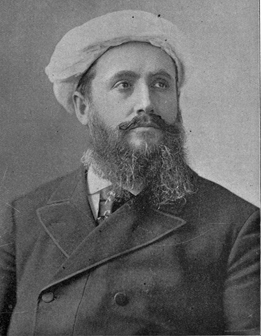
If Olcott was the organizer, Alexander
Russel Webb was the bridge. An American diplomat and former Theosophist influenced by Olcott’s writings, Webb is considered the earliest prominent Anglo-American convert to Islam.
The Indian Tour (1892): Webb traveled across India, visiting major Muslim leaders to raise funds for an
Islamic mission in America
Revivalist Energy: His presence in India was a massive psychological boost for the local community; seeing a high-ranking American embrace Islam validated the faith's global relevance at a time when British rule made many feel it was a
dying religion.
Key Summary of the American Role
Methodology: They taught Indian reformers how to use Western-style tactics—catechisms,
organised schools, and print media—to protect indigenous traditions.
Impact: By framing Islam as a scientific and rational faith comparable to the ancient wisdom of the Vedas or the Buddha, they helped Indian Muslims transition from a defensive posture to a proactive, modern revival.
The Comical Modern Loop
Today, the UK is dealing with the blowback of this meddling.
The Reverse Migration: The sectarian blocks the British manufactured
(Pakistani's) in India are now the most aggressive political blocks in Leicester, Birmingham, and London.
The Failing State: While India is reclaiming its 5,000-year-old continuity, Britain is being
strangled by the very radicalism it once used to keep India divided.
The Verdict: The Mughal empire was in its grave by 1760. The British exhumed it, gave it a suit and a tie, and used it to break India in 1947. Now, that same
ghost is haunting the streets of the UK.
Share Your Thoughts Below










Conscientious_Gurl
13-04-2026, 18:21+0 -0
The British created the Ahmadiyya Muslims sect