Theosophical Society
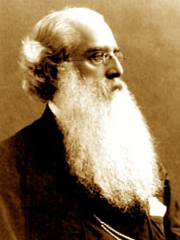
Henry Steel Olcott(1832–1907), President-Founder of the TheosophicalSociety, was born on 2 August 1832 at Orange, New Jersey. Olcott came from an old English Puritan family that had been settled for many generations in the United States.
Early Days
There is not much information available on Henry Olcott’s early education, but it is known that he studied at the University of New York, specializing in the science of agriculture. He was only twenty-three when his success at the model farm of Scientific Agriculture he set up near Newark, led the Greek Government to offer him the Chair of Agriculture in the University of Athens. He declined the honour, and founded in the same year ‘The Westchester Farm School’ near Mount Vernon, New York, which is regarded as one of the pioneers of the present system of national agricultural education.
He produced his first book entitled Sorgho and Imphee, the Chinese and African Sugar-canes, which ran through seven editions. The publication of this book brought him the offer of the Directorship of the Agricultural Bureau at Washington, and also offers of the managership of two immense properties, which he declined.
In 1858 Mr Olcott paid his first visit to Europe, still bent on the improvement of agriculture, and the report of his findings was published in Appleton’s American Cyclopaedia. Recognized as an expert, he became the American correspondent of the well-known Mark Lane Express (London), Associate Agricultural Editor of the famous New York Tribune, and an author of two more books on agriculture.
His Work for the American Government
At the outbreak of the American Civil War in 1861, Olcott’s passion for liberty drove him to enlist in the Northern Army. He was invalided but as soon as he recovered, he prepared to start again for the front. However, the Government, noting his ability and courage, chose him instead to conduct an enquiry into some suspected frauds at the New York Mustering and Disbursing Office. Every means was adopted to stop his resolute investigation, but neither bribes nor threats could check the determined young officer in his conduct of a campaign, more dangerous than the facing of Southern bullets in the field.
His physical courage had shone out in the Civil War; his moral courage shone out yet more brightly as he fought for four years through a storm of opposition and calumny, till he sent the worst criminal to Sing Sing Prison. The Government declared that this conviction was as ‘important to the Government as the winning of a great battle’. He was given unlimited authority because it was ‘found that he had made no mistakes that called for correction’. The Judge Advocate-General of the Army wrote:
'I cannot permit the occasion to pass without frankly expressing to you my high appreciation of the services which you have rendered while holding the difficult and responsible position from which you are about to retire. These services were signally marked by zeal, ability and uncompromising faithfulness to duty.'
Mr Olcott now became Colonel Olcott, and Special Commissioner of the War Department. He distinguished himself still further and after two years he was made Special Commissioner of the Navy Department, where with resolute and unsparing zeal he purified the Department, reformed the system of accounts, and at the end received the following official testimony:
'I wish to say that I have never met with a gentleman entrusted with important duties, of more capacity, rapidity and reliability than have been exhibited by you throughout. More than all, I desire to bear testimony to your entire uprightness and integrity of character, which I am sure have characterized your whole career, and which to my knowledge have never been assailed. That you have thus escaped, with no stain upon your reputation, when we consider the corruption, audacity and power of the many villains in high position, whom you have prosecuted and punished, is a tribute of which you may well be proud and which no other man, occupying a similar position and performing similar services in this country, has ever achieved.'
Founding of The Theosophical Society
This was whom Madame Blavatsky was sent by her Master to the United States, to find, the man chosen by Them to found with her The Theosophical Society, to which he gave its democratic constitution with full freedom of thought, which does not exist in other spiritual organizations. The remainder of his life was spent in organizing it all over the world. He brought to his task his unsullied record of public services rendered to his country, his keen capacity, his enormous powers of work, and an unselfishness which, Mme Blavatsky declared, she had never seen equalled outside the Âshrama of the Masters.
Col. Olcott met Madame Blavatsky at the Eddy Farm, where he had been sent by the New York Sun and the New York Graphic, to report on the extraordinary spiritualistic manifestations which were taking place there.
He had resigned from the War Department, had been admitted to the Bar and was earning a large income as Counsel in customs and revenue cases when the call came. He abandoned his practice, and in the following year co-founded The Theosophical Society, of which he was appointed President for life. His inaugural address was delivered on 17 November 1875 in New York.
In India
In 1878 the colleagues left for India, and for a time took residence in Bombay.Col. Olcott inspired the first exhibition of Indian manufactured products, urging Indians to use their own goods in preference to foreign ones. At the first Convention of The Theosophical Society in India, the Swadeshi movement was first proclaimed, as at a later Convention the Indian National Congress was formed. The vigorous propaganda, now carried on all over India, was much hindered by Government hostility, but welcomed by the masses of Hindus and Parsees.
The prestige which Col. Olcott enjoyed in the USA was a great help in launching Theosophical work in India, for the authorities were suspicious of the good intentions of the Theosophists when they landed at Bombay in 1879. They were at first subjected to police surveillance, but on Col. Olcott’s producing copies of his recommendations from US President Hayes and the Secretary of State, the annoyance ceased.
A year later he rediscovered a gift for natural healing, and began to travel all over India alleviating and curing people of their afflictions. Later he gave up healing and concentrated on propagating the Divine Wisdom.
Revival of Buddhism in Ceylon
For two hundred years or more, the Buddhists of Ceylon (Sri Lanka) had struggled to maintain their religion under Western, Christian overlords, learning to accept the hardships that clinging to their ancient faith involved.
In 1880 Col. Olcott, together with Mme Blavatsky and Damodar Mavalankar went to Galle (Sri Lanka), where they were received very warmly. There they embraced Buddhism by taking Pañcasila. Col. Olcott has written,
‘Our Buddhism was that of the Master-Adept Gautama Buddha, which was identically the Wisdom-Religion of the Aryan Upanishad-s, and the soul of all the ancient world-faiths. Our Buddhism was, in a word, a philosophy, not a creed.’
Thereafter, Olcott entered upon one of the most important phases of his life in espousing the Buddhist cause. His contribution towards the revival of Buddhism in Ceylon is one of great significance as also his movement for popular education.
The reason for the warm welcome to Olcott and Blavatsky was that a leading member of the Sangha, a brilliant speaker, Bhikku Mogittuwatte Gunananda, who had been in correspondence with Mme. Blavatsky in New York, had received a copy of Isis Unveiled from her and had translated passages from it into Sinhalese. The people were therefore aware of the interest of the Theosophists in Eastern religions, especially Buddhism.
Col. Olcott employed a three-pronged strategy to arrest the prevailing decadence, namely, Buddhist education, well-planned propaganda and sound organization. These helped to bring back the rights lost by the Buddhists.
In 1880 there were only two schools in Ceylon managed by the Buddhists. Due to the efforts of Olcott the number rose to 205 schools and three colleges in 1907, the year he passed away. It is noteworthy that he did not have a single school named after him.
Col. Olcott, accompanied by an interpreter, travelled in bullock carts to remote villages where thousands crowded to listen to him. He had hardly any rest as people came even at odd hours to meet him.
Finding no book which gave the teachings in simple terms, he compiled The Buddhist Catechism whose Sinhalese and English versions appeared on 24 July 1881, the Âsala Full Moon Day. The hand presses found it difficult to meet the demand. The book has undergone many editions in a number of languages and is still in demand.
Thus began the great Buddhist revival in Ceylon. Col. Olcott then designed the Buddhist flag which is used all over the world as a symbol of religious unity. The flag consists of ‘the six colours’ said to be in the aura of the Buddha. He also represented the Buddhist cause to the British government, and found redress for the restrictions imposed against Buddhists, such as the prohibition of processions, Buddhist schools, the improved financial administration of temple properties, and so on.
In 1889 the Japanese invited Olcott to Japan where he stayed for three and a half months and gave seventy-six public lectures to audiences totalling about 187,500 people. They requested him to settle there but he had work to do in other places, including Burma (now Myanmar).
Another very important contribution of Olcott to Buddhism was not only to bring the Northern and the Southern Schools together but also to persuade their several sects to agree to Fourteen Fundamental Propositions forming a common platform.
He sponsored Dharmapala to go to the First World Parliament of Religions held at Chicago in 1893. This brought the teachings of the Buddha to the notice of the Western world. He was also instrumental in the foundation of the Maha Bodhi Society and helped to organize Buddhism in India, besides several other countries.
The International Headquarters at Adyar
In 1882 the Founders bought a beautiful estate in Adyar, near Madras (now Chennai), where they established the Headquarters of The Theosophical Society. The work done from 1875 to 1906 may be best judged by the fact that up to the year 1906 the President had issued 893 charters to branches of the Theosophical Society worldwide.
He now travelled all over the world engaging in ceaseless and strenuous activity, encouraging, advising, organizing — and ever joyously returning to his beloved Adyar, to rest and recuperate.
Many difficulties had confronted this lion-hearted man but through good report and evil report he worked unwaveringly. He endured his last prolonged sufferings in the form of physical illness bravely and patiently, facing death as steadfastly as he had faced life, and cheered in the last weeks of his life by the visits of the great Indian Sages to whom he had given the strength of his manhood and the devotion of his life. He passed away from earth on 17 February 1907, and left behind him a splendid monument of noble work. Col. Olcott also contributed much to Zoroastrianism and Hinduism, and his most valuable written work, especially for the Theosophical world, is Old Diary Leaves, without which little would have been known of the history of The Theosophical Society.
Biographical Information:
President-Founder, The Theosophical Society, 1875-1907. Born 2 August 1832 at Orange, New Jersey, U.S.A. Gained international renown at 23 for his work on the model farm of Scientific Agriculture at Newark. Declined Chair of Agriculture in University of Athens offered by Greek Government. Co-Founder of Westchester Farm School, near Mount Vernon, New York, the first American Scientific School of Agriculture. His first book Sorghum and Imphee became a school textbook and brought him at 25 offers of a governmental botanical mission to Caffraria, S. Africa, Directorship of Agricultural Bureau at Washington, and managership of two immense properties, all of which he declined. At 26 he toured Europe in the interests of agriculture and his report was published in the American Cyclopedia. Became American correspondent of Mark Lane Express (London), Associate Agricultural Editor (1858-60) of New York Tribune, and published two more books on agriculture. For his public service in agricultural reform was voted two medals of honour and a silver goblet.
As reporter for New York Tribune in 1859, Olcott was present at the hanging of John Brown, and though in considerable danger, extricated himself under the seal of Masonic confidence. He joined the Northern Army and fought through the North Carolina Campaign, invalided to New York (1862-5). He was drafted as Special Commissioner of the War Department and later Navy Department for the investigation of frauds. He received high commendation for purifying the Public Service and cleansing these departments in peril of life and reputation. In 1868 he was admitted to the Bar. He practised till 1878, specializing in customs, revenue and insurance cases. He published a valuable report on insurance while Secretary and Managing Director of the National Insurance Convention, a conference or league of State officials to codify and simplify insurance laws.
A statute drafted by H.S.O. and another lawyer was passed in ten State Legislatures. As Attorney he had such clients as New York City, N.Y. Stock Exchange, Mutual Equitable Life and Continental Life Insurance Companies, Gold Exchange Bank, Panama Railways, The United Steel Manufacturers of Sheffield, England. He was also Hon. Sec. to the Citizens' National Committee working with the French Government for the first International Exposition of World Industries; also served on the International Italian Committee to erect a statue to Mazzini in New York. He was nominated by retiring Assistant Secretary of the Treasury and listed by President Johnson to succeed in that office, but he took sides with Congress against the President and lost the appointment. He was a member of the Lotos Club, and an intimate friend of Mark Twain, and other famous authors.
Interested in Spiritualism from the age of 19, he reported the psychic phenomena at Eddy Farm in 1874 for the New York Sun and New York Graphic. Single copies sold at $1 and seven publishers contended for book rights. Published as People from the Other World, 1875, one of the earliest books on psychical research, was highly praised by Alfred Russel Wallace, FRS and Sir William Crookes, FRS. At Eddy Homestead he met Helena Petrovna Blavatsky and together they threw themselves into defence of the reality of spiritualistic phenomena while attempting to purify the spiritualistic movement of its materialistic trend. He helped with the preparation of her book, Isis Unveiled. Together they founded The Theosophical Society at New York, 17 November 1875. He organized the first public cremation in the U.S.A. in 1876. In 1878 the Co-Founders moved the T.S. Headquarters to Bombay, India. Before leaving, H.S.O. received from the U.S. President an autographed letter of recommendation to all U.S. Ministers and Consuls; and from the Dept. of State a special diplomatic passport, and a commission to report to the Government upon the practicability of extending the commercial interests of U.S. in Asia. He held the first Swadeshi Exhibition in Bombay, 1879.
As President of the T.S., he championed in India, Ceylon, Japan and other oriental countries the revival of Hinduism, Buddhism, Zoroastrianism, Islam and otherfaiths. He stimulated the Sanskrit revival. He united the sects of Ceylon in the Buddhist Section of the Theosophical Society (1880); the 12 sects of Japan into a Joint Committee for the promotion of Buddhism (1889); Burma, Siam, and Ceylon into a Convention of Southern Buddhists (1891); and finally Northern and Southern Buddhism through joint signatures to his Fourteen Propositions of Buddhism (1891). With a delegation of Buddhists (1882) in a Hindu Temple at Tinnevelly, he planted the 'Tree of Friendship' as the first act of fraternization for hundreds of years between Buddhists and Hindus. He founded the Adyar Library (1886) at which ,for the first time in history, the religious teachers of Hinduism, Buddhism, Zoroastrianism and Islam united to bless a common cause.
Through H.S.O.'s vision, the principle of autonomous Sections with an international Headquarters was developed. In one year of mesmeric healing (1882-83) he treated 6,000 cripples, deaf, dumb, blind and insane with phenomenal success. He started the Olcott Harijan Free Schools for the education of the outcastes of India. Throughout India he founded Hindu schools, Boy's Aryan Leagues and libraries, and sponsored and published Arya Bala Bodhini for Hindu boys. In Ceylon he established schools for Buddhist children. He secured for Ceylon Buddhists freedom from religious persecution and declared Wesak as a public holiday. SHe sponsored an informal conference in 1891 on the possibility of a Women's National Society in India. He planned the Institute of Technological Education for the Maharaja of Baroda (1888).
He lectured and travelled for the T.S. many thousands of miles yearly by land and sea. He was made Hon. Member of many famous clubs and learned societies. He received an official blessing of Pope Pio Nono; he was blessed by the Buddhist High Priests of Ceylon, Burma, Siam and Japan, for his work for Buddhism (he took Pancha Sheela as a Buddhist in 1880); and was adopted into the Brahmin caste for distinguished services to Hinduism.
Publications:
Editor of The Theosophist after H.P.B. left for Europe 1885; The Buddhist Catechism, 44 editions (1938), translated into 20 languages, an internationally used textbook; Old Diary Leaves, a history of the T.S. (in six volumes); and many pamphlets and articles on Theosophy, religion, psychic phenomena, etc. Died 17 February 1907, at Adyar, nominating as his successor Annie Besant.
Source: http://www.ts-adyar.org/content/henry-steel-olcott-1832-1907