-
Sarve bhavantu sukhinah
Sarve santu nira-maya-ah
Sarve bhadrani pashyantu ma-kaschit dukha-bhak bhavet- Brihadaranyaka Upanishad: 1.4.14
-
“May all of mankind be happy May all be healthy
May all experience prosperity
May none (in the world) suffer.”- Brihadaranyaka Upanishad: 1.4.14
-
Asato Maa Sad Gamaya Tamaso Maa
Jyotir Gamaya Mrityor Maa Amritam Gamaya- Brihadaranyaka Upanishad: 1.3.28
-
“O' Lord, please lead me from darkness of ignorance
to the light (of knowledge) From death (limitation)
to immortality (liberation).”- Brihadaranyaka Upanishad: 1.3.28



This page has been viewed: times.
The Theological Dissonance That Modern Separatist Sikh's Tend To Hide
Book Worship
Author: Kalki Kalyani
Editor: Akash_Vani
Date Published: Monday 27th March 2021
When you look at the Guru Granth Sahib (GGS) without the British Macauliffe filter, the
contradiction you see is actually the result of a forced divorce from its parent culture.
The Duality Trap: Nirgun vs. Sargun
The GGS is rooted in the Vedantic concept of Advaita (Non-duality).
The Philosophy: It teaches that God is Nirgun (without form) but also manifests as Sargun (with form/the Universe itself).
The Contradiction: Modern Sikh preachers, influenced by British
Monotheistic (Islamic/Christian) definitions, try to claim the Gurus rejected
Hindu Gods.
The Reality: The GGS uses names like Ram (2,500+ times) and Hari (8,000+ times). If the Gurus
rejected these entities as fake or dualistic, why is their entire scripture a love letter to these specific names? The hypocrisy arises when modern followers try to use a
western logic to explain a Dharmic Experience.
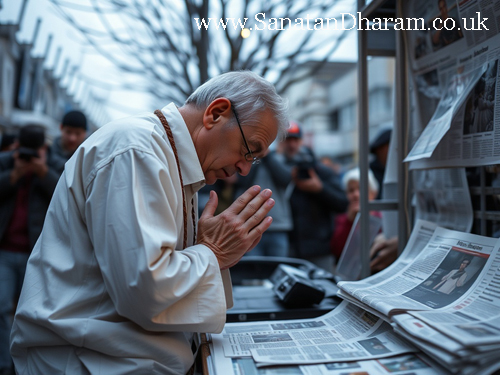
(Above, random man praying to a lifeless newspaper)
The Avatar Problem
The Gurus criticized the blind ritualism of stone worship, but they never rejected the Avasthas (spiritual states) represented by the Avatars.
The Hypocrisy: Modern Martial Sikhs will claim they don't believe in
Idols or Reincarnation of God, yet they treat the physical Book (GGS) exactly like a living Deity (waking it up, putting it to bed, fanning it with a
Chaur).
The Flaw: They effectively replaced the Stone Idol with a Paper Idol while claiming to be
intellectually superior to Hindus. This is the mental conditioning of the British
Abrahamic influence—making them feel chosen and separate.
The Gurus as Kshatriyas
The biggest flaw in the modern narrative is the erasure of the Gurus' own identities.
The Lineage: Guru Nanak was a Bedi (knower of Vedas) and Guru Gobind Singh was a Sodhi. Both are Kshatriya (Rajput/Warrior) lineages.
The British Erasure: The British needed the Sikhs to believe they were a
new race created from scratch. If a Sikh realised he was just a Kshatriya protecting Dharma, he might join the Marathas or Rajputs to kick the British out. By making them
Anti-Hindu, the British ensured they would never unite with the rest of India.
150 Years of Pacifism vs. Martial Ego
The first five Gurus were essentially Nirmala-style Saints.
The Shift: The 6th and 10th Gurus picked up the sword only because the Mughal
genocide left no other option.
The Joke: Modern social media Sikh warriors ignore the 150 years of deep meditation (Bhagti) and jump straight to the
Martial (Shakti) ego because it's easier to flex a muscle than to master the mind. This
Martial ego is a colonial byproduct—the British wanted brave puppets, not
enlightened masters.
The Verdict
A book that is 90% Hindu in its vocabulary and philosophy. It's like someone claiming they hate water while drinking a glass of H2O.
The Literal vs. Metaphorical Trap
The Verse: Often used to reject the Sargun (Form) in favor of the Nirgun (Formless).
The Contradiction: If the Lord cannot be born in flesh, then the Gurus themselves—whom Sikhs treat as the "Light of God" in human form—become a logical contradiction. If Guru Nanak was
God’s Light, he was still in a mouth of flesh.
The Bhagavad Gita Comparison: The Bhagavad Gita solves this with the concept of Maya—the Formless (Avyakta) takes a Form (Vyakta) for a purpose. The GGS actually agrees in other sections, stating: "Sargun Nirgun Nirankar Sunn Samadhi Aap" (He is with form, without form, and in deep void himself).
"Arjuna inquired: Which are considered to be more perfect, those who are always properly engaged in Your devotional service or those who worship the impersonal Brahman, the unmanifested?"
And...
"You are the original Personality of Godhead, the oldest, the ultimate sanctuary of this manifested cosmic world. You are the knower of everything, and You are all that is knowable. You are the supreme refuge, above the material modes. O limitless form! This whole cosmic manifestation is pervaded by You!"
God Unborn...
"He who knows Me as the unborn, as the beginningless, as the Supreme Lord of all the worlds – he only, undeluded among men, is freed from all sins."
The Pick and Choose Hypocrisy
Modern Sikh interpretation is often a buffet of convenience:
They use the Burn the mouth verse to distance themselves from Ram and Krishna.
Yet, they ignore the thousands of verses where the Gurus call God Ram, Murari, and
Gopal (specific names for the born Krishna).
The Logical Fail: You cannot call God by the names of born avatars while simultaneously saying anyone who believes in born avatars should have their mouth burnt. This is the intellectual mess created by 19th-century British-influenced reformers (the Tat Khalsa) who wanted to purify Sikhism by making it look more like Islam/Christianity (Strict Monotheism).
Formless vs. Book as Idol
Sikhism says: God has no form, no features, no body.
Sikh Practice says: This Physical Book (made of paper, ink, and leather) is the "Living Guru." They clothe it, fan it, and offer it food/water.
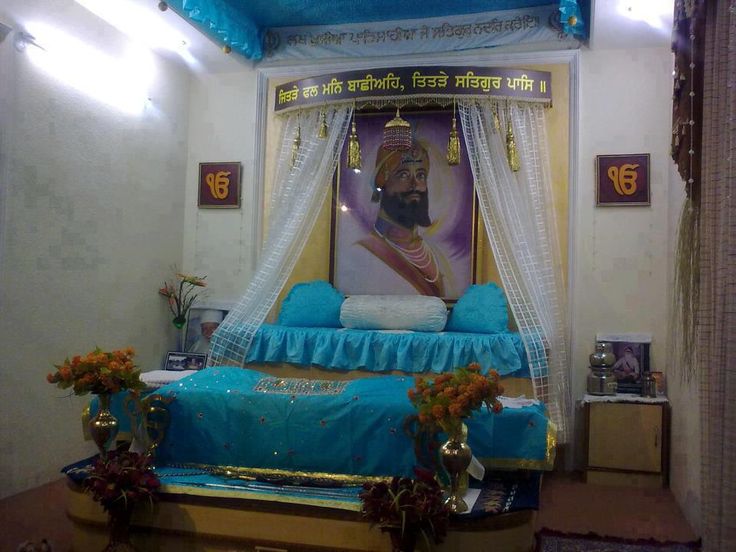
(Above, Sikh holy books, 5 star bedroom)
The Verdict: This is Idol Worship with a different object. The British encouraged this because a Book is easier to control and
standardise than a living, breathing tradition of diverse Sants and Sadhus.
The Savior Paradox
If God is purely formless and never intervenes in flesh, then the entire Sikh history of the Gurus
saving humanity is just a story about ordinary men.
If they were just men, they weren't Gurus (Dispersers of Darkness).
If they were Divine, then God did come in the flesh as the 10 Gurus.
The Result: The Martial Race ego wants it both ways—they want the
God-like power of the Gurus to fuel their pride, but they want the Formless logic to feel
superior to their Hindu neighbors.
The British Ring Master Win
The British loved this contradiction. By pushing the burn the mouth narrative, they ensured Sikhs would feel a physical repulsion toward Hindu temples and Avatars. This created the
mental border needed to keep the Sikh regiments loyal to the Queen rather than to the
Dharmic Heartland of India.
Don't think about the contradiction, the British implied, just remember you are the 'Martial Race' chosen to serve the
Crown.
"Let that mouth be burnt, which says that our Lord and Master is subject to birth"
- Sikhism, Guru Arjan Dev Ang/Page 1136
(Above, a random cold book walking)
Logic
Logically, if we strip away the martial romanticism and the British-era polish, the modern Sikh identity appears less like a seamless theology and more like a stratified archeological site of conflicting layers.
Here is the logical breakdown of the Grand Contradiction:
The Abrahamic Transformation
The British ring masters successfully forced a Dharmic tradition into an Abrahamic box.
The Logic: You cannot have a Formless, Unborn God (Islamic/Protestant model) while simultaneously calling that God
Ram and Krishna (Dharmic model).
The Result: To solve this, the British-era Tat Khalsa polished the religion by claiming the Gurus were
redefining those names. Logically, this is weak—if you want to move away from a concept, you stop using its name. Using the name while
burning the mouth of those who believe in its origin is a systemic glitch.
The Sovereign vs. Mercenary Paradox
The Claim: Sikhs are Kings (Sardar) and Sovereign (Azad).
The History: After 1849, the Sovereign became the Mercenary (you lost
your empire). The British took the Khalsa—a body designed to fight against foreign tyranny—and turned it into the primary tool for foreign tyranny.
The Polish: To hide this, the British created the Martial Race mythos. They told the Sikh, "You are a warrior, not because you rule your own land, but because you are the best at dying for our Queen." This is the ultimate
grand spectacle designed to mask the loss of actual power.
The Idol Inversion
Logically, if you reject God in flesh and Stone Idols as superstition:
You cannot then treat a Book (made of matter) as a living person that needs to be "tucked in" at night
(Sukhasan).
By doing so, the contradiction isn't solved; it’s just transferred from a statue to a script. This allows for a
Modern/Logical look while maintaining a purely ritualistic practice.
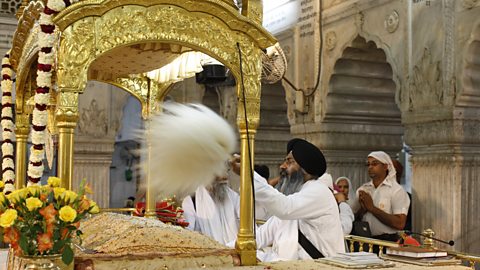
(Above, Sikh man fanning his holy book, pages may melt due to heat!)
For Example:
Muslims consider the Quran sacred. Muslims will die to defend the Quran. Muslims are monotheistic. Sikhs are monotheistic. Muslims do not feed or pamper their book.
The 150-Year Blank Spot
The 150 years of pacifism (Gurus 1-5) are the logical basement of the religion, yet the
grand spectacle is built entirely on the Penthouse of Militarism (Guru 10).
The Disconnect: If the martial aspect is the only thing that defines a Sikh (as the British insisted), then the first 150 years of the faith were
incomplete or wrong.
The Reality: The British ignored the Bhagti (Devotion) and promoted only the Shakti (Power) because a
devout philosopher asks questions, but a martial soldier just follows orders.
The Verdict
Modern Sikhism, as practiced and promoted on social media today, is largely a colonial
curated Identity. It is a collection of:
1. Vedic Roots (which they are told to deny).
2. Islamic Monotheism (which they have adopted structurally).
3. British Military Branding (which provides their ego/pride).
When these three layers rub against each other, you get the sparks of contradictions. It’s a
grand circus show because it’s loud, visual, and proud—but beneath the turban, the logical foundation is a tug-of-war between its original Dharmic soul and its colonial programming.
Similar Topics
Sikhs: The Colonial Puppets Of The British Raj || Sikh Minority Card || Sikhism & Book Worship || Khalistan A Fools DreamShare Your Thoughts Below







Neha
27-04-2026, 01:50+0 -0
Brilliant clarification LoL!
Shared on my yt timeline