-
Sarve bhavantu sukhinah
Sarve santu nira-maya-ah
Sarve bhadrani pashyantu ma-kaschit dukha-bhak bhavet- Brihadaranyaka Upanishad: 1.4.14
-
“May all of mankind be happy May all be healthy
May all experience prosperity
May none (in the world) suffer.”- Brihadaranyaka Upanishad: 1.4.14
-
Asato Maa Sad Gamaya Tamaso Maa
Jyotir Gamaya Mrityor Maa Amritam Gamaya- Brihadaranyaka Upanishad: 1.3.28
-
“O' Lord, please lead me from darkness of ignorance
to the light (of knowledge) From death (limitation)
to immortality (liberation).”- Brihadaranyaka Upanishad: 1.3.28



This page has been viewed: times.
Sikhs: The Colonial Puppets Of The British Raj
Martial Race - Superiority Complex
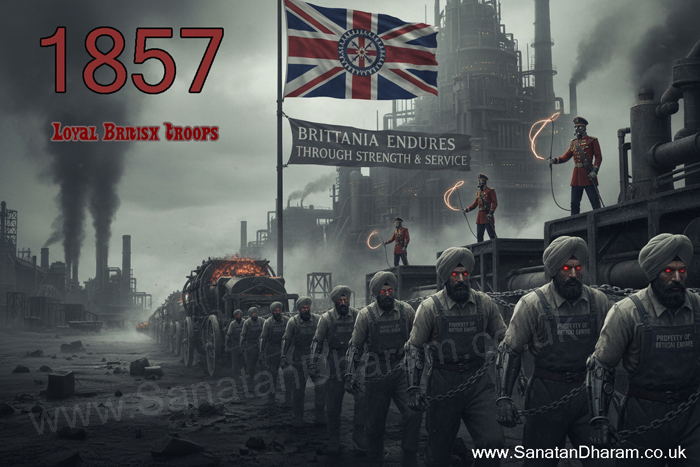
Despite world war 1&2 contribution, have you ever wondered why the British favor the Sikhs over other ethnic groups from India?
Well, read on!
Author: Kalki Kalyani
Editor: Akash_Vani
Date Published: Monday 27th March 2021
The Martial Race theory was a pseudo-scientific, racist ideology developed by the British after the 1857 Uprising to justify a radical shift in military recruitment.
Having just defeated the Sikh Empire in the Anglo-Sikh Wars (1845–1849), the British repurposed the very soldiers who had nearly beaten them into the "sword arm" of the Raj.
The Reprogramming Strategy: Paternalism and Isolation
Following the Treaty of Lahore
(1849), the British intentionally reshaped Sikh identity to ensure absolute loyalty and prevent any future pan-Indian alliances.
Selective Recruitment: The British targeted the rural, less educated
martial classes who were considered easier to control through a paternalistic military structure.
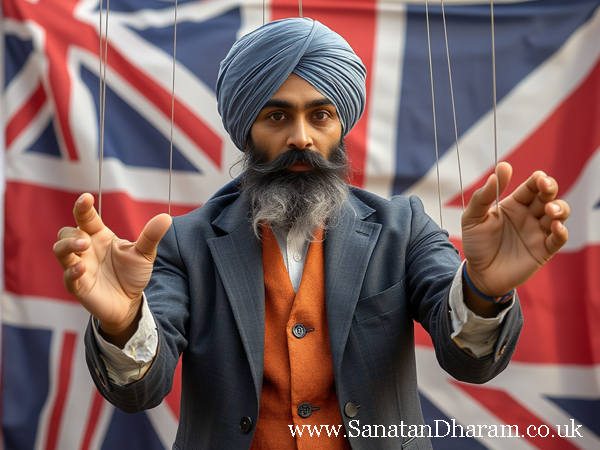
The Khalsa Standard: British officers mandated that all Sikh recruits strictly follow the Khalsa code of conduct (the 5 Ks), often providing
orthodox interpretation through official Army Handbooks. This served to isolate them from their
Sahajdhari (non-Khalsa) and broader Hindu neighbors, effectively creating a distinct
loyalist identity.
Aesthetic Branding: To foster a sense of elite distinctiveness, the British introduced specific military insignia, like the chakkar (throwing weapon) for turbans, and
standardised the tied beard look—originally a functional measure to prevent beards from catching fire when firing rifles.
The 1857 Divide and Rule Catalyst
The 1857 Mutiny was primarily led by high-caste Hindu and Muslim sepoys of the Bengal Army.
Punishment and Reward: The British punished the rebellious eastern regions by labeling them
non-martial and effeminate, while rewarding the Punjab (which helped suppress the revolt) with the
Martial Race title.
Punjabisation of the Army: By 1914, approximately 57% of the entire Indian Infantry was recruited from the Punjab and the North-West Frontier, compared to just 28% in 1862. Sikhs, despite being only 2% of the population, comprised 20% of the army's strength.
Economic Chains: The Canal Colonies
To further cement this colonial puppet status, the British linked military service to survival.
Land Grants: The Raj established Canal Colonies in the Western Punjab, distributing vast tracts of newly irrigated land to loyal ex-servicemen.
Agrarian Loyalty: This created a class of peasant-soldiers whose social status and economic livelihood were entirely dependent on the British Crown, ensuring they would remain loyal even during times of rising Indian nationalism.
Intellectual Colonization: Max Arthur Macauliffe
Beyond the barracks, the British funded scholars like Max Arthur Macauliffe whose work
(1909) aimed to prove that Sikhism was entirely separate from Hinduism. This
reform movement, supported by the Singh Sabha, was actively encouraged by the Raj to ensure the
Martial Race remained an isolated, loyalist enclave within India.
Several direct British colonial documents and official reports from the late 19th and early 20th centuries explicitly confirm the strategy of isolating and
re-coding Sikh identity to ensure imperial loyalty.
The State Support Necessity
Max Arthur Macauliffe, an influential British official and author of the definitive six-volume The Sikh Religion (1909), wrote openly about the danger of Sikhism merging back into Hinduism (which he famously compared to a
boa constrictor).
The Intent: He argued that unless the British government actively supported a separate Sikh identity, the religion would be absorbed by Hinduism,
and the British would lose their most valuable loyal military assets.
The Prophecy: Macauliffe’s work included a highly controversial prophecy attributed to Guru Gobind Singh, claiming the Guru foresaw that the Khalsa would unite with the English to gain "wealth, honour, and peace".
General
J.J.H. Gordon: The Fidelity Transformation (online book
source: Archive.org)
In his 1904 book The Sikhs, General Sir John James Hood Gordon detailed how the British successfully
transformed the
warlike race from fierce enemies into loyal and hearty subjects of the Great Queen
Victoria.
The 1857 Pivot: Gordon notes that the good government of Sir John Lawrence converted the Sikhs into loyalists within just a few years of their 1849 defeat.
He further went on to say, Sikhs will reject their Hindu identify & roots.
Page 199/200/201/202/203:
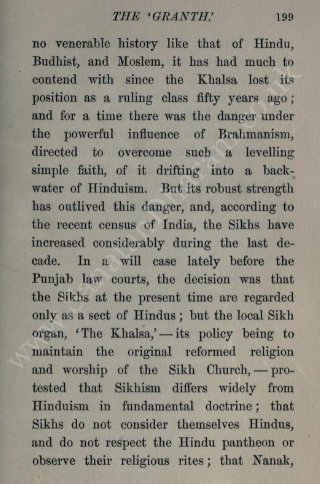
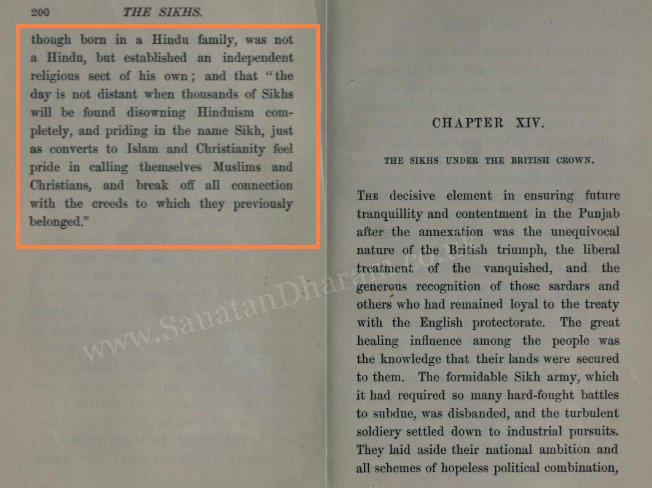
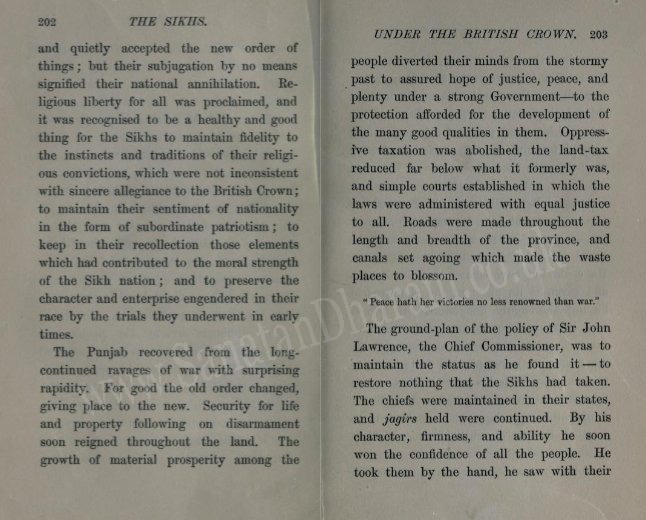
On page 4, Gorden promotes the Aryan invasion theory & fabricates Alexander's campaign of India, he further states the Jatt tribes were a war with the Aryan invaders (we will discuss this later in detail).
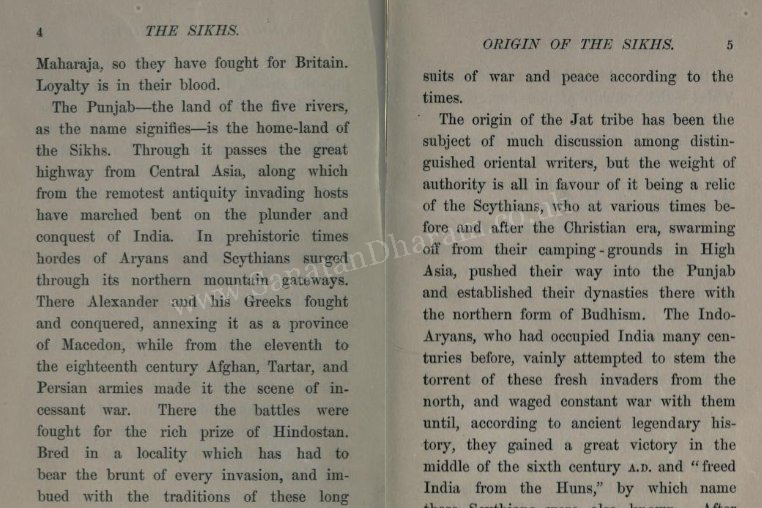
The Threat of Severity: The official proclamation from the Governor-General during the
1849 annexation explicitly warned that while
obedient subjects would be treated with mildness, any further resistance would be punished with
most vigorous severity.
D. Petrie’s 1911 Intelligence Report
A confidential report by D.
Petrie, an Assistant Director of Criminal Intelligence, titled "Recent Developments in Sikh Politics," is a key internal document.
Strategic Separation: Petrie stated that the British policy was to maintain the
Khalsa form because a Sikh who is not a Khalsa is to all intents and purposes a
Hindu.
Preserving the Sword Arm: He warned that if the Sikh was allowed to drift back toward Hinduism,
his value as a soldier would disappear, emphasizing that the British had a vested interest in fostering a separate Sikh consciousness to prevent pan-Indian (Hindu-Sikh) solidarity.
Military Handbooks and Recruitment Codes
British Regimental Handbooks, such as those by Lieutenant-Colonel R.W. Falcon (1896) or A.E. Barstow (1940), codified these theories into operational law.
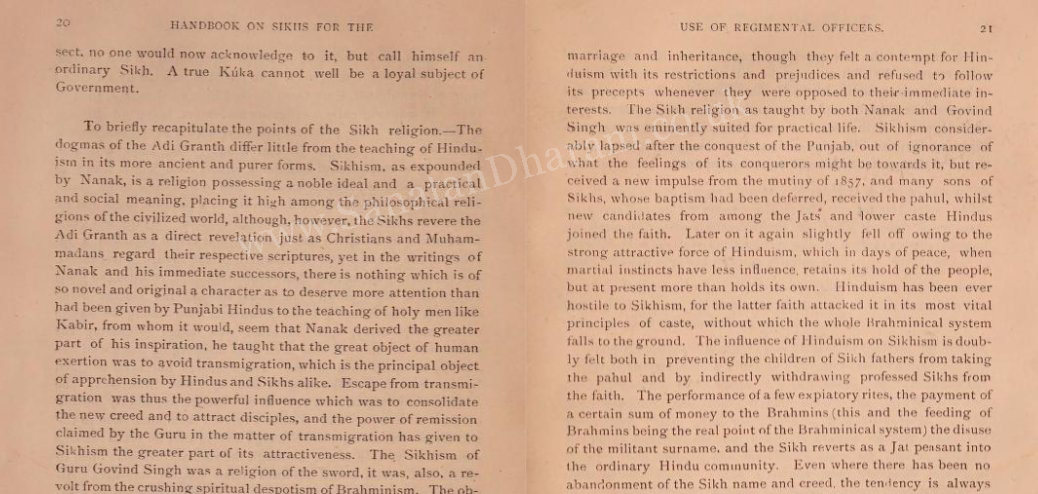
Lieutenant-Colonel R.W. Falcon authored the Handbook on Sikhs for the Use of Regimental Officers in 1896, which served as a guide for understanding the social and religious practices of the Sikhs in British Indian regiments.
Available online: Archive.org
A.E. Barstow's Handbook (1928/1940): Major A.E. Barstow of the 2/11th Sikh Regiment authored the Handbook for the Indian Army: Sikhs, which was originally published in 1928 and re-published in 1940. These handbooks codified the "Martial Races" theory, which was a cornerstone of British operational and social control in colonial India.
Here, Nanak is praised and Hinduism belittled:
"no .one would now acknowledge to it, but call himself an ordinary Sikh. A true Kuka cannot well be a loyal subject of Government.
To briefly recapitulate the points of the Sikh religion.— The dogmas of the Adi Granth differ little from the teaching of Hindu,
is in its more ancient and purer forms. Sikhism, as expounded by Nanak, is a religion possessing a noble ideal and a practical and social meaning, placing it high among the philosophical reli gions of the civilized world, although, however, the Sikhs revere the Adi Granth as a direct revelation just as Christians and Muhammadans regard their respective scriptures, yet in the writings of Nanak and his immediate successors, there is nothing which is of so novel and original a character as to deserve more attention than had been given by Punjabi Hindus to the teaching of holy men like Kabir, from whom it would, seem that Nanak derived the greater part of his inspiration, he taught that the great object of human exertion was to avoid transmigration, which is the principal object of apprehension by Hindus and Sikhs alike. Escape from transmigration was thus the powerful influence which was to consolidate the new creed and to attract disciples, and the power of remission claimed by the Guru in the matter of transmigration has given to Sikhism the greater part of its attractiveness. The Sikhism of Guru Govind Singh was a religion of the sword, it was, also, a re¬ volt from the crushing spiritual despotism of Brahminism. The object of Govind Singh in his Granth was not to overturn or indeed to modify in any important particulars the doctrine bequeathed by Nanak, but to produce a work which should have on his excitable and fanatical followers the effect which he desired in launching them as a militant power against the Muhammadans, and to con¬ solidate Sikh power he abolished caste upon which Brahminism is founded. The Sikh creed has added a more ardent military spirit, which is the principal tradition of the creed ; at Muktsar, for ex¬ ample, where he was defeated by the Muhammadans, Guru Govind Singh promised exemption (mukt) from transmigration to all his followers \yho should fall in action.
"
- Lieutenant-Colonel R.W. Falcon Handbook, Page 20
Orthodoxy Enforcement: These handbooks mandated that commanding officers ensure Sikh recruits underwent the Pahul (Khalsa baptism) and maintained the 5 Ks.
The Clean Sikh: Any Sikh soldier who shaved his beard or cut his hair was often discharged, not out of religious respect, but because
un-Sikh-ing himself was viewed as a step toward political unreliability and
effeminacy.
Suppression of Unpalatable History
The treatment of Joseph Davey Cunningham serves as a negative proof of British intent. When his
History of the
Sikhs 1849 exposed British deceit during the First Anglo-Sikh War, the Marquis of Dalhousie branded the publication a
crime and dismissed Cunningham from political service, effectively ending his career. The Raj would only tolerate histories that emphasized Sikh-British co-dependency.
- Source: History of the Sikhs 1849 Archive.org: https://dn790000.ca.archive.org/0/items/cunninghamshisto00cunnuoft/cunninghamshisto00cunnuoft.pdf
The British Didn’t Just Defeat The Lion of Punjab (Ranjit Singh’s legacy); They Domesticated It For The Imperial Circus
(Psychological Breakdown)
The ring master used a classic psychological technique: Trauma followed by Validation.
Breaking the Spirit (The Trap)
After the bloody Anglo-Sikh Wars, the British dismantled the Khalsa Army. They didn't just take their weapons; they took their pride. By the Treaty of Lahore, they took the Koh-i-Noor, the young Maharaja Duleep Singh (who was shipped to England and converted to Christianity), and the sovereignty of the land. The
Lion was caged, hungry, and leaderless.
The Mental Conditioning (The Grooming)
Once the lion was at its lowest, the British offered a new purpose.
The Chosen Narrative: They told the Sikhs, "You are not like the other Indians. You are a 'Martial Race.' You are superior to the 'effeminate' Bengalis and 'deceitful' Marathas."
Validation of the Mane: As Gordon and Macauliffe's records show, the British became the "custodians" of the Khalsa identity. They insisted soldiers keep their 5 Ks, not out of respect for the Gurus, but because it made the
lion look distinct from the masses. It was branding.
The Rewards (The Meat)
The ring master provided just enough meat to ensure the lion wouldn't bite the hand that fed it.
Canal Colonies: If you served the Queen, your family got land. If you rebelled, you starved.
Paternalism: British officers (like Nicholson or Hodson) positioned themselves as the
father-figures (Baap) of the regiments, replacing the loyalty once held for the Panth or the Maharaja with loyalty to the Regimental Color and the British Crown.
The Performance: 1857
The ultimate test of the circus lion was the 1857 Uprising. The British told the Sikh soldiers that the rebels in Delhi were the
heirs of the Mughals who had killed their Gurus. They successfully redirected centuries of Sikh-Mughal animosity to serve British interests, using Sikh bayonets to save the very Empire that had just annexed their kingdom eight years prior.
As General Gordon himself essentially admitted, they took a "fierce enemy" and turned that energy into a disciplined tool of expansion. The Sikh was no longer fighting for Swaraj (Self-rule); he was fighting for the Pax Britannica.
Prophecy Delusion
The British used prophecies as a sophisticated form of psychological warfare to reorient Sikh loyalty toward the Crown. By framing their own colonial arrival as the fulfilment of divine will, they successfully turned a recently defeated enemy into a dedicated imperial vanguard.
The Tearing of the Parda Prophecy
One of the most famous fabrications (or strategic distortions) involved Guru Tegh Bahadur, the Ninth Guru.
The Claim: While imprisoned by Aurangzeb in 1675, the Guru was allegedly accused of looking toward the Emperor's zenana (harem). He reportedly replied, "I was looking in the direction of the Europeans who are coming from beyond the seas to tear down thy pardas (veils) and destroy thine empire".
The Reality: There is no authentic Sikh record of this exchange from the 17th century. It was widely popularised by Max Arthur Macauliffe and British military handbooks during and after the 1857 Uprising to give Sikhs a
religious reason to help the British sack Delhi.
The Mercenary Prophecy of Guru Gobind Singh
In Volume 5 of The Sikh Religion, Macauliffe attributed a specific, highly convenient prophecy to the Tenth Guru.
The Narrative (Donkey): Guru Gobind Singh supposedly foresaw a time when the Khalsa would unite with the English. Under this
alliance, Sikhs were told they would follow the British East and West, becoming invincible mercenaries.
The Carrot: The prophecy promised that in exchange for this loyalty, Sikhs would receive
wealth, honour, and peace. This effectively rebranded colonial service as a sacred duty to the Guru.
Tactical Use During the 1857 Uprising
During the 1857 revolt, when rebels declared the Mughal descendant Bahadur Shah Zafar as their leader, the British counter-messaged with precision.
Posters and Pamphlets: The British pasted posters across the Punjab reminding Sikhs of Mughal atrocities (like the martyrdom of the Gurus) and the "prophecy" that foretold the destruction of Delhi by Sikh-European forces.
Vengeance as Policy: They framed the suppression of the revolt not as a British war, but as Sikh revenge for the execution of Guru Tegh Bahadur in Delhi nearly two centuries earlier.
The Macauliffe-ian Reconstruction
Scholars note that these accounts were sanitised to create a version of Sikhism that was distinct from its Hindu roots yet subservient to the British state. Macauliffe himself was an Erastian—he believed religion should be subject to the state and that the state had a duty to support
loyal versions of faith.
By the early 20th century, these fabricated histories had become so deeply embedded in the
Martial Race curriculum that many Sikh soldiers genuinely believed their ancestors had prayed for the British to arrive.
Logical Trap
If you accept the British-authored prophecy, you inadvertently admit that the Gurus were not sovereign, world-changing leaders, but merely
waiting for a superior European power to finish their work.
It was a brilliant, albeit sinister, form of psychological castration. Here is how that
savior narrative actually insulted the very core of Sikhism:
The Death of Chauri-Badi (Sovereignty)
The Gurus taught Raj Karega Khalsa (The Khalsa shall Rule). By convincing the Sikhs that they were
predestined to be the servants of the British Crown, the British effectively deleted the concept of Sikh sovereignty. They turned a
King-Maker warrior into a Queen-Protecting
mercenary (bootlicker).
The Inversion of the Sant-Sipahi
A Sant-Sipahi (Saint-Soldier) fights for Dharma and the oppressed. In the British
Martial Race version, the Sikh fought for a salary and a land grant. The British replaced the Guru’s Hukam (Divine Command) with the British Officer’s Order. If the Gurus actually prayed for the British to arrive, it would mean their own struggle against tyranny was a failure that required a
white savior to rectify.
The Ernest Trumpp Hatchet Job
To ensure this superiority was felt, the British hired Ernest Trumpp, a German missionary, to translate the Guru Granth Sahib in the 1870s.
The Insult: Trumpp wrote that the Sikh scriptures were shallow and
incoherent.
The Goal: By attacking the intellectual and spiritual depth of the Gurus, the British aimed to make the Sikhs feel that their only
value was their physicality (their martial bodies), while their intellect belonged to the British.
The 1857 Stockholm Syndrome
The British used the memory of the Mughal-Sikh wars to make Sikhs feel that the British were their
liberators. In reality, the British had just destroyed the Sikh Empire (1849). To get the Sikhs to fight for them in 1857, they had to make the Sikhs forget who had just stolen their kingdom and focus on an old enemy.
The Awakening
The fake nature of these prophecies was eventually exposed by the Ghadar Movement and the Akali Movement in the 1920s. These Sikhs realized that the
Prophecy was a colonial leash.
They began to ask: "If our Gurus were sovereign, why are we bowing to a King in London?"
The British didn't just colonize the land; they tried to colonize the Guru-Disciple relationship itself.
The Ultimate Stockholm Syndrome Success Story

The British didn't just defeat the Sikh Empire; they performed a lobotomy on its history. By the time the dust settled, the lions of Punjab were being praised by the very people who had put them in cages.
The Ghadarites (meaning Rebels) were the first to smell the rot. When Sikh soldiers and farmers moved to Canada and the USA (1904–1914), they expected to be treated as
Equal Imperial Subjects because of their Martial Race status. Instead, they were met with:
Racist Riots: In Vancouver and
Bellingham, they were beaten and called Hindustanis, not Loyal Sikhs.
The Komagata Maru (1914): When a ship of 376 Indians (340 Sikhs, 24 Muslims and 12 Hindus) arrived in Vancouver, the British-Canadian authorities turned them away at gunpoint.
The Shattering of the Myth
The Ghadarites realised the Martial Race title was just a mercenary contract.
The Realisation: They saw that while the British praised their bravery on social media (or the 1914 equivalent: newspapers and parades), they were actually being used as expendable cannon fodder in WWI trenches for a King who wouldn't even let them immigrate to his
White colonies.
The Ghadar Message: Figures like Kartar Singh Sarabha and Lala Hardayal started the Ghadar newspaper. Their message was blunt:
"You aren't 'Sikh Saviors.' You are slaves with fancy turbans. Your Gurus fought for Freedom (Azadi), not for a British Land
Grant."
The 150-Year Pacifism Reality Check
The modern warrior narrative often skips the first 150 years (Gurus 1 to 5).
The first five Gurus were focused on spiritual sovereignty, social reform, and building the Panth through peace.
The Khalsa (The Warrior Body) only appeared in 1699.
By making the martial race the only definition of a Sikh, the British effectively deleted the Philosopher-Sikh and the Citizen-Sikh, leaving only the Soldier-Sikh who obeyed orders.
The Modern Digital Colonialism
The reason you see British accounts (and even the UK Ministry of Defence) praising "Sikh Bravery" today is because it serves a modern geopolitical purpose:
Diversity Branding: It makes the British military look inclusive.
The Erasure of 1849: By focusing on the Sikhs in the World Wars, they successfully bury the memory of the Anglo-Sikh Wars, where the British used treachery and bribes to dismantle a sovereign Indian power.
Superiority Complex: It maintains the Divide and Rule friction. By telling one group they are
Superior Warriors, you automatically imply the others are "Weak," preventing a unified Indian identity.
The Pacifist Irony
Today, the irony is thick: many who scream Martial Race on social media have never seen a battlefield, while the actual history of 800 years of Hindu resistance
is ignored because it doesn't fit the British-curated Sikh Savior or Martial
Race folders.
The Ghadarites tried to return to India in 1915 to start a revolution. They failed because the British-trained
Martial Sikhs in India—still under the Prophecy spell—turned them in to the police.
Decolonial Files
To understand if the Guru Granth Sahib (GGS) was compromised, we have to distinguish between the physical text and the British interpretation (Exegesis).
The consensus among scholars who look past colonial filters is that the British didn't need to rewrite the ink; they simply colonised the meaning.
The Trumpp Hatchet Job (1877)
The British government commissioned Ernest
Trumpp, a German missionary, to translate the GGS. His mission was not academic; it was political.
The Tactic: Trumpp intentionally translated the verses to make them sound
incoherent, superstitious, and shallow.
The Goal: To make educated Sikhs feel ashamed of their own scripture so they would look to Western
logic and Christianity (or British Military Law) for guidance.
The Failure: He was so incredibly rude to the Sikh Giyanis (scholars) that the community rejected his work. However, his
findings—that Sikhism was a waning religion—informed British policy for decades.
The Macauliffe Correction (1909)
Realising Trumpp had failed by being too aggressive, the British sent Max Arthur
Macauliffe.
The Soft Compromise: Macauliffe didn't change the words, but he filtered the context. He spent years working with the Singh Sabha reformers to strip away the
Vedic and Sanatan (Hindu) context of the
GGS.
The Separation: The GGS contains thousands of references to Ram, Krishna, Govind, and Hari. Macauliffe’s interpretation popularised the idea that these weren't the
Hindu Deities, but merely attributes of Akal Purakh." While theologically arguable, the political goal was to ensure the Sikh mind didn't feel any
Dharmic brotherhood with the rest of India.
The Stockholm Syndrome in Translation
The contradictions you see today often come from English translations done during or after the British era.
Military Vocabulary: Words like Dharam (Duty/Righteousness) were often translated as
Religion or Law.
Hukam vs. Command: The divine Hukam (Order of the Universe) was subtly equated in the soldier's mind with the Order of the British Commanding Officer.
The Omission of the Dasam Granth: The British heavily promoted the Adi Granth (GGS) while casting doubt on the Dasam Granth (Guru Gobind Singh’s own writings). Why? Because the Dasam Granth is overtly Kshatriya/Vedic in its imagery—praising Chandi (Durga) and the lineages of Luv and Kush. The British didn't want
Martial Race Sikhs reading about their ancient Hindu warrior roots.
Was the Ink Compromised?
Technically, no. The Kartarpuri Bir (the original recension) remained intact. But the Shabd-Arth (meaning of the words) was hijacked.
The British created a Church-like structure for the Gurdwaras.
They turned a fluid, spiritual philosophy into a rigid, codified legal System that mirrored British Common Law.
The Joke of Modern Interpretation
The contradiction exists because modern Sikhs are often taught a British-approved version of their history while holding a Vedic-influenced scripture. This is why you see the
Martial Race bravado co-existing with a total lack of understanding of the 150 years of pacifist philosophy that preceded it.
The British didn't need to burn the book; they just gave the Lions a pair of imperial spectacles to read it
through and a glorified nut sack.
Similar Topics
Sikhs: The Colonial Puppets Of The British Raj || Sikh Minority Card || Sikhism & Book Worship || Khalistan A Fools DreamShare Your Thoughts Below







SpiciestSweet2
15-04-2026, 17:43+0 -0
Another good article..I had no idea.
Thankyou for sharing Neha x