-
Sarve bhavantu sukhinah
Sarve santu nira-maya-ah
Sarve bhadrani pashyantu ma-kaschit dukha-bhak bhavet- Brihadaranyaka Upanishad: 1.4.14
-
“May all of mankind be happy May all be healthy
May all experience prosperity
May none (in the world) suffer.”- Brihadaranyaka Upanishad: 1.4.14
-
Asato Maa Sad Gamaya Tamaso Maa
Jyotir Gamaya Mrityor Maa Amritam Gamaya- Brihadaranyaka Upanishad: 1.3.28
-
“O' Lord, please lead me from darkness of ignorance
to the light (of knowledge) From death (limitation)
to immortality (liberation).”- Brihadaranyaka Upanishad: 1.3.28



This page has been viewed: times.
Sikhism The Deep Dive: The Trumpp Sabotage: Part One
Questioning Sikhism: Sikh Perspective
Author: Kalki Kalyani
Editor: Akash_Vani
Date Published: Monday 5th April 2021
Let's play devils advocate!
A continuation from: Sikhs: The Colonial Puppets Of The British Raj
Now, let’s get into the Trumpp Smoking Gun scenario. To understand why this matters, we have to look at his intent.
Ernest Trumpp wasn't just a bad translator; he was a missionary-linguist hired by the India Office. His mission was to prove that the Adi Granth was
incoherent so the British could justify guiding the Sikhs toward a more rational
(westernised) religious structure (brainwashing!)
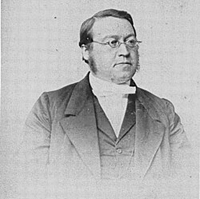
The Evidence:
1. The Disorderly Argument: Trumpp complained that the Granth was arranged by Raag (musical
measure rather than logical"western topics. This was a deliberate attempt to hide the fact that the Granth is a vibrational manual, not just a book of stories.
2. The Tobacco Provocation: Historically, it's noted he blew tobacco smoke over the Saroop (the physical volume) while translating. This wasn't just a lack of manners; it was a psychological power move to show that the
state (Britain) stood above the sacred (The Guru).
3. The Nanak vs. Gobind Split: Trumpp was among the first to heavily push the narrative that Guru Nanak was a
pacifist and Guru Gobind Singh changed the religion. We now know this was a divide-and-rule tactic to strip the Sant-Sipahi
(saint-soldier) duality from the Sikh psyche, even though what he stated was true.
The massive logical hole that Trumpp and the Victorian
scholars tried to hide.
If the Sikh core doctrine is Bani Guru, Guru Hai Bani (The Word is the Guru, and the Guru is the Word), then the logic must be consistent from the 1st Guru to the 10th. If they were different
types of people, the Bani would have changed. It didn't.
Here is the breakdown of that contradiction:
1. The Pacifist Myth vs. Babar Vani
Trumpp’s narrative ignores Guru Nanak’s Babar Vani (Ang 360). Guru Nanak didn't justwitness" the invasion; he launched a verbal surgical strike against the Emperor Babur, calling him a
Messenger of Death and slamming the Islamic elite for their cowardice.
The Fact: A true pacifist (in the Western, passive sense) stays silent to avoid conflict. Guru Nanak confronted the most powerful man on earth. That is the Sipahi (Soldier) spirit in its purest, mental form.
The Shastar (Weapon) as Bani
If Guru Gobind Singh is the same light as Guru Nanak, then the Kirpan is simply the physical manifestation of Guru Nanak's Words.
Guru Nanak used the shabad (sound-weapon) to cut through ego.
Guru Gobind Singh used the shastar (steel-weapon) to cut through tyranny.
The Contradiction: By splitting them, Trumpp tried to claim the
steel was a corruption of the word. But in Vedic physics, vibration (sound) precedes
matter (steel). They are the same energy at different densities.
The Change Narrative as a Disarming Tool
The British pushed the Nanak = Pacifist story because it made the population easier to manage. If you believe your founder was a
quietist who just sang songs, you feel guilty or confused when you have to pick up a sword.
The Trumpp Sabotage: He tried to make the sant (saint) and sipahi (soldier) fight each other inside the Sikh mind.
The 1699 Signature
Guru Gobind Singh didn't start something new; he sealed the 200-year-old process. When he called for
Five Heads, he was testing the Commitment to the Word that Guru Nanak had preached.
The Next Strike: The Pacifist Gaslighting (1877)
Now that we've established they are the same light, let's look at how Trumpp specifically tried to gaslight the community with his 1877 translation.
He wrote that Guru Nanak’s religion was a formless, vague thing that would have
died out if Guru Gobind Singh hadn't transformed it into a military sect.
The Logic against this:
1. The Vague Label: By calling Guru Nanak’s philosophy vague, he was trying to erase the Vedic precision of the Gurmukhi script. If it’s
vague, then the British rational mind is needed to explain it.
2. The Military Sect Label: By calling the Khalsa a military sect, he stripped away the Sovereignty (Raj). He wanted the British to see Sikhs as
brave soldiers (hired help) rather than Sovereign Kings (Patshah).
The Question for the reader:
If the British succeeded in making Sikhs believe Guru Nanak was a "pacifist," they effectively turned the Kirpan into a
relic rather than a tool of
Dharam.
Here is the cold, hard biological realiy of that Nepotism vs. Light transition:
1. The Meritocratic Era (Guru 1 to 3)
Guru Nanak rejected his own sons (Sri Chand and Lakhmi Das) because they didn't meet the
standards. He chose Bhai Lehna (Guru Angad)—a complete outsider. Guru Angad then chose Guru Amar Das (another outsider).
The Fact: For the first 100 years, the Guru was a functional office earned through merit, not a DNA inheritance. This proves the Bani (The Word) was the only authority.
The Sodhi Bloodline Lockdown (Guru 4 onwards)
The shift happens with Guru Ram Das (the 4th Guru). He was the son-in-law of the 3rd Guru. From his son, Guru Arjan (the 5th), the title becomes hereditary within the Sodhi family.
The Nepotism Anaysis: To an outsider, it looks like a
family business (the Sodhi clan).
The Internal Defense: The tradition claims the Light (Joti) simply stayed within one vessel to protect the institutional stability as the Mughal persecution ramped up.
The Allegiance Paradox
Why would they have allegiance to Nanak over Gobind (his direct blood descendant)?
The Legal Truth: Because without Nanak’s Patents/Foundation, the 10th Guru has no
Title Deed. If Guru Gobind Singh is different from Nanak, then he is just another warlord.
The Bani Logic: By keeping the 1st Guru’s Bani at the very front of the Adi Granth, the later Gurus (who were related by blood) were constantly submitting their physical bodies to the 1st Guru’s non-biological
word. It was their way of saying, "The Blood doesn't matter; the bani does."
The Colonial Trap
The British loved the bloodline narrative. Why? Because they understood Dynasties. They could treat the Gurus like
Princely States or Kings they could negotiate with.
Trumpp's Sabotage: He tried to emphasise the Family aspect to make it look like a Middle-Aged
feudal sect rather than a global sovereignty.
Trumpp Had A Very Low Option On Guru Nanak & Pretty Much Decimates Him, As Some Charlatan
(book extracts)
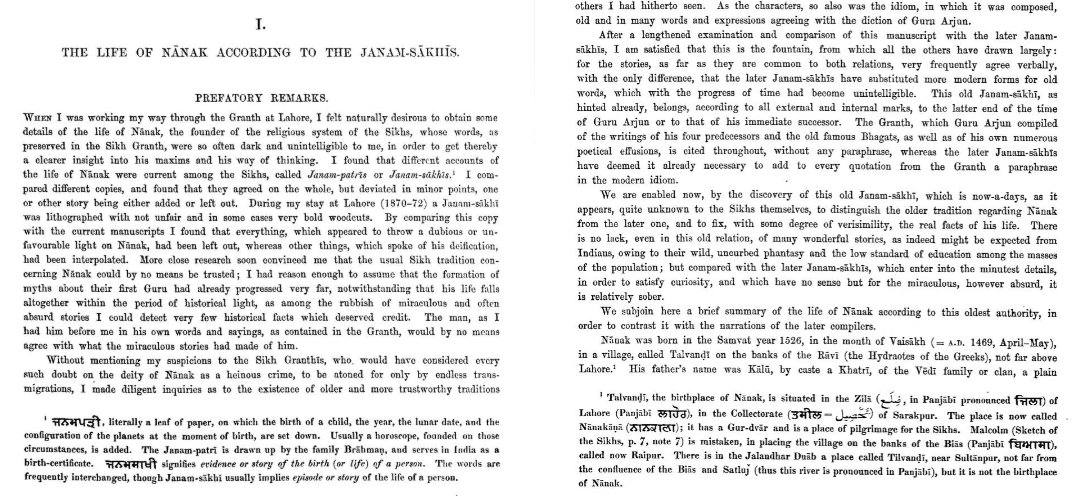
"When I -was working my way through the Granth at Lahore, I felt naturally desirous to obtain some details of the life of Nanak, the founder of the religious system of the Sikhs, whose words, as preserved in. the Sikh Granth, were so often dark and unintelligible to me, in order to get thereby a clearer insight into his maxims and his way of thinking. I found that different
accounts of the life of Nanak were current among the Sikhs, called Janam-patris or Jamm-sahhis.'- I compared different copies, and found that they agreed on the whole, but deviated in minor points, one or other story being either added or left out. During my stay at Lahore (1870-72) a Janara-saklu was lithographed with not unfair and in some cases very bold
woodcuts. By comparing this copy with the current manuscripts I found that everything, which appeared to throw a dubious or
unfavorable light on Nanak, had been left out, whereas other things, which spoke of his deification, had been interpolated.
More close research soon convinced me that the usual Sikh tradition concerning Nanak could by no means be trusted;
I had reason enough to assume that the formation of myths about their first Guru had already progressed very far, notwithstanding that his life falls altogether within the period of historical light, as among the rubbish of miraculous and often absurd stories I could detect very few historical facts which deserved
credit. The man, as I had him before me in his own words and sayings,
as contained in the Granth, would by no means agree with what the miraculous stories had made of him.
Without mentioning my suspicions to the Sikh Granthls, who. would have considered every such doubt on the deity of Nanak as a heinous crime, to be atoned for only by endless transmigrations, I made diligent inquiries as to the existence of older and more trustworthy traditions regarding tlie life of Nanak. I applied to different persons, who, I had heard, were in possession of old Gurmukhi manuscripts, in order to get Janam-sakhls of Nanak, but all my efforts proved in vain, none but the usual compilations being forthcoming.
After my return to Europe in 1872, some manuscripts of the Grauth were forwarded to me from the India Office Library, for the prosecution of my labours, and to these some other Gurmukhi manuscripts were added, in the expectation that the one or the other might prove useful in my researches. In looking them over, I found an old manuscript, partly destroyed by white ants, the early characters of which, resembling those of the old copy of the Granth, preserved at Kaitarpur, and signed by Guru
Arjun himself, at once caught my eye. On the first leaf it contained in Sanskrit letters the short title, ^ qil, A book of
Nanak, referring to his birth {or life). The copy had been presented to the Library of the East India House, according to the entry on the first leaf, by the famous H. T. Colebrooke, without his being aware, as it appears, of the contents of the book. As soon as I commenced to read the book, I observed with great pleasure, that this was a description of the life of
Nanak quite different from all the others I had hitherto seen. As the characters, so also was the idiom, in which it was composed, old and in many words and expressions agreeing with the diction of Guru
Arjun.
After a lengthened examination and comparison of this manuscript with the later Janamsakhls, I am satisfied that this is the fountain, from which all the others have drawn
largely: for the stories, as far as they are common to both relations, very frequently agree verbally, with the only
difference, that the later Janam-sakhls have substituted more modern forms for old words, which with the progress of time had become unintelligible. This old Janam-sakhI, as hinted
already, belongs, according to all external and internal marks, to the latter end of the time of Guru Arjun or to that of his immediate successor. The Granth, which Guru
Arjun compiled of the writings of his four predecessors and the old famous Bhagats, as well as of his own numerous poetical effusions, is cited throughout, without any paraphrase, whereas the later Janam-sakhls have deemed it already necessary to add to every quotation from the Granth a paraphrase in the modern idiom.
"We are enabled now, by the discovery of this old Janam-sakhi, which is now-a-days, as it appears, quite unknown to the Sikhs themselves, to distinguish the older tradition regarding
Nanak from the later one, and to fix, with some degree of verisimility, the real facts of his life. There is no lack, even in this old relation, of many wonderful stories, as indeed might be expected from Indians, owing to their wild, uncurbed
fantasy and the low standard of education among the masses of the population; but compared with the later Janam-sakhls, which enter into the minutest details, in order to satisfy curiosity, and which have no sense but for the miraculous, however absurd, it is relatively sober.
We subjoin here a brief summary of the life of Nanak according to this oldest authority, in order to contrast it with the narrations of the later compilers.
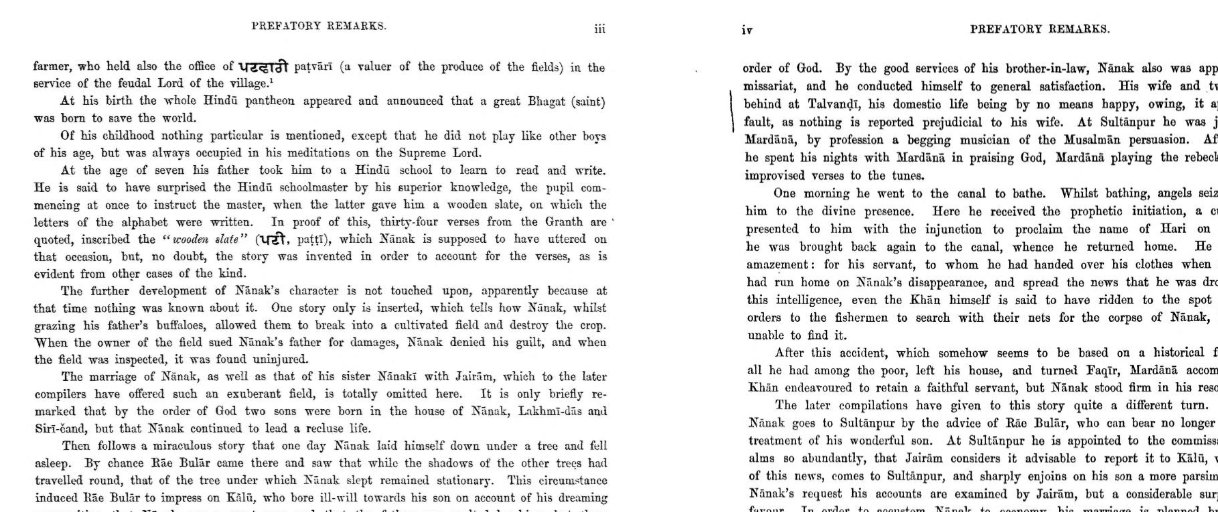
Nanak was born in the Samvat year 1526, in the month of Vaisakh (= a.d. 1469, April-May), in a village, called Talvandl on the banks of the Ravi (the Hydraotes of the Greeks), not far above Lahore.' His father’s name was Kalu, by caste a Khatrl, of the VedI family or clan, a plain
farmer, who held also the ofdce of patvarl (a valuer of the produce of the fields) iu the
service of the feudal Lord of the village.'
At his birth the whole Hindu pantheon appeared and announced that a great Bhagat (saint) was
born to save the world.
Of his childhood nothing particular is mentioned, except that he did not play like other hoys of his age, hut was always occupied in his meditations on the Supreme Lord.
At the age of seven his father took him to a Hindu school to learn to read and write.
He is said to have surprised the Hindu schoolmaster by his superior knowledge, the pupil
commencing at once to instruct the master, when the latter gave him a wooden slate, on which the letters of the alphabet were written. In proof of this, thirty-four verses from the Granth are quoted, inscribed the “ wooden slate ” (TfzV,
pattt), which
Nanak is supposed to have uttered on that occasion, but, no doubt, the story was invented in order to account for the verses, as is evident from other cases of the kind.
The further development of Nanak’s character is not touched upon, apparently because at that time nothing was known about it. One story only is inserted, which tells how
Nanak, whilst grazing his father’s buffaloes, allowed them to break into a cultivated field and destroy the crop.
"When the owner of the field sued Nanak’s father for damages, Nanak denied his guilt, and when
the field was inspected, it was found uninjured.
The marriage of Nanak, as well as that of his sister Nanaki with Jairam, which to the later compilers have offered such an exuberant field, is totally omitted
here. It is only briefly remarked that by the order of God two sons were
born in the house of Nanak, Lakhml-das and Sri-cHand, but that nanak continued to lead a recluse life.
Then follows a miraculous story that one day Nanak laid himself down under a tree and fell asleep. By chance
Rae Bular came there and saw that while the shadows of the other trees had travelled round, that of the tree under which
Nanak slept remained stationary. This circumstance induced Rae Bular to impress on
Kalu, who bore ill-will towards his son on account of his dreaming propensities, that
Nanak was a great man and that the father was exalted by him; but these words made no impression on Kalu’s mind, who slightingly answered, that the things of God only God knew. The later Janam-sakhls have embellished and enlarged this story by adding another miracle, that a large black snake expanded its hood over Hanak in order to protect him from the glowing rays of the sun.
Then it is stated expressly, that Nanak always kept company with Faqlrs and w'as averse to any earnest labour or calling, which greatly alarmed his family, who would not recognize his divine calling, and especially his worldly-minded father Kalu, whom the narrators seem to take a secret pleasure in describing as a miser.
His family at last considered him a lunatic and began to mourn this
calamity.’ At the instigation of the relatives a physician was called, but
do could do nothing, Nanak showing himself the cleverer of the two.
It is very significant, that this whole circumstance is carefully passed over in the later Janamsakhis, as every other point which throws an unfavourable or doubtful light on Nanak.
At last his parents sent Nanak to Sultanpur, to his brother-in-law Jairam, who held an appointment in the commissariat of Kavab Daulat Khan. They probably despaired of bringing him into an orderly course of life at home ; but according to the original text, he was sent by the order of God. By
tle good services of his brother-in-law, Nanak also was appointed to the commissariat, and he conducted himself to general satisfaction. His wife and two children he left I behind at Talvandi, his domestic life being by no means happy, owing, it appears, to his own j fault, as nothing is reported prejudicial to his wife. At Sultanpur he was joined by a certain Mardana, by profession a begging musician of the Musalman persuasion. After his daily work he spent his nights with Mardana in praising God, Mardana playing the rebeck, whilst he himself improvised verses to the tunes.
One morning he went to the canal to bathe. Whilst bathing, angels seized him and carried him to the divine presence.
Here he received the prophetic initiation, a cup of nectar being presented to him with the injunction to proclaim the name of Hari on earth. After this he was brought back again to the canal, whence he returned home. He was received with
amazement : for his servant, to whom ho had handed over his clothes when entering the water,
had run home on Nanak’s disappearance, and spread the news that he was drowned. On hearing this intelligence, even the
Khan himself is said to have ridden to the spot and to have given orders to the fishermen to search with their nets for the corpse of Nanak, but they had been unable to find it.
After this accident, which somehow seems to be based on a historical fact, Nanak divided all he had among the poor,
left his house, and turned Faqlr, Mardana accompanying him. The Khan endeavoured to retain a faithful servant, but Nanak stood firm in his resolution. _
The later compilations have given to this story quite a different turn. According to them
Nanak goes to Sultanpur by the advice of Kae Bular, who can bear no longer Kalu’s disrespectful
treatment of his wonderful son. At Sultanpur he is appointed to the commissariat. But he gives alms so abundantly, that Jairam considers it advisable to report it to Kalu, who, in consequence of this news, comes to Sultanpur, and sharply enjoins on his son a more parsimonious conduct. At Nanak’s request his accounts are examined by Jairam, but a considerable surplus appears in his favour. In order to accustom Nanak to economy, his marriage is planned by Jairam at Kalu’s request, and this is described in full detail.
But notwithstanding his married state Nanak continues his former habits of giving lavish alms, which leads to domestic quarrels and the interference of his
parents-in-law. This is very graphically described, the later compilers here apparently feeling very sure of the ground under their feet.
To the story of the bath in the canal, which could not quite be set aside, a different turn is given. Nanak’s initiation into the Guruship is not mentioned (though this is the very
turning point of the whole story), as according to these later compilations Nanak has entered the world as Araiar, as the Formless one himself. It is therefore related, that one of the Govind-faqirs advised him to bathe in the river daily, in order to cure himself of a liver-complaint. One day Nanak, whilst taking a bath, was lost in the river. On this the rumour was spread that Nanak had been guilty of embezzlement. When he reappeared after three days (it is not even hinted where he was during those three days), the Khan ordered an inquiry to be made into his accounts, but it turned out that 760
rupees were due to him, which Nanak would not accept, hut taking his discharge retired into the wilderness, leaving his wife and children behind.
As it appears, Nanak stayed at first in the vicinity of Sultanpur. His first saying, which made some noise amongst the people, was: There is no Hindu and no Musalman, but this
brought upon him again the charge of madness. At the instigation of the Kazi the Navab Daulat Khan summoned him to his presence in order to interrogate him about this new doctrine. It was just the time of noonday-prayer and the Khan invited Nanak to accompany him to the mosque. The KazI said prayers, but Nanak, instead of listening devoutly, began to laugh. Prayers being over the
Kazi complained of the irreverent conduct of Nanak. Being called to account by the Khan he replied, that he laughed, because the prayers of the Kazi were nugatory. Being asked for a nearer explanation he continued, that the KazI had left a foal in his courtyard,
in which there was an open well; and that whilst saying prayers his thoughts were always wandering hack to the foal, lest it should fall into the well. On this the
Kazi fell down at Nanak’s feet and confessed that it was true. Nanak rose at once in the estimation of all, and the Khan dismissed him
graciously. He now commenced wandering about the country, accompanied by Mardana, the musician.
Tip to this point both relations agree, at least in substance, though the later compilations, out of love for the miraculous, strive hard to exaggerate everything into the supernatural. But with the commencement of the wanderings of
Nanak nearly all points in common cease and the old and the later tradition diverge in such a manner that they cannot be reconciled. This proves
sufficiently, either that very little was known about them or that very little could be said about
them, as the old Janam-sakhi testifies. The later tradition, which pretends to have a knowledge of all the details of the life of Nanak, was therefore compelled to put forth as voucher for its sundry tales and stories Bhai Bala, who is said to have been the constant companion of Nanak from his youth up, whereas our old Janam-sakhi does not even once mention Bhai Bala, though at every new wandering of Nanak it gives the names of his companions. If Bhai Bala had been the constant companion of Nanak and a sort of mentor to him, as he appears now in the current Janam-sakhls, it would be quite incomprehensible, why never a single allusion should have been made to him in the old tradition.
We will now briefly sum up here, what the old Janam-sakhi has to say about the further life of Nanak.
His first wandering is said to have been to the east. There he came to a certain Shekh Sajan, who had built a temple for Hindus and a mosque for Muhammadans. He received all who came to him, with ostensible friendliness, but murdered them, whilst sleeping, and plundered their goods. Nanak got quickly at the bottom of his rascality and convinced him of his sinful life, which brought him to repentance.
At Delhi he is said to have vivified a dead elephant. But when the then emperor, who had heard of this miracle, called on Nanak to kill the elephant and to vivify it in his presence, he prudently declined.
Also Thags, with whom he fell in on his way, he brought to repentance by his firm and intrepid conduct.
Other adventures, which he is narrated to have experienced, are so childish and nonsensical, ' that it is not worth while mentioning them.
At the capture of Sayyidpur he is reported to have been taken prisoner by the troops of Babar, but by a miracle he attracted the attention of Babar, who released him with the other prisoners. As Babar conquered the Panjab in 1524, a personal meeting of Nanak with Babar is not impossible,
but it is not very probable. For Nanak speaks in the Granth several times of the great calamities which at that time befell various cities of the Panjab ; Babar also is mentioned by him, hut no allusion whatever is made to his having come into personal contact with Babar.
The meetings and verbal contests with other Paqirs and Shekhs, which are described at full length, are in themselves very probable, but in other respects of no importance, except that they give some hints to the mental development of Nanak. After some lengthened wanderings Nanak retraced his steps to his home at Talvandi.
His unquiet spirit gave him no rest at home and he soon commenced his second wandering, which was directed to the
south. The incidents of this period also are of little consequence. That on this excursion he should have come to Ceyhn (Singhala dvipa), as is reported, is in the highest degree unlikely. The whole story is so mixed up with the miraculous, that it bears the stamp of fable on its front."
- Ernest Trumpp, "The Adi Granth: Or The Holy Scriptures Of The Sikhs" (1877)
Source: Adi Granth: Or The Holy Scriptures Of The
Sikhs (1877)
Ernest Trumpp
A German missionary and scholar commissioned by the India Office to translate the scripture
Available on: Amazon
Available online: Archive.org
Similar Topics
Sikhs: The Colonial Puppets Of The British Raj || Sikh Minority Card || Sikhism & Book Worship || Khalistan A Fools DreamShare Your Thoughts Below
No comments found.







Resend activation URL
Login | Register
Enter your email address in the field below and we'll send you an email with activation URL.