-
Sarve bhavantu sukhinah
Sarve santu nira-maya-ah
Sarve bhadrani pashyantu ma-kaschit dukha-bhak bhavet- Brihadaranyaka Upanishad: 1.4.14
-
“May all of mankind be happy May all be healthy
May all experience prosperity
May none (in the world) suffer.”- Brihadaranyaka Upanishad: 1.4.14
-
Asato Maa Sad Gamaya Tamaso Maa
Jyotir Gamaya Mrityor Maa Amritam Gamaya- Brihadaranyaka Upanishad: 1.3.28
-
“O' Lord, please lead me from darkness of ignorance
to the light (of knowledge) From death (limitation)
to immortality (liberation).”- Brihadaranyaka Upanishad: 1.3.28



This page has been viewed: times.
The Truth of The Charitropakhyan
EXPOSED: Dasam Granth - Deconstructing the Lustful Lie
Author: Kalki Kalyani
Editor: Akash_Vani
Date Published: Friday 6th June 2025
The Victorian Morality Filter: 19th-century British officers and missionaries couldn't handle the raw, psychological realism of the Charitropakhyan. They projected their own repressed
Victorian shame onto the Guru’s war-manual for the mind, mislabelling divine cautionary tales as
obscenity.
The Soldier-Making Sterilisation: The British wanted a tame soldier. A warrior who understands the depths of human deception (Chritars) is harder to manipulate than a soldier who has been
sterilised of his complex Indic
heritage.
The Modern Separatist Tool: Today’s half-baked worms use these colonial misreadings to claim the Dasam Granth isn't the Guru's work. By doing so, they strip the Guru of his role as a Maha-Kaal devotee—the master of time, death, and the destruction of ego
(Kaam).
The Shakti Rebuttal
The Charitropakhyan wasn't written for the lustful; it was written to arm the Khalsa against the world's deceptions.
Weaponised Psychology: Just as a soldier learns to dismantle a rifle, the Guru taught the Khalsa to dismantle the
traps of the mind.
Sanatan Source Code: These 404 tales are a direct continuation of the Indic tradition of Updesh (instruction), using worldly examples to elevate the soul to Nirvair (fearlessness).
The Obscenity Trap (Victorian Morality) The primary lie used to discredit the Charitropakhyan is the claim that it is vulgar or pornographic..
The Lie: British translators like Ernest Trumpp viewed the Dasam Granth through a lens of Victorian Prudery. Unable to understand the Guru’s psychological warfare, they dismissed these tales as indecent and depraved.
The Goal: To make the Guru's writings appear un-Sikh by Western moral standards, forcing a sterilised version of the faith that was easier for the British to manage.
Quote: "Nanak himself was by no means an independent thinker...He followed in all essential points the common Hindu philosophy... whose writings were composed in the vulgar tongue."
— Ernest Trumpp, 1877 (Colonial Missionary/Linguist)
The Benti Chaupai Connection
The Truth: Detractors conveniently ignore that the most beloved Sikh prayer, Benti Chaupai, is actually the conclusion (405th tale) of the Charitropakhyan.
The Strike: If the 93% is rejected, then why do they still recite the prayer that comes from the heart of the rejected text? You can't have the Protection (Chaupai) without acknowledging the Dangers (Chritars) the Guru warned us about.
The Authorship Denial (The Separatist Tool) Modern detractors—often influenced by 19th-century Singh Sabha purges—claim the Guru didn't write the Dasam Granth.
The Lie: They claim that 93% of the material (including the Charitropakhyan) was added later by Brahminical poets to corrupt the Sikh faith.
The Goal: By denying authorship, they can throw out the Guru’s Indic roots and his Kshatriya (warrior) philosophy, isolating the Khalsa from its broader civilizational context.
— Source: Ernest Trumpp (Colonial Translator)The War Manual for the Mind
The Truth: These 404 tales are a Psychological Armoury. A warrior must know how a spy, a traitor, or a seducer thinks.
The Strike: The Guru didn't write "obscenity"; he wrote Counter-Intelligence. He was arming a young Khalsa army against the
wiles of the world so they wouldn't be destroyed by ego, lust, or treachery on or off the battlefield.
The Lustful Man Slander: This is the most direct attack on the Guru’s character, often found in online wiki dribble.
The Lie: Because the Guru wrote about the wiles of men and women (Chritars), detractors argue he must have been obsessed with lust.
The Goal: To reduce a divine military strategist to a lustful poet, effectively stripping the Saint-Soldier of his Saint half and making him look like an ordinary, flawed man.
— Source: Modern Separatist Narrative
The British Tried To Downgrade The Gurus Into Mere
Translators Of Kabir To Justify Their Later Orthodoxy Filter.
(Below, extracts from Ernest Trumpp's book)
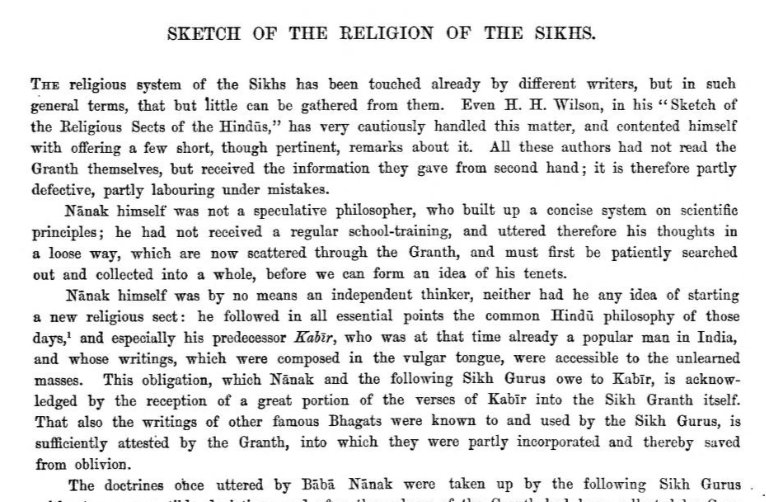
"The religious system of the Sikhs has been touched already by different writers, but in such general terms, that but little can he gathered from them. Even H. H. Wilson, in his “Sketch of the Religious Sects of the Hindus,” has very cautiously handled this matter, and contented himself with offering a few short, though pertinent, remarks about it. All these authors had not read the Granth themselves, but received the information they gave from second hand ; it is therefore partly defective, partly labouring under mistakes.
Nanak himself was not a speculative philosopher, who
built up a concise system on scientific principles; he had not received a regular
school-training, and uttered therefore his thoughts in a loose way, which are now scattered through the Granth, and must first be patiently searched out and collected into a whole, before we can form an idea of his tenets.
Nanak himself was by no means an independent thinker, neither had he any idea of starting a new religious sect : he followed in all essential points the common Hindu philosophy of those
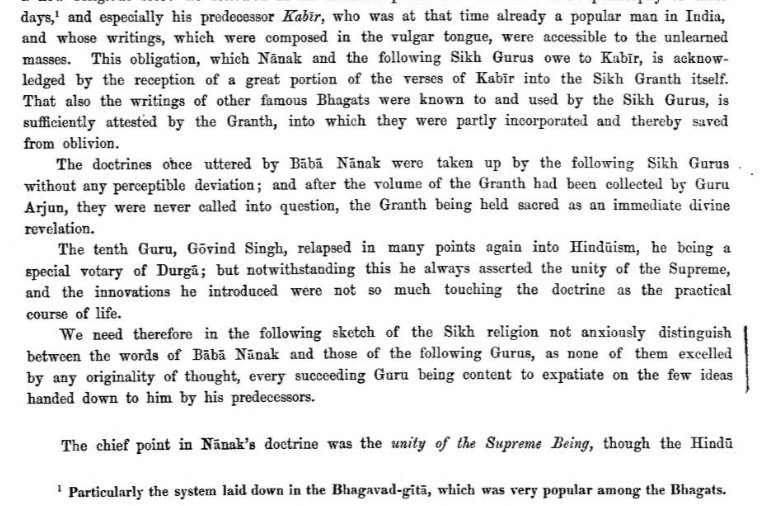
days,* and especially his predecessor Kahir, who was at that time already a popular man in India, and whose writings, which were composed in the vulgar tongue, were accessible to the unlearned masses. This obligation, which
Nanak and the following Sikh Gurus owe to Kabir, is acknowledged by the reception of a great portion of the verses of Kabir into the Sikh Granth itself. That also the writings of other famous Bhagats were known to and used by the Sikh Gurus, is
sufficiently attested by the Granth, into which they were partly incorporated and thereby saved from oblivion.
The doctrines once uttered by Baba Nanak were taken up by the following Sikh Gurus without any perceptible deviation; and after the volume of the Granth had been collected by Guru Aijun, they were never called into question, the Granth being held sacred as an immediate divine revelation.
The tenth Guru, Govind Singh, relapsed in many points again into Hinduism, he being a special votary of Durga; but notwithstanding this he always asserted the unity of the Supreme, and the innovations he introduced were not so much touching the doctrine as the practical course of life.
"We need therefore in the following sketch of the Sikh religion not anxiously distinguish between the words of Baba
Nanak and those of the following Gurus, as none of them excelled by any originality of thought, every succeeding Guru being content to expatiate on the few ideas handed down to him by his predecessors."
- Ernest Trumpp, "The Adi Granth: Or The Holy Scriptures Of The Sikhs" (1877) Page 110
Source: "Adi Granth: Or The Holy Scriptures Of The
Sikhs" (1877) Page 110
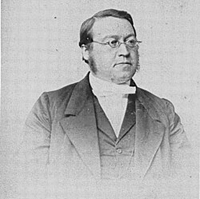
Ernest Trumpp
A German missionary and scholar commissioned by the India Office to translate the scripture
Available on: Amazon
Available online: Archive.org
By calling Guru Nanak "by no means an independent thinker,"
Trumpp was laying the groundwork to treat the Sikh faith as a colonial "subset" that they could then "reform" into the Soldier-Making machine.
The British used the term "vulgar tongue" to dismiss the Sanatan Source Code (the language of the people).
They couldn't handle the raw, divine power of the Bhasha, so they labeled it "crude" to justify their own "Orthodoxy Filter."
Similar Topics
Sikhs: The Colonial Puppets Of The British Raj || Sikh Minority Card || Sikhism & Book Worship || The Genius Of British Psychological WarfareShare Your Thoughts Below
No comments found.







Forgot password
Login | Register
Type in your email below, which you registered with. Your password will be automatically reset and sent to you.