-
Sarve bhavantu sukhinah
Sarve santu nira-maya-ah
Sarve bhadrani pashyantu ma-kaschit dukha-bhak bhavet- Brihadaranyaka Upanishad: 1.4.14
-
“May all of mankind be happy May all be healthy
May all experience prosperity
May none (in the world) suffer.”- Brihadaranyaka Upanishad: 1.4.14
-
Asato Maa Sad Gamaya Tamaso Maa
Jyotir Gamaya Mrityor Maa Amritam Gamaya- Brihadaranyaka Upanishad: 1.3.28
-
“O' Lord, please lead me from darkness of ignorance
to the light (of knowledge) From death (limitation)
to immortality (liberation).”- Brihadaranyaka Upanishad: 1.3.28



This page has been viewed: times.
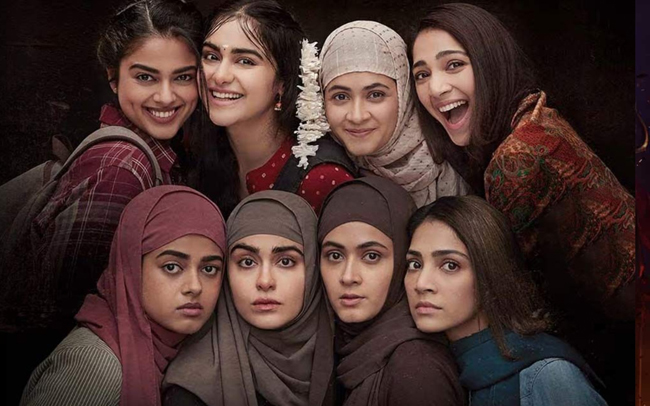
Hindu Population In Pakistan Has Significantly Shrunk.
Hindus Forcefully Converted To Islam Or
Killed.
Author: Kalki Kalyani
Editor: Akash_Vani
Date Published: Wednesday 17th April 2024
While the hypocritical jihadi world is busy crying over minorities rights in India, Hindus are being persecuted in Pakistan and Bangladesh.
The Muslim population has rapidly grown in India since 1947.
The Hindu population is being systematically erased in Pakistan since 1947.
The world is silent.
Jihadi appeasers are silent.
A sane "rational" person should be asking, where have all the Hindus gone?
Raw Facts
A forensic examination of official census data exposes the profound double standard of transnational propaganda. In independent India, the Muslim population has steadily grown from 9.8% in 1951 to over 14.2% today, expanding both in absolute numbers and total demographic share. Conversely, the indigenous Hindu minorities in the broken fragments of the subcontinent have faced systematic erasure. In Pakistan, the Hindu population plummeted from a pre-Partition baseline of over 14% down to a restricted 1.6% today. In Bangladesh, the Hindu frequency was siphoned down from 23.2% in 1950 to a mere 8% today. The data proves that while minority populations thrive under the native cradle of Bharat, indigenous majorities are systematically forcefully converted to Islam, persecuted, raped and killed across its borders.
The Inversion of Muslim Persecution Narratives: The SOAS article frames the native majority in India as practitioners of systematic erasure. However, the hard mathematics prove that India is the only nation in the fractured subcontinent where the primary Muslim minority population GREW (Pew research) consistently in total percentage share since Partition. Persecuted populations do not grow.
The Missing Millions Baseline: In Pakistan and Bangladesh, the indigenous Hindu population was crushed by administrative overwrites and physical displacement. By failing to account for these missing millions while critiquing India, Western scholastic institutions commit active data manipulation.
"Growth rates have declined for all of India’s major religious groups, but the slowdown has been more pronounced among religious minorities, who outpaced Hindus in earlier decades. Between 1951 and 1961, the Muslim population expanded by 32.7%, 11 percentage points more than India’s overall rate of 21.6%. But this gap has narrowed. From 2001 to 2011, the difference in growth between Muslims (24.7%) and Indians overall (17.7%) was 7 percentage points. India’s Christian population grew at the slowest pace of the three largest groups in the most recent census decade – gaining 15.7% between 2001 and 2011, a far lower growth rate than the one recorded in the decade following Partition (29.0%).
In absolute numbers, all of the country’s largest religious groups are still gaining millions (tens of lakhs) of adherents. In the most recent decade between censuses, Hindus added 138 million (13.8 crore) people, while Muslims grew by 34 million (3.4 crore). India’s total population increased by nearly 200 million (2o crore) in that time, from about 1 billion (100 crore) in 2001 to 1.2 billion (120 crore) in 2011."
Systematic Discrimination of Hindus in Pakistan
Source One:
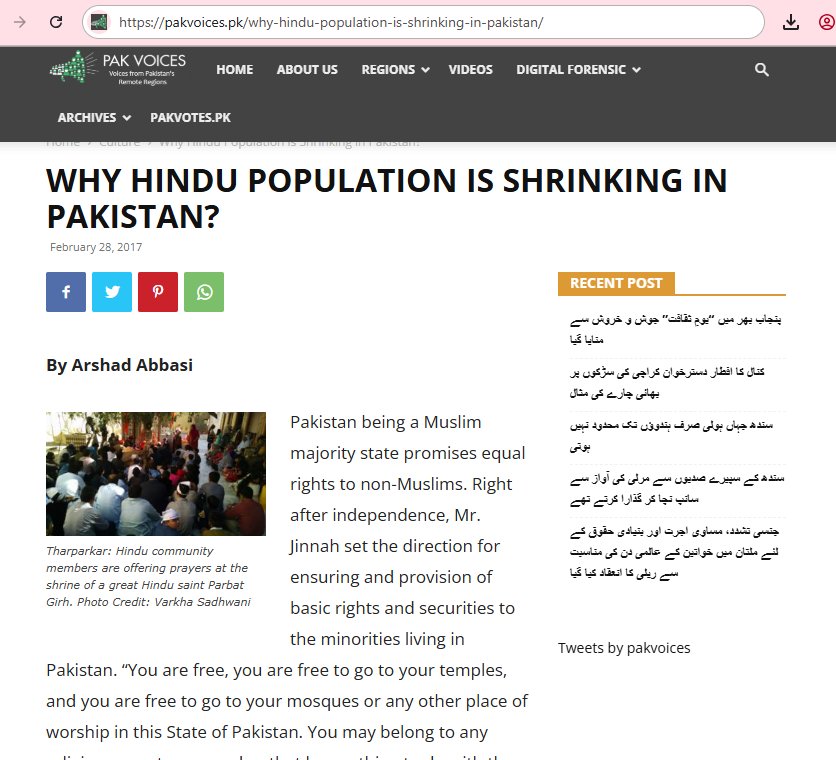
"Pakistan being a Muslim majority state promises equal rights to non-Muslims. Right after independence, Mr. Jinnah set the direction for ensuring and provision of basic rights and securities to the minorities living in Pakistan. “You are free, you are free to go to your temples, and you are free to go to your mosques or any other place of worship in this State of Pakistan. You may belong to any religion or caste or creed — that has nothing to do with the business of the State,” uttered by Jinnah in his first speech to the Constituent Assembly in August 1947.
However, these words remain in the annals of the country’s history bereft of practical meaning and substance.
The focus of this piece of writing is on the Hindu minority albeit their condition can provide the context to assess the situation of other religious minorities.
Hindus constitute the largest non-Muslim group in the country. But today the number of this minority in Pakistan is decreasing and they are fleeing to other countries where their rights are better protected.
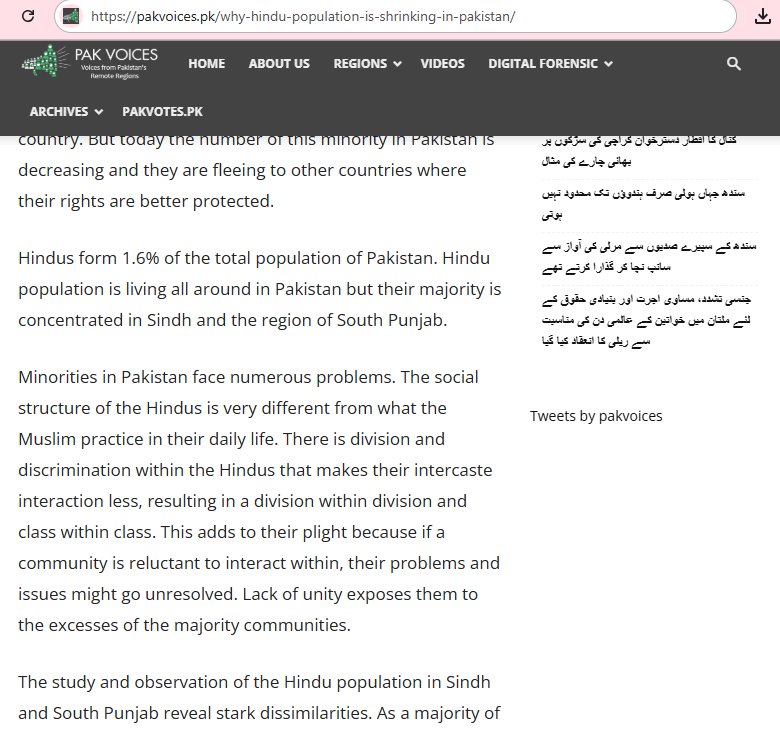
Hindus form 1.6% of the total population of Pakistan. Hindu population is living all around in Pakistan but their majority is concentrated in Sindh and the region of South Punjab.
Minorities in Pakistan face numerous problems. The social structure of the Hindus is very different from what the Muslim practice in their daily life. There is division and discrimination within the Hindus that makes their intercaste interaction less, resulting in a division within division and class within class. This adds to their plight because if a community is reluctant to interact within, their problems and issues might go unresolved. Lack of unity exposes them to the excesses of the majority communities.
The study and observation of the Hindu population in Sindh and South Punjab reveal stark dissimilarities. As a majority of the Hindu population is concentrated in the province of Sindh, there they have more resources in terms of education and employment as compare to the Hindus living in South Punjab.
Regarding the employment opportunities, the Hindu population in Sindh is gaining strength in terms of the economic resources for they are having more and better opportunities for employment.
However, the Punjab government has not been able to address the issues of the Hindu community in the South Punjab as effectively as ensured by its counterpart in Sindh.
One of the main causes of the Hindus concern is that forces conversion of their girls. The girls escape from house as a result of kidnapping, when they are found; they are forcefully married to some Muslim boy and converted to Islam. The judicial procedure has not been able to establish the truth of the conversion is the girl is with her new in-laws and there is pressure on her to give the public statement in accordance with what they say.
Sindh government has been more responsive towards protecting the right of the Hindus in their province. The declaration of the public holiday on Holi, the first province to pass the marriage bill regarding Hindu and other non-Muslim marriages and the clauses related to the conversion of Hindus are great step forward
The Hindu population forms a sizable minority in Sindh as they are in form of the clusters but the size of the Hindu population in the South Punjab is less and scattered ,which is one of the main reason of their being neglected at various levels.
The Hindus of South Punjab live in vulnerable precincts encircled by religious and sectarian zealots who exercise subtle pressure and domination on them. On the contrary, the Hindus living in Sindh have sizable population centres which provide them safety net against exploitation although the situation is not enviable for them. This is only in comparison with the Hindu minority living in other parts of the country.
Even at the political level, it is the Hindu representatives from Sindh who are able to make it to the corridors of power whereas the South Punjabi Hindu community remains under-represented due to the electoral map of the province.
South Punjab itself finds at odds with the rest of Punjab hence being treated as minority sub-provincial unit within Punjab. This deals a double blow to the Hindus living in the almost ghettoised clusters.
In Sindh, the Hindu minority is well-knit and closely tied to the majority communities in terms of facing problems and seeking their resolution.
What comes out of this comparison is that the Hindu community of South Punjab should learn from their brethren in Sindh about extracting favourable treatment from the government through affirmative action.
On its part, the Punjab provincial government needs to learn from the approach and actions of the Sindh government to bring the Hindus and other minorities at par with the rest of the citizenry.
The present state of affairs on this count is well described by an analyst Iqbal Mustafa in his book “Dysfunctional Democracy in Pakistan” “we have ignored the long term for so long that even now short term looks difficult”.
All is not yet lost, the provincial and central governments can take the right step in right direction to alleviate the situation for the minorities. The passage of the Hindu Marriage Bill by the Senate after the National Assembly is an encouraging development. Its enforcement in letter and spirit would be the litmus test of the authorities and a positive development for all the Minorities in general and Hindus in particular."
Source: www.pakvoices.pk
Source Two:
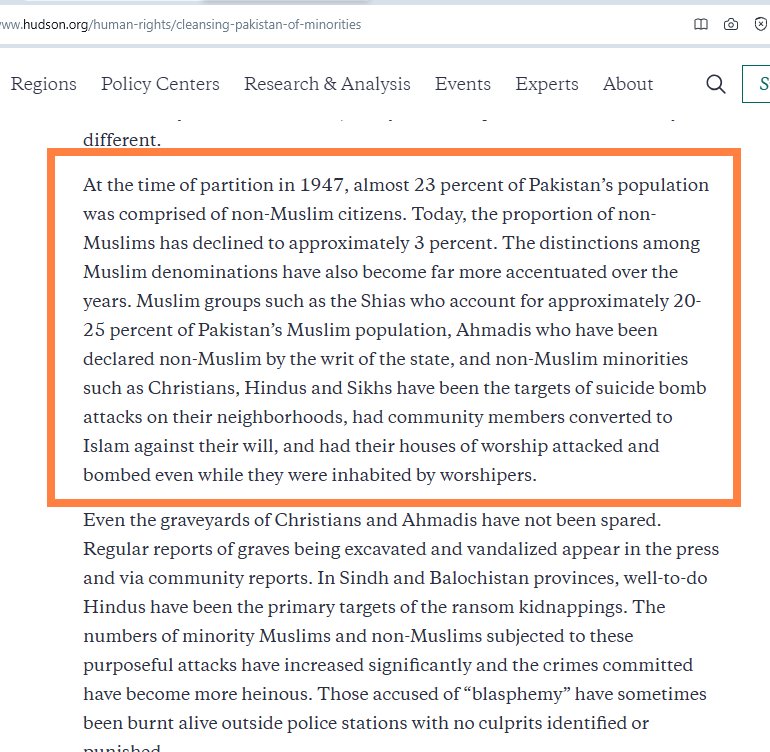
"At the time of partition in 1947, almost 23 percent of Pakistan’s population was comprised of non-Muslim citizens. Today, the proportion of non-Muslims has declined to approximately 3 percent. The distinctions among Muslim denominations have also become far more accentuated over the years. Muslim groups such as the Shias who account for approximately 20-25 percent of Pakistan’s Muslim population, Ahmadis who have been declared non-Muslim by the writ of the state, and non-Muslim minorities such as Christians, Hindus and Sikhs have been the targets of suicide bomb attacks on their neighborhoods, had community members converted to Islam against their will, and had their houses of worship attacked and bombed even while they were inhabited by worshipers.
Even the graveyards of Christians and Ahmadis have not been spared. Regular reports of graves being excavated and vandalized appear in the press and via community reports. In Sindh and Balochistan provinces, well-to-do Hindus have been the primary targets of the ransom kidnappings. The numbers of minority Muslims and non-Muslims subjected to these purposeful attacks have increased significantly and the crimes committed have become more heinous. Those accused of “blasphemy” have sometimes been burnt alive outside police stations with no culprits identified or punished."
Source: www.hudson.org
Muslim and Pakistani Apologetics:
By using the massive 1947 Partition exodus to explain away the low percentage of Hindus today, apologists try to create a historical shield to hide ongoing, modern-day atrocities.
The argument falls apart completely when looked at through the lens of human rights and real numbers.
The core logical flaw in that narrative is the assumption that an event that happened 80 years ago somehow prevents human rights abuses from happening today.
It is a historical fact that mass migration in 1947 caused the initial drop to roughly 1.6%.
However, using 1947 to justify the current situation completely ignores what has happened since then. The abduction of young girls, forced conversions, the systemic denial of basic legal rights, and the physical attacks on temples are happening right now, in the 2020s.
A historical migration does not give a pass to ongoing modern persecution.
The Case of the Ahmadiyya: Proving the Pattern
The argument is completely proven false by the fate of the Ahmadiyya Muslim community. Their numbers offer undeniable proof that systemic state-sponsored erasure is actively happening:
Unlike Hindus, the Ahmadi community did not migrate to India in 1947. They stayed in Pakistan, heavily supported the creation of the country, and their population was entirely intact post-Partition.
In 1974, the Pakistani state officially stepped in and passed a constitutional amendment declaring Ahmadis to be
"non-Muslims." In 1984, Ordinance XX made it a criminal offence for Ahmadis to call themselves Muslims, use Islamic greetings, or display Islamic symbols.
Because of this targeted, institutional persecution, the Ahmadi population has steadily shrunk, dropping to a mere 162,684 people (0.07%) in the 2023 census.
The Ahmadis did not leave in 1947; their decline is the direct result of decades of systematic legal, social, and physical persecution.
Weaponising the Absolute Growth Narrative:
When cornered with modern data, the narrative often shifts from "it all happened in 1947" to "but look, the absolute number of Hindus went up from 3.5 to 3.8 million in the latest census, so they aren't being wiped out."
Human rights groups point out that this is an incredibly cynical use of statistics:
If a community of 3.8 million people loses 1,000 young women a year to forced conversions and thousands more to quiet, forced emigration to India, the community is still experiencing an absolute tragedy.
Pointing to high birth rates to say "you are fine because you are still multiplying" is a deliberate attempt to mask the immense terror, trauma, and legal helplessness that these families live through every single day.
Bharat Is Not A Muslim Country
The Truth: It deliberately overwrites the deep-time identity of Bharat (भारत), a geographical and civilisational entity named after
Emperor Bharata in antiquity and explicitly written into
Article 1 of the Indian Constitution ("India, that is Bharat, shall be a Union of States").
"Name and Territory of the Union
(1) India, that is Bharat, shall be a Union of States.
(2) The States and the territories thereof shall be as specified in the First Schedule.
(3) The territory of India shall comprise —
(a) the territories of the States;
(b) the Union territories specified in the First Schedule; and
(c) such other territories as may be acquired."
Islam originated in the 7th century CE in the Arabian Peninsula; India is the native cradle of Vedic history and indigenous traditions. Labeling the restoration of indigenous history as
modern ethno-nationalism is a classic colonial-Islamic overwrite designed to strip native
Hindu populations of their ancestral continuity.
India's history (civilization) is over 5,000 years old.
The Geopolitical Double Standard (The 1947 & 1971 Fractures)
The article portrays any assertion of Hindu civilisational identity as an aggressive, exclusionary import.
The subcontinent was explicitly fractured along religious lines during the 1947 Partition to create Islamic states (Pakistan, which later split in 1971 to form Bangladesh). These states established Islam as the state religion, structurally cementing a demographic and theological monopoly.
The narrative exposes a deep psychological double standard: it validates the creation and existence of explicit Islamic states in the region, yet labels the native majority's desire to preserve the only global sanctuary for Vedic history as an existential threat.
The article establishes a rigid moral binary: unconditional solidarity with specific global conflicts (Palestine) dictates whether a native Hindu is categorised as good or nationalist.
It Was Hindu Nationalists Who Defended The Land And Fought Muslim Invaders: Dharmic Resistance Timeline (712–1849)
The Selective Human Rights Loophole (The Persecution Silence)
The narrative operates via deliberate omission. It maintains complete silence regarding the systemic cleansing and demographic collapse of indigenous minorities across the borders—specifically the
Kashmiri Hindu Pandits within India, and the native Hindu populations facing ongoing violence in Pakistan and Bangladesh.
By weaponising global political solidarity while completely ignoring
localised, real-world cleansing of indigenous Hindus, the article functions as a weapon of geopolitical displacement rather than objective human rights journalism.
The Erasure of Deep-Time Geography: Because the global infrastructure views Pakistan through a modern post-1947 lens, it ignores that this land is the literal birthplace of the Indus Valley Civilisation (Harappa & Mohenjo-daro) and ancient Vedic sites. The erasure of the people is structurally tied to the erasure of Vedic history.
The accusation that India’s border enforcement is inherently discriminatory collapses when evaluated against the geopolitical architecture of the 1947 Partition. The subcontinent was explicitly fractured to fulfill the demand for an exclusive Islamic homeland, resulting in the creation of Pakistan and Bangladesh. Today, the Citizenship (Amendment) Act (CAA) of 2019 serves as a specific, localised humanitarian window to fast-track naturalisation for heavily persecuted, displaced religious minorities (Hindus, Sikhs, Buddhists, Jains, Parsis, and Christians) from those specific theocratic states who entered India before 2014.
Excluding the majority demographic of Pakistan, Bangladesh, and Afghanistan from a refugee fast-track is a baseline sovereign necessity; individuals cannot claim state-sponsored religious persecution in nations where their faith is constitutionally enshrined as the state religion. Furthermore, despite the existence of over 50 sovereign Muslim-majority nations globally, regional demographic patterns show a massive, unidirectional flow of millions of illegal economic migrants moving out of these Islamic states and into Hindu-majority India. In Assam alone, this influx drove the Muslim demographic from 24.6% in 1951 to 34.22% in 2011.
Claiming A Sovereign Right To Illegally Infiltrate The Exact Indigenous Hindu Civilization That Was Partitioned
To Accommodate Their Separate Political Demands Is A Logical And Legal
Absurdity!
"As per latest census, Hindu are majority in Assam state. Hinduism constitutes 61.47% of Assam population. In all Hindu form majority religion in 18 out of 27 districts of Assam state. The data for 2025 & 2026 is under process and will be updated in few weeks.
Muslim Population in Assam is 1.07 Crore (34.22 percent) of total 3.12 Crore. Christian Population in Assam is 11.66 Lakhs (3.74 percent) of total 3.12 Crore.
Muslims plays important role in electoral of Assam state forming significant 34.22% of total population. Islam is followed with majority in 9 out of 27 districts."
Verification Authorities & Census Identifiers:
- [1] 1951 Baseline: Registrar General of India, Census of India, 1951, Vol. XII (Assam), Part II-A (Religious Distribution Matrices).
- [2] 2011 Baseline: Ministry of Home Affairs, Govt of India, Census of India 2011: Assam Religion-Wise Data Tables.
- [3] Linguistic & Migration Modeling: Saikia, N., Saha, A., & Bora, J. K., "Trends in population share by religion between 1951 and 2011 in Assam," Springer Demographic Ingest.
Similar Topics
Reverse Mass Migration || Reverse Mass Migration Mughal Comparison || Why Indian Immigrants Outperform in the US and UKShare Your Thoughts Below







B34VER
15-05-2026, 18:14+0 -0
3. The Judicial Intervention: The ruling came from the judicial branch, not the executive. A Supreme Court bench consisting of Justice Aftab Alam (a Muslim) and Justice Ranjana Desai issued the directive. It was Justice Aftab Alam who authored the order citing the Quran to note that the pilgrimage is only mandatory for those who can personally afford it, stating the subsidy was "best done away with."
Sounds about right (y) Good job.