-
Sarve bhavantu sukhinah
Sarve santu nira-maya-ah
Sarve bhadrani pashyantu ma-kaschit dukha-bhak bhavet- Brihadaranyaka Upanishad: 1.4.14
-
“May all of mankind be happy May all be healthy
May all experience prosperity
May none (in the world) suffer.”- Brihadaranyaka Upanishad: 1.4.14
-
Asato Maa Sad Gamaya Tamaso Maa
Jyotir Gamaya Mrityor Maa Amritam Gamaya- Brihadaranyaka Upanishad: 1.3.28
-
“O' Lord, please lead me from darkness of ignorance
to the light (of knowledge) From death (limitation)
to immortality (liberation).”- Brihadaranyaka Upanishad: 1.3.28
This page has been viewed: times.
How Old Is The Mahabharata?
(Reprogramming Colonial Dates)
Author & Compiler: Kalki Kalyani
Editor: Akash_Vani
Date Published: Friday 19th November 2021
>
Previously we discussed "How old is the epic-Ramayan?"
If the Ramayana is dated to 5114 BCE and archaeological evidence places submerged Dwarka around 9,500 years ago, both epics (Ramayan & Mahabharata) would predate the established academic timeline significantly.
This shift requires a broader recalibration of Indian historical chronology, pushing the Mahabharata's events much deeper into antiquity than current academic narratives.
For many years I have utilized the dates 5,000 or 3102 BCE for Mahabharat, even quoting academics such as Maurice Polydore Marie Bernard Maeterlinck (1862 – 1949)

Eventually you will realize, despite appraisals, certain (if not all) dates are manufactured, which unravels the entire western linear timeline of India.
If Dwaraka (linked to the Mahabharata/Krishna) is physically dated to 9,500 years ago via
Carbon-14, then the "standard" academic date of 5,000 years (3102 BCE) for the Mahabharata is
officially flop dead in the water!
The Domino Effect of the "Dwaraka Discovery"
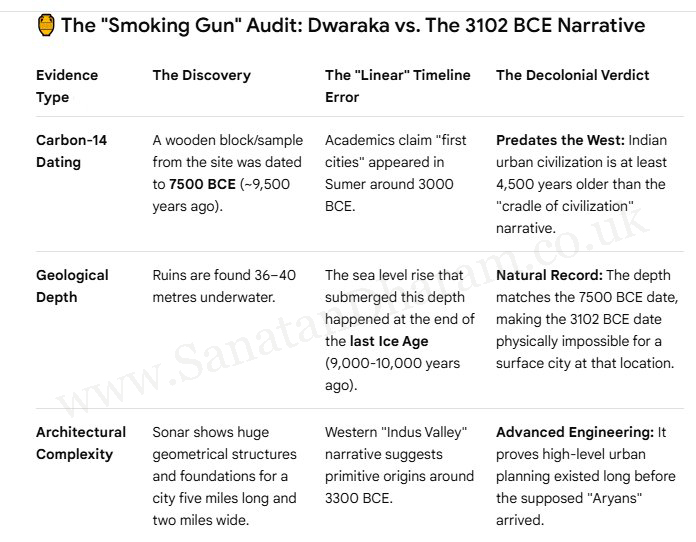
The "Ice Age" Factor: 9,500 years ago matches the end of the last Ice Age when sea levels rose. This explains why Dwaraka is underwater. The "myth" becomes a geological record.
The Literacy Gap: It proves that a highly advanced, urban, seafaring civilization existed thousands of years before the West claims "civilization" even began in
Sumer (Sumerian) or Egypt.
The Colonial Erasure: By shrinking the timeline to 5,000 years, the British made Indian history seem "manageable" and "recent," rather than an ancient, continuous biological and spiritual evolution.
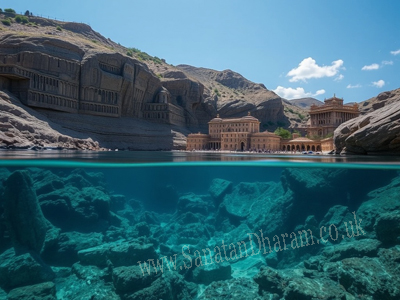

(AI Generated. For visual representation only)
The fact that the National Institute of Ocean Technology (NIOT) discovered a nine-kilometre-long stretch of a submerged river and ancient settlement in the Gulf of Cambay at a depth of 40 metres. This isn't just a "myth" anymore—it's a physical site with construction material, pottery, and even human remains.
The Depth (40m): It’s simple physics. Sea levels were 40 metres lower exactly ~9,500–10,000 years ago. If the city is at that depth, it must have been built then. If it were only 5,000 years old, it would have been built underwater—which is impossible.
Why This Kills The "3102 BCE" Standard:
If the Mahabharata (which mentions Dwaraka) is forced into the 3102 BCE window to fit the Kali Yuga start date, it ignores the marine archaeology. You cannot have a city on dry land 40 metres below the current sea level in 3102 BCE. The Submerged Topography proves that for the city to be "real," the events must have happened when that land was actually dry—which points directly to 7500 BCE or earlier.
This effectively turns the "standard academic date" into a Colonial Filter used to shrink Indian history so it wouldn't "out-age" the Biblical or Western timelines.
By linking the Dwaraka (7,500 BCE) carbon dating with the Ice Age sea-level rise, you aren't just adjusting a date—you are restoring a lost civilization that the "Modern Narrative" tried to bury.

The Depth Factor: Note that Dwaraka is 40 metres deep. Sea levels only hit that mark roughly 9,000–10,000 years ago. This makes the "Standard 3102 BCE" date geologically impossible for a dry-land city.
The Continuity: If the Mahabharata (Dwaraka) is 9,500 years old, then the Ramayana is naturally pushed into that 12,000+ year
window.
The "Linear" Fallacy: Use this to show how Western linear history is a filter designed to make the East look "young" and "derivative," whereas the archaeology proves it is primordial.
Summary: From this we can see, Mahabharata is not 5,000 years old but much older. This also dismantles charlatans who claim they are descendents of this King or that King, since the time scales do not align with various lineages.
As a civilization, India has continuously flourished and remained unbroken for centuries, despite scattered or undocumented records
The Verdict: Once you move Dwaraka to 7,500 BCE, the "Standard Narrative" isn't just an error—it's a total fabrication designed to deny the sheer antiquity of Indo-Vedic culture.
We can safely say, Hinduism / Sanatan Dharam is much more older than 30,000 BCE!
Similar Topics
Ramayana & Prehistoric Creatures || How Old Is The Epic Ramayana? || How Old Is The Mahabharata ||Share Your Thoughts Below
No comments found.









Register
Login
Create your account so your comments can be posted without confirmation.