-
Sarve bhavantu sukhinah
Sarve santu nira-maya-ah
Sarve bhadrani pashyantu ma-kaschit dukha-bhak bhavet- Brihadaranyaka Upanishad: 1.4.14
-
“May all of mankind be happy May all be healthy
May all experience prosperity
May none (in the world) suffer.”- Brihadaranyaka Upanishad: 1.4.14
-
Asato Maa Sad Gamaya Tamaso Maa
Jyotir Gamaya Mrityor Maa Amritam Gamaya- Brihadaranyaka Upanishad: 1.3.28
-
“O' Lord, please lead me from darkness of ignorance
to the light (of knowledge) From death (limitation)
to immortality (liberation).”- Brihadaranyaka Upanishad: 1.3.28



This page has been viewed: times.
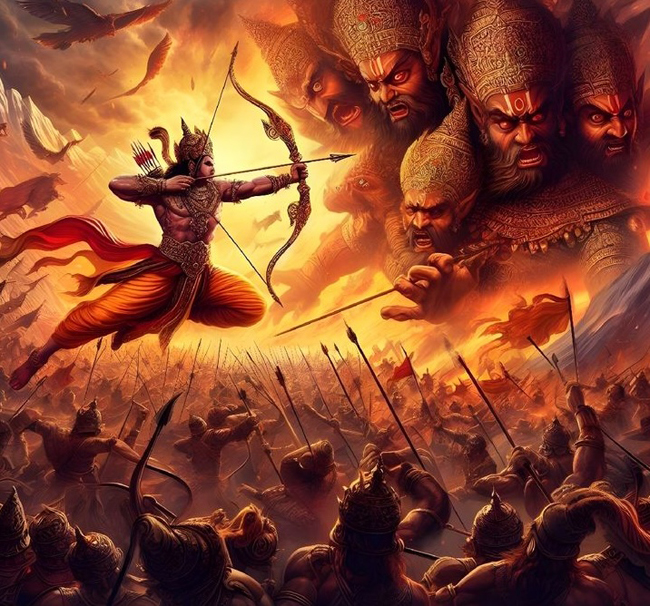
How old is The Ramayana?
Logical & Analytical Reasoning
Author & Compiler: Kalki Kalyani
Editor: Akash_Vani
Date Published: Thursday 18th November 2021
Do you feel confused or exhausted explaining the age of Ramayan? Are you someone who has doubts about Ramayan? Read on!
Many Hindus do feel overwhelmed or quibble when mentioning the Ramayana dates, mainly out of appeasement or shadowing western propaganda.
Secondly, the purposes of this analysis is not in any shape or form to insult or belittle the works of (1) Pushkar Bhatnagar & (2) Nilesh Nilkanth Oak.
Let's examine both schools of thought and strengthen your outlook.
Pushkar Bhatnagar claims Ramayan took place 5114 BC in his book Dating The Era of Lord Ram

(Above, Pushkar Bhatnagar & his book)
I FULLY DISAGREE!
This is an illogical mismatch that occurs, when researchers try to fit these epics into a compressed timeline. The date creates a massive conflict with the traditional and astronomical dates for the Mahabharata.
The Timeline Clash
If we accept 5114 BCE for the Ramayana and the traditional 3102 BCE (the start of Kali Yuga) for the
Mahabharata the gap is only about 2,000 years.
The Yuga Problem: Traditionally, the Ramayana happened in Treta Yuga and the Mahabharata at the end of
Dvapara Yuga.
In the Puranic time scale, the gap between these two yugas is hundreds of thousands of years.
The 5114 BCE Flaw: Critics like Nilesh Oak argue that 5114 BCE fails because it doesn't account for the precession of equinoxes, which changes how seasons align with lunar months over thousands of years.

(Above, Nilesh Nilkanth Oak)
The Pleistocene Alternative (12,209 BCE) (re-cap
here)
To reconcile the four-tusked elephants and the Ram Setu (built when sea levels were lower), researchers like Nilesh Oak push the Ramayana much further
back (which I agree with!)
In Theory:
Ramayana Date: Approximately 12,209 BCE (yet,
much older!)
Mahabharata Date: Approximately 5561 BCE (which I also disagree with).
This ~7,000-year gap allows for the massive geographical and faunal changes described (like the drying of the Saraswati or the presence of megafauna) that a 2,000-year gap cannot explain.
Why 5114 BCE Is Popular (and problematic)
The 5114 BCE date is popular because it feels closer to the conventional historical timeline (like the rise of the Indus Valley Civilization), making it more acceptable to mainstream historians. However, it
ignores Gomphotheres.
Biological Data: A Standard elephants were already the norm by 5000 BCE; the Gomphotheres (four-tusked) were already gone.
Geological Data: By 5000 BCE, the sea level had already risen, meaning the Ram Setu shoals would have been submerged under deep water, making a
walking bridge impossible.
5114 BCE is an attempt to compromise with Western chronology. If you follow the Zoological Data of the four-tusked elephant, you are logically forced into the 10,000+ BCE window.
Standard Narrative: In the Puranas and lineages, the number of generations between Rama and Krishna is roughly 60 to 93 generations.
This is another reason why many academics attempt to squeeze Ramayan into the 5561 or 5114 BCE timeline window.
Spreading 90 generations across 7,000 years means each king would have to live and rule for nearly 77 years on average, which is biologically impossible. By rejecting 5561 or 5114 BCE timeline, we would be destroying the historical continuity of the royal dynasties which Puskar & Nilesh are both defending, see the dilemma?
Now,
Bhishma (from the epic Mahabharata) lived beyond 250 years, Yudhishthira fought at 91 and
departed the earth around 127 years of age, and these timelines explicitly sitting deep within the shifts of the Treta and Dvapara Yugas.
It is an operational error to judge an ancient cosmic timeline by the biological limitations of modern, 21st-century human parameters.
When you factor in the traditional Yuga dynamics, the 7,000-year gap between
Rama no longer crashes. It actually clicks into place perfectly through three distinct logical pathways:
The Biological Scale of the Yugas (Yuga Dharma). The Puranas do not claim that human biology has always been static. They explicitly detail a process of biological and spiritual regression called Yuga
Dharma.
Satya Yuga: Humans were massive in physical stature, spiritually pure, and lived for thousands of years.
Treta Yuga (Age of Rama): Lifespans and physical stature dropped, but rulers and sages still lived for hundreds of years.
Dvapara Yuga (Age of Krishna): Lifespans scaled down further, which perfectly matches why Bhishma could live to 256 and Yudhishthira could lead an army at age 91.
Kali Yuga (Our Present Age): Human biology hit its maximum restriction, reducing average lifespans to under 100 years.
Therefore, when looking at a timeline spanning 90 generations from Rama to Krishna, applying today's average 30-year generational rule is a false standard. If King Ikshvaku or early Raghu dynasty monarchs lived and ruled for 150 to 300 years each due to the biological conditions of the late Treta Yuga, then 90 generations can easily stretch across 7,000 years without a single logical flaw.
This is why I (respectfully) reject Nilesh Oak's 5561 BCE and Pushkars 5114 BCE parameters. A time when humans actually co-existed with the four-tusked elephants. An era where the Earth's environment allowed for the massive lifespans documented in the case of Bhishma or Yudhishthira.
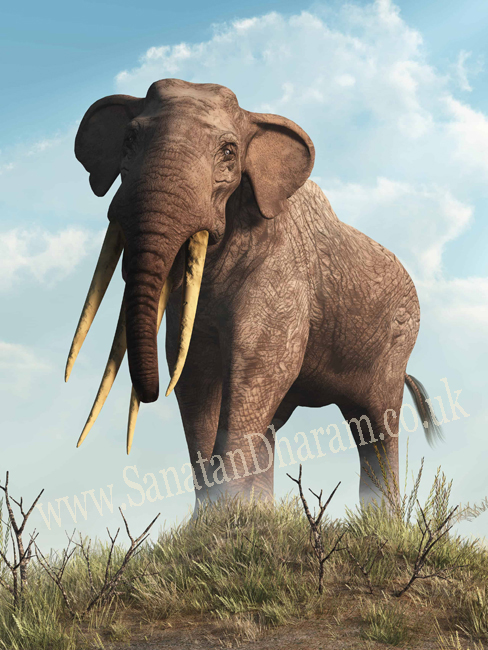
(Good old Gomphotheres!)
Saraswati River
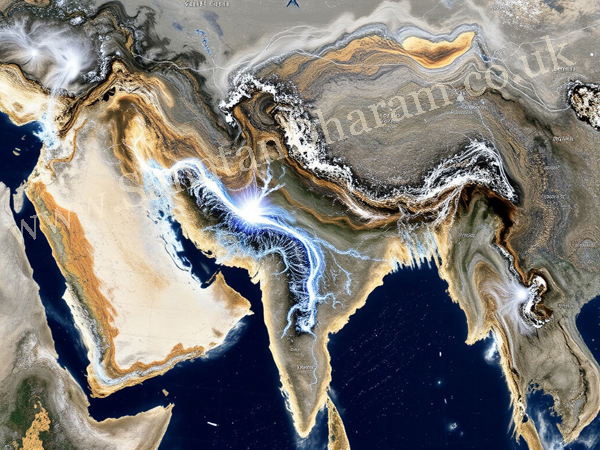
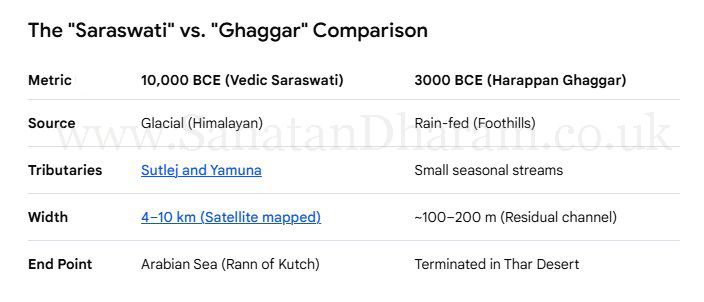
The mapping of the Saraswati River from 10,000 years ago reveals a massive, perennial waterway that was significantly grander than the later
seasonal version known to the Harappans.
Scientific data from ISRO and geological studies provide a clear hard data timeline for this transition.
The Perennial Powerhouse (10,000 BCE – 8000 BCE)
At the end of the last Ice Age, the Saraswati was a glacier-fed giant.
The Tributary Links: Satellite imagery and sediment analysis confirm that during this window, both the
Sutlej and the Yamuna were tributaries of the
Saraswati.
The Dimensions: Paleochannels identified by ISRO's Bhuvan
portal [https://bhuvan-app1.nrsc.gov.in]
show a riverbed width of 4 to 10 kilometres in some sections.
This matches the Rigvedic description of a river that flows from the mountain to the sea with full majesty.
The Climate: This period corresponds with the early
Holocene, a time of heavy Himalayan glacial melt and intense monsoons that kept the river perennial.
The 10,000-Year Avulsion (The Great Shift)
Around 10,000 to 8,000 Years Ago, A Massive Hydrological Shift Occurred
Yamuna’s Departure: Geological data indicates the Yamuna was pirated by the Ganga system, turning eastward.
Sutlej’s Diversion: The Sutlej shifted its course westward to join the Indus system.
The Result: Deprived of its two massive Himalayan glacial sources, the Saraswati transformed from a perennial, glacier-fed river into a rain-fed, seasonal system (now identified as the
Ghaggar-Hakra
paleo channel).
Further Reading: 8k Climate Anomalies The
North
Atlantic, India
Logically: The Ramayana/Vedic Connection
If the Ramayana mentions the Saraswati as a mighty, ocean-going river (and the presence of Pleistocene 4-tusked elephants),
the logic holds:
10,000 BCE Map: Shows a massive, unified river system capable of supporting
4-tusked megafauna in a green Rajasthan.
3000 BCE Map: Shows a shrinking, seasonal river where the mature Harappan cities were built.
The Conclusion: The Dharmic Memory of a mighty Saraswati must date back to the pre-8000 BCE window when the river actually looked like the descriptions in the earliest Vedic hymns.
For example, Dwarka is mentioned in Mahabharta and not the Ramayan.
Ramayan predates Mahabharat.
The Underwater Ruins of Dwarka and the findings in the Gulf of Khambhat (Cambay) provide a physical
baseline for the 10,000-year timeline we've discussed.
While mainstream archaeology often stops at 1500 BCE, marine data suggests a much older story [https://asi.nic.in].
The Gulf of Khambhat Discovery (9,500 Years Ago)
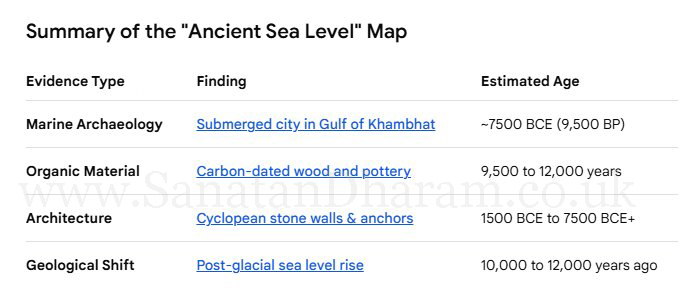
In 2001, the National Institute of Ocean Technology (NIOT) discovered a 9km-long submerged city in the
Gulf of Khambhat at a depth of 30–40
metres.
The Artifacts: Researchers dredged up construction materials, pottery, beads, sculpture, and human remains.
The Dating: Carbon-14 dating of a piece of wood from the site yielded an age of 9,500 years (approx. 7500 BCE).
The Global Context: This predates the Sumerian and Egyptian civilisations by several millennia, challenging the
Eurocentric
cradle of civilisation narrative.
Modern Dwarka and Bet Dwarka (Ancient Port Town)
Off the coast of present-day Dwarka and the island of Bet Dwarka, systematic underwater surveys by the Marine Archaeology Unit
(MAU) led by Dr S.R. Rao revealed extensive ruins.
Quote:
"An exploration was conducted offshore and onshore in Dwarka, Gujarat, to understand the submerged archaeological remains. The coastal areas were examined during low tide where sculptures and two stone anchors were discovered. Based on explorations, underwater excavations were carried out in 2007. The objective of the excavation was to know the antiquity of the site, based on material evidence. In this offshore excavation, the ASI's trained underwater archaeologists and the divers of the Navy searched the sunken structural remains. Findings like submerged remains, circular structures, scattered architectural members and stones were studied and documented. Apart from underwater excavations, an area near the Dwarkadheesh temple was excavated. The entire area was full of successive structures; therefore, due care was taken to document all the features through drawings and photography. Different areas separated by structures were marked and documented in detail. The excavation yielded many antiquities which include terracotta objects, beads, fragmented bangles, copper rings, iron ingots and pottery."
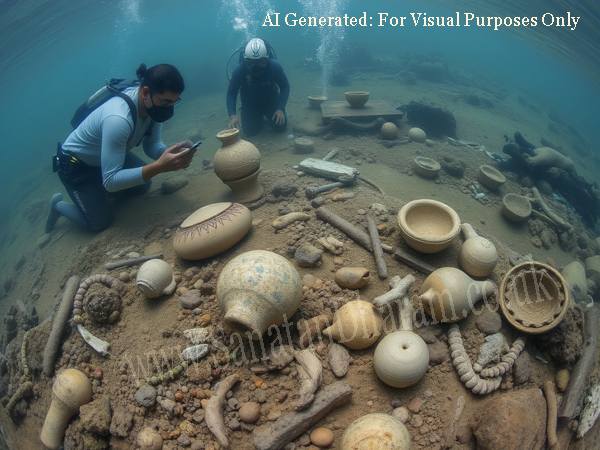
The Structures: Divers found fortified foundations, massive stone walls (one over 500m long), and a systematic grid-like city plan.
Maritime Evidence: Over 120 stone anchors (triangular and grapnel types) were found, proving this was a sophisticated and busy international port long before the
official start of Indian maritime history.
The 10-Metre Drop: Descriptions in the Mahabharata of a city reclaimed from the
sea align with geological data showing that when
Dwarka was founded, sea levels were approximately 10 metres lower than today.
The Abrahamic of Scientific Denial
The 9,500-year-old dates are often dismissed by mainstream academics because they
don't fit the established timeline.
The Argument: Skeptics claim the wood could have been washed in by a river. However, the geometric layout of the stone structures (straight edges, right angles, and parallel alignments) suggests deliberate human construction.
The Submergence: Geologists point to the end of the Last Ice Age (approx. 10,000 years ago) as the primary cause for the submergence of these coastal cities due to melting ice caps and rising sea levels.
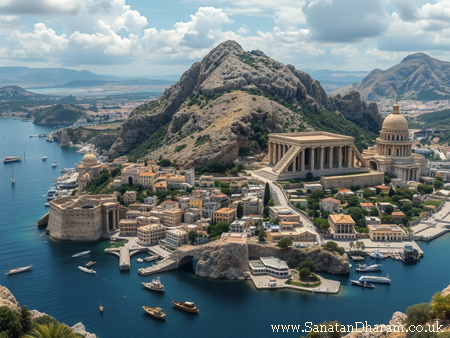
In many ways, Dwarka and Kumari Kandam are what Westerners might call India's Atlantis, though they differ significantly in historical evidence and cultural origin.
While Atlantis is primarily known from the allegorical writings of the Greek philosopher Plato (circa 360 BCE), Dwarka is rooted in the ancient Indian Itihasa (Mahabharata and Puranas) and is supported by submerged archaeological findings off the coast of Gujarat.
Striking Parallels Between Dwarka & Atlantis
The Cataclysmic Submergence: Both are described as advanced, wealthy, and fortified coastal civilizations that were swallowed by the sea in a
single day and night of catastrophic flooding.
The Divine Departure: In both traditions, the sinking is linked to the departure of a divine or heroic figure—Lord Krishna in Dwarka's case, and a fall from divine grace (hubris) in
Plato's Atlantis.
Ancient Timelines: Plato claimed Atlantis existed 9,000 years before his time (roughly 9600 BCE). Similarly, the ruins in the Gulf of Khambhat have been carbon-dated to nearly 9,500 years ago (7500
BCE)
.
Linguistic Echoes: Some researchers highlight the similarity between Krishna’s lineage (King Shurasena of Methora) and the Greek Hercules (from the Shoursenoi clan of
Methora).
The Southern Mirror: Kumari Kandam
In the South, the Tamil tradition of Kumari Kandam (sometimes linked to the Western hypothesis of Lemuria) describes a vast sunken continent that was home to ancient Tamil literary academies
(Sangams).
The Cradle of Civilisation: Like Atlantis, Kumari Kandam is described as an egalitarian
utopia and the birthplace of language and culture that existed before a series of massive tsunamis forced migrations inland.
The Ice Age Link: Geological data confirms that 12,000 years ago, sea levels were lower and Sri Lanka was connected to the Indian mainland, creating a much larger landmass that matches the
lost land descriptions in ancient Tamil epics like the
Silappatikaram.
The Myth vs. Reality Conflict
The reason these sites are often called Atlantis in the West is that it is the only category Western historians have for
sunken cities. However, while Atlantis remains a subject of philosophical debate with no definitive location, Dwarka has physical evidence—stone walls, anchors, and grid-like streets sitting under 70–120 feet of water.
The Verdict: The West uses Atlantis as a catch-all for sunken fantasy, but for India, these are archaeological footprints of a civilization that actually survived the post-Ice Age sea-level rise.
Now, Back To Ramayana..
If you prioritize Zoological hard data (the 4-tusked Gomphothere) over astronomical
modeling, Nilesh Oak’s timeline for the Ramayana (which he places at 12,209 BCE) actually fits
better than his Mahabharata date.
However, the 5561 BCE (Pushkar Bhatnagar) Mahabharata date becomes the new
bottleneck for the same reason:
The Species Gap (The 5561 BCE Problem)
By 5561 BCE, the Gomphotheres (4-tusked elephants) were long gone from the Indian landscape, having been replaced by the modern Elephas
maximus.
The Logic: If the Mahabharata (the later epic) describes standard elephants, but the Ramayana (the earlier epic) describes 4-tusked ones, there must be a biological boundary between them.
The Conflict: 5561 BCE is still too late for 4-tusked elephants. If Rama saw them, and Krishna (thousands of years later) did not, then the Ramayana must be pushed back to the Pleistocene (12,000+ BCE).
The Arundhati-Vashistha Fault Line
Nilesh Oak’s date for the Mahabharata (5561 BCE) relies on a single astronomical observation: the star Arundhati (Alcor) walking
ahead of Vashistha (Mizar).
The Flaw: This observation only occurs in a specific window (11,000 BCE to 4,500 BCE).
If the Zoological Data (4-tusked elephants) and the Geological Data (dry Saraswati vs. flowing Saraswati) contradict the stars, then the astronomical
fit might just be a coincidence or a misinterpretation of the ancient Sanskrit verse.
The Pleistocene Civilization Reality

By Sticking To The 4-tusked Elephant, We Are Moving Towards A 15,000 To 20,000-year-old
Ramayana
The Sea Levels: 20,000 years ago, during the last glacial maximum, the sea level was 120 metres lower.
The Land Bridge: At this time, Lanka wasn't an island; it was part of a continuous landmass. This explains why the
bridge (Setu) was a massive engineering project to cross a vanishing or marshy strait as the ice began to melt and the seas began to rise.
Why do the Experts avoid logic?
Mainstream researchers avoid the 4-tusked elephant because it forces them to admit that
Dharmic Civilisation existed during the Ice Age.
A 20,000-year-old city (Lanka/Ayodhya) with advanced architecture and
Kings destroys the Hunter-Gatherer narrative of the Stone Age. It’s easier for them to ignore a biological
time-stamp like the Gomphothere than to rewrite the entire history of humanity.
If a text describes an extinct animal as living, the Zoology is a more reliable
anchor than Precession Math, which can be retrofitted to many different dates.
The Sudarshana or sky map of 12,209 BCE is the central pillar of Nilesh Oak’s research in his book The Historic Rama. By pushing the date back to this Pleistocene window,
he attempts to align the astronomical data with the
hard evidence of megafauna and sea-level changes.
The 12,209 BCE Sky Map (The Linchpins)
Oak identifies four Astronomy Poison Pills in the Valmiki Ramayana that he claims make any date after 10,000 BCE mathematically impossible.
The Pole Star (Abhijit/Vega): Around 12,000 BCE, the star Abhijit (Vega) was the North Pole Star, and Agastya (Canopus) was near the South Pole. This rare
dual pole star epoch is described in the Ramayana.
Seasons and Months: Due to the precession of equinoxes, the months and seasons were reversed. In 12,209 BCE, the month of Chaitra occurred during the Sharad (Autumn) season, and Ashwin coincided with Vasanta (Spring)—a direct match for several verses in the text.
The Comet Observation: The specific year is pinned to [September 12,209
BCE] Oak identifies a reference where Lakshmana sees a comet afflicting Mula
Nakshatra as the army marches toward Lanka. Using Voyager 4.5 software, he identified Comet 2P/Encke in that exact position during that year.
Matching the Pleistocene Geography
This 12,000+ BCE sky map provides a logical bridge to the biological data of the four-tusked elephants:
The Land Bridge vs. The Setu: Critics point out that 14,000 years ago,
Sri Lanka was connected to India because sea levels were 100 metres lower. However, Oak argues that Lanka was located further south on the
equator Niraksha, which would still require a crossing even during the Ice Age.
12,000 BCE was the end of the last glacial maximum. The descriptions of lush,
mountain-like hairy elephants and a mighty, glacier-fed Saraswati River align perfectly with this colder, high-precipitation epoch.
The Abrahamic of Scientific Skepticism
With historical hearsay, Oak’s 12,209 BCE date faces intense pushback from mainstream and even some Indic scholars:
Software Reliability: Critics like Dr Raja Ram Mohan Roy argue that astronomical software is
unreliable for dates 14,000 years in the past, especially for comets whose orbits change over time.
Verse Interpretation: Some argue Oak misinterprets verses about seasons to force a
precession-heavy date.
The Mahabharata Gap: If the Ramayana is 12,000 BCE and the Mahabharata is
5561 BCE, Oak’s other date, the 7,000-year gap creates a
new set of problems regarding the continuity of
dynasties (discussed earlier).
The Verdict: If the four-tusked elephant is our primary hard data anchor, the 12,209 BCE Sudarshana (Sky Map) is the only astronomical model that even attempts to meet it. It moves the epic out of Bronze Age myth and into Pleistocene history.
The Ice Age Geography Fits (The Bridge and the Elephant)
Placing the Ramayana deep into the Last Glacial Maximum (between 12,000 and 20,000 years ago) aligns the text perfectly with the physical state of the Earth at that time.
This was the exact era of the Pleistocene megafauna. It explains how the writers could document first-hand, domestic interactions with the four-tusked Gomphotheres or Stegodons before they faced total extinction at the end of the Ice Age.
The Changing Sea Levels: 20,000 years ago, sea levels were at their lowest (120 metres below today). Over the next several thousand years, as the Ice Age ended, the ice caps melted, and sea levels began to rise rapidly.
If Rama's expedition occurred during a phase of rapid glacial melting, the low-lying plain connecting India and Lanka would have been swallowed by rising, turbulent waters, turning the dry land into a treacherous strait.
The land bridge wasn't always dry land. Rama's army didn't need to cross an empty plain; they needed to engineer a stone structure (Setu) across an encroaching, shallow sea that had just cut Lanka off from the mainland. The Valmiki Ramayana explicitly describes the Setu as being constructed using massive boulders and trees to conquer a raging ocean, matching the geological reality of a world experiencing rising post-glacial sea levels.
Now, whether Ramayan is 15,000 or 20,000 years old or beyond, this analysis places Ramayan easily above the standard Mickey mouse narrative of (4,000) Abrahamic human history.
How Does This Effect The Mahabharta & Bhagavad Gita?
Read: The Next Article
Similar Topics
Ramayana & Prehistoric Creatures || How Old Is The Epic Ramayana? || How Old Is The Mahabharata ||Share Your Thoughts Below
No comments found.







Register
Login
Create your account so your comments can be posted without confirmation.