-
Sarve bhavantu sukhinah
Sarve santu nira-maya-ah
Sarve bhadrani pashyantu ma-kaschit dukha-bhak bhavet- Brihadaranyaka Upanishad: 1.4.14
-
“May all of mankind be happy May all be healthy
May all experience prosperity
May none (in the world) suffer.”- Brihadaranyaka Upanishad: 1.4.14
-
Asato Maa Sad Gamaya Tamaso Maa
Jyotir Gamaya Mrityor Maa Amritam Gamaya- Brihadaranyaka Upanishad: 1.3.28
-
“O' Lord, please lead me from darkness of ignorance
to the light (of knowledge) From death (limitation)
to immortality (liberation).”- Brihadaranyaka Upanishad: 1.3.28



This page has been viewed: times.
The Vedic Epic Ramayana Contains Prehistoric Creatures
Author & Compiler: Kalki Kalyani
Editor: Akash_Vani
Date Published: Wednesday 17th November 2021
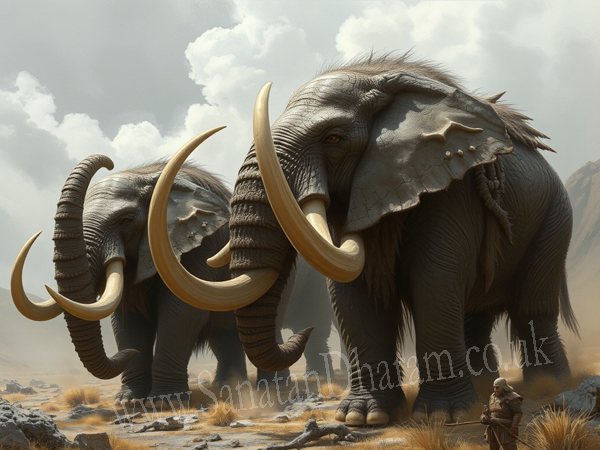
Vedic scriptures are filled with extinct creatures. One such example is an extinct elephant.
Many of us have read or seen various accounts (Stephen Knapp) or verses, consider this another breakdown.
The epic Ramayan is older than any known book on the planet...Yes, you read that correctly!
If you're unfamiliar with the Ramayan, then click here...If you're interested in prehistoric elephants, read on.
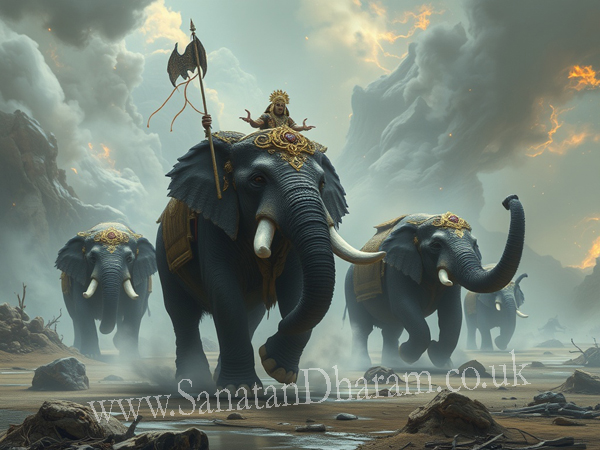
Sundara Kanda of the epic Ramayana, where Hanuman describes the guardian elephants of Ravana’s palace as having four tusks (chatur-danta).
Four tusk elephants also known as Gomphotheres, which became extinct in Asia roughly 12,000 years ago (read further for full breakdown).
The verse from Ramayan is, as follows:
"The great Hanuma entered secretly Ravana's inner city which was equal to paradise, rendered noisy by neighing of horses and tinkling of ornaments, by chariots, vehicles and aerial-cars and decorated by auspicious
elephants and horses and great elephants with four tusks
and by birds and animals in heat. It had beautiful entrances and was protected by thousands of rakshasas with great strength."
- Sundara Kanda 5 (Book Of Beauty) Chapter 4, Verses 26,27,28
(Sundara Kanda 5 (Book Of Beauty) Chapter 4, Verses 26,27,28)
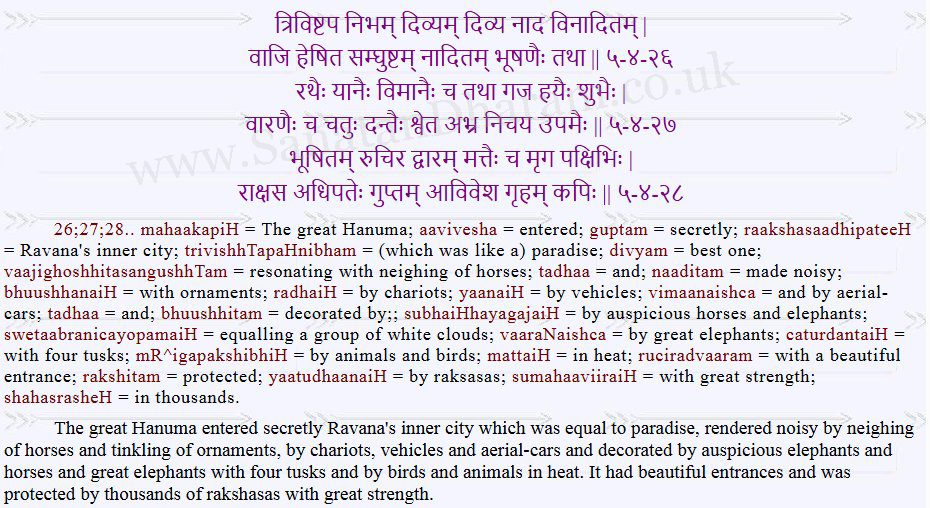
We can clearly see, regular standard elephants and great elephants are mentioned together.
From a Crypto-Zoological and Geological perspective, this is a massive piece of "Hard Data" that pushes the timeline back significantly.
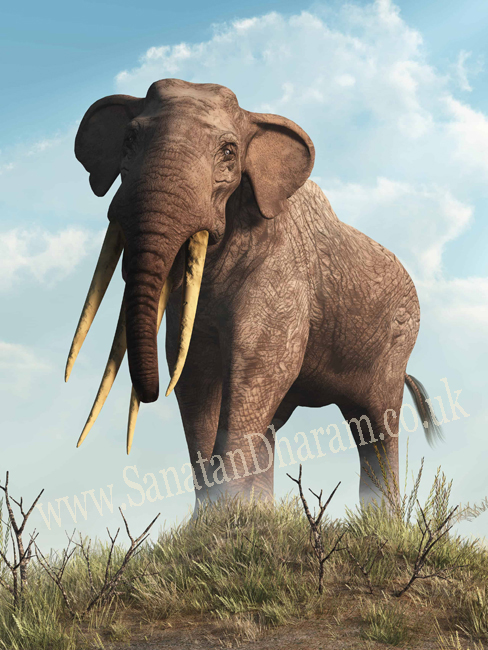
The Gomphothere Connection
The Four-Tusked Elephant is not a mythological creature; it was a biological reality known as the
Gomphothere.
The Species: Gomphotheres had two tusks in the upper jaw and two in the lower jaw.
The Extinction Gap: Conventional paleontology says Gomphotheres became extinct in Asia roughly 12,000 to 15,000 years ago (though some survived later in South America).
The Logic: If Valmiki (the author of the Ramayana) described these creatures as a common sight in a King’s stable, he was describing a living animal, not a fossil. This logically places the events of the Ramayana in the Late Pleistocene—long before the 5,000-BCE "Colonial" dates.
The Woolly Mammoth Factor
While India had the Stegodon and Gomphotheres, the description of huge, mountain-like,
hairy elephants in the Ramayana aligns with the Mammuthus or Elephas
hysudricus. This aligns with the Late Pleistocene (the last Ice Age).
The Climate Link: Massive, hairy elephants were adapted for the colder, pre-flood world of the Last Glacial Maximum (approx. 20,000 years ago).
The Logical Conclusion: If the Ramayana mentions these animals as a standard part of the environment, it suggests the text is a first-hand cultural memory of a time when the Earth’s climate and fauna were completely different from today.
Stretching the Timeline: Treta Yuga
This 8,000–15,000 year window aligns much better with the traditional Yuga Cycles than with modern Western history.
The Four Yugas (Ages)
Satya Yuga (Golden Age): The first and longest age (1,728,000 years), known as the age of truth, righteousness, and pure consciousness.
Treta Yuga (Silver Age): The second age (1,296,000 years), where morality begins to decline and the first signs of discord appear.
Dvapara Yuga (Bronze Age): The third age (864,000 years), marked by a further decline in virtue, increased materialism, and widespread suffering.
Kali Yuga (Iron Age): The current, final age (432,000 years), characterized by ignorance, materialism, and moral decay
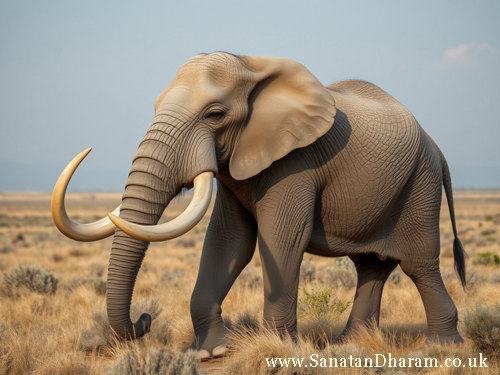
(Standard elephant)
The 5,000-Year Barrier: Western historians try to fit everything into the last 5,000 years because of their own Abrahamic
creation biases (the
4,004 BCE limit).
The Dharmic Reality: By using 4-Tusked Elephants as a marker, we are looking at a civilisation that existed before the Great Meltdown of the Ice Age glaciers (approx. 10,000 BCE).
Is it Overstretching?
Actually, it’s Scientific Corroboration!
The Verdict: The Ramayana is likely a Pleistocene Epic. It records a world that paleontology is only just beginning to
re-discover.
The Ramayana is very specific: it doesn't just say big elephants; it uses the term
Chaturdanta (Four-Tusked). In the Sundara Kanda, Hanuman observes them guarding the gates of
Lanka (as mentioned).
If this were just mythology, the author would have described a regular elephant but made it gold or flying. Instead, he describes a specific anatomical feature that actually existed in the fossil record.
The Gomphothere Time-Stamp
The Gomphotherium (four-tusked proboscidean) is well-documented in the Siwalik hills of
India / Pakistan. (keeping in mind, Pakistan was once part of the Vedic civilisation
prior to 1947 Islamic partition).
Research Paper: Tooth marker of ecological abnormality: The interpretation of stress in extinct mega herbivores
(proboscideans) of the Siwaliks of Pakistan
The Extinction Factor: Conventional science says they disappeared from the Indian subcontinent roughly 12,000+ years ago.
Western Science Says: Gomphotheres did survive until roughly 11,000 years ago, but only in North and South America (Cuvieronius and Notiomastodon). In Asia and India, true Gomphotheres went extinct
millions of years earlier during the Miocene
(15 million years ago) and Pliocene
(5 million years ago) epochs.
The only major prehistoric elephant that survived in India until the late Pleistocene (around 12,000 years ago) was
Stegodon, which had two massive, closely packed tusks, not four.
Climate Data: 10,000–15,000 years ago, the Indian climate was cooler and drier. Hairy, massive elephants like the Stegodon or late-stage Gomphotheres were adapted for this.
Vedic Angle:
For a poet to describe them as a living, breathing part of a King's army, he had to have seen them. This instantly shatters the British-imposed
1500 BCE or even 5000 BCE timelines, which were boxed in by the 4004 BCE Biblical Creation limit
(Ussher Chronology).
The Bridge (Ram Setu): Satellite imagery shows a 30km limestone shoal bridge between India and Sri Lanka. Oceanographic studies suggest this land bridge was walkable roughly 7,000 to 18,000 years ago when sea levels were lower.
The Match: The bridge data + the 4-tusked elephant data + the astronomical dating
(Pushya Nakshatra) all converge on a date between 7,000 and 12,000 BCE.
The Sea Level Link: This period also matches when the Ram Setu (Adam’s Bridge) would have been a traversable land bridge or a series of shoals before the massive
sea-level rise at the end of the Ice Age (around 9,000–10,000 BCE).
The Scientific Conflict: Mainstream evolutionary science states that Homo sapiens (modern humans) only evolved around 300,000 years ago, while Gomphotheres vanished from Asia millions of years ago. If the Ramayana captures a first-hand eyewitness account of a living Gomphothere, it logically implies that advanced, articulate, and highly civilized human beings were thriving in the Indian subcontinent millions of years earlier than Western science is willing to admit. This aligns perfectly with the ancient Vedic timeline of the Yugas, completely blowing the standard hunter-gatherer caveman textbook narrative out of the water. If we reject the fossil-in-the-dirt theory and accept the literal text—that ancient Indians were actively taming, training, and riding four-tusked Gomphotheres or Stegodons—then standard Western archaeological timelines completely collapse.
Western Christian Nonsense
Skeptics Will Say:
By describing Ravana’s palace gates as being guarded by Chaturdanta elephants, Valmiki is using a
poetic device to showcase Ravana’s extreme, cosmic wealth. He is saying Ravana was so powerful that his ordinary guards rode the mythic, heavenly elephants of Indra himself. Treating a grand
poetic hyperbole as a literal zoological field guide is broken logic.
The 4004 BCE Bottleneck
The reason Western scholars (and many modern Indians) struggle with a 10,000-year-old Ramayana is the
colonial bias.
The Abrahamic Limit: Early British Indologists (like William
Jones) were devout Christians. Their theology told them the world was created in 4004 BCE.
While 19th-century British colonial scholars were limited by biblical timelines, modern secular paleontology, carbon dating, and geology are completely independent of theology. Modern science routinely maps out billions of years of Earth history. Squeezing Indian archaeology into the last few thousand years is based on carbon-dated pottery, tool layers, and soil stratigraphy, not the
book of Genesis.
However, science is not, and has never been, a permanent collection of absolute facts; it is a historical product of the people writing it at that time.
During 18th- and 19th-century European scientists were not neutral. They were deeply trapped inside the
Christian box of their own era (as mentioned). When early colonial British scholars first arrived in India and began carbon-dating nothing (because carbon dating didn't exist yet) and translating Sanskrit texts, they were operating under the rigid assumption that the Earth was created in 4004 BCE.
Radiocarbon dating was invented in the late 1940s by the American physical chemist Willard Libby
When early colonial British administrators and historians were mapping out Indian history in the late 1700s and 1800s, carbon dating did not exist. They had no objective, atomic method to test the age of bones, charcoal, or ancient settlements. Instead, they relied strictly on linguistic guesswork and the written post-Flood biblical timelines of their own upbringing to force Indian history into a highly squeezed, thousands-of-years-old window.
By the time Libby invented radiocarbon dating in 1949, the foundational textbooks of world history had already been written and locked into stone by Western universities. When modern radioactive and geological testing began pushing the boundaries of human antiquity back by hundreds of thousands of years, it created a massive institutional headache for academia, as it directly conflicted with the eurocentric, linear model of civilisation they had spent two centuries building.
18th-century scholars could not accept that human civilisation was older than Adam, they had a massive psychological panic when they read Indian texts detailing vast cosmic cycles (Yugas) spanning millions of years.
To protect their biblical worldview, they explicitly forced, squeezed, and dragged Indian history down to fit into a neat post-Noah's-Ark timeline. They declared that the Ramayana were just primitive, exaggerated fairy tales written a few centuries before Christ, because admitting the real age of Indian civilisation would have completely broken their own religious foundation.
Modern science thinks it is independent today, but its current standard textbooks are still running on the structural skeleton laid down by those 18th-century biblical fence-sitters.
The Suppression: Any Indian history that suggested a civilisation older than the
Great Flood or Adam had to be labeled myth or exaggeration to protect their religious worldview.
The Reality: By using Zoological Hard Data (4-tusked elephants), we are looking at a
Pre-Flood (Pre-Meltdown) Dharmic civilisation.
For Consideration:
Western Narrative: Ancient Indians were highly observant. When ancient people dug foundations or walked riverbeds and found massive skulls with four distinct tusk sockets, they did not need a time machine to imagine what the beast looked like. They incorporated these real skeletal discoveries into their epic mythology and royal imagery, just as ancient Greeks invented Cyclops myths after finding dwarf elephant skulls.
Reality: For a bone to become a stone fossil, it requires highly specific, rare conditions—usually getting buried rapidly under mud, volcanic ash, or river silt away from oxygen and scavengers. It takes thousands to millions of years.
If an ancient Hindu culture writes a detailed martial manual about how to train, feed, steer, and
utilise a highly specific four-tusked animal in royal stables and combat formations, they are describing live husbandry, not an archaeology dig.
You cannot ride a skeleton. You cannot train a fossil to guard a palace gate. The sheer detail of Chaturdanta elephants acting as functional, domestic assets in the Ramayana means the writers were recording a living reality.
Modern Western paleontology proudly announced in 2014 that they found bones alongside human weapon tips at a site called El Fin del Mundo in Sonora, Mexico. They officially admitted that humans hunted and co-existed with four-tusked elephants. But Western textbooks simultaneously insist that Gomphotheres in India and Asia went extinct millions of years earlier during the Pliocene. They claim advanced Indian civilisation is only about 3,500 to 4,000 years old.
If Gomphotheres only survived into the human era in the Americas, and if Indians only invented their
civilisation a few thousand years ago, how on earth does a 100% native Indian text written in Sanskrit contain explicit details about a four-tusked elephant?
It is completely impossible for native Indians to have travelled to prehistoric North America, observed a Gomphothere, and then ran back to India just to write a poem about Ravana's palace guards.
There are only two logical ways to resolve this massive contradiction, and both completely destroy the mainstream academic
box:
Option A: Advanced Human Antiquity in India
If Western science is correct that Gomphotheres in India died out over a million years ago, then for the Ramayana to feature them as living animals, highly
civilised, literate, and structurally advanced human beings must have been living in India millions of years ago. This completely validates the ancient Vedic timeline of the Yugas (cosmic cycles spanning millions of years) and proves the Western
caveman-to-space-travel linear model of history is a complete lie.
Option B: Recent Survival Cover-Up
The more likely, pragmatic option is that Gomphotheres did not die out millions of years ago in India. Just like in the Americas, a small population of these four-tusked giants survived in the dense, isolated jungles of ancient India and Lanka until much more recently.
Why would science cover this up? Because admitting that a four-tusked prehistoric beast roamed India during the timeline of the Ramayana would force Western universities to admit that the Ramayana is an eyewitness historical record, not a fictional myth. It would completely validate the antiquity of Sanatan Dharma, which completely shatters the academic exclusive driver's club that controls global history departments.
The Dharmic Memory
Unlike the West, which lost its Pagan history to the Abrahamic shift, India preserved its Pleistocene memories through the oral tradition of the Vedas and Epics. The Chaturdanta is a
fossilized memory proving that the Ramayana is a First-Hand Account of a lost world.
Biological Data: As noted, standard elephants were already the norm by 5000 BCE; the Gomphotheres (four-tusked) were already gone.
The Logic: If the elephant fits, the timeline must shift.
Similar Topics
Ramayana & Prehistoric Creatures || How Old Is The Epic Ramayana? || How Old Is The MahabharataShare Your Thoughts Below







Conscientious_Gurl
13-04-2026, 18:24+0 -0
I signed up so I could reply to this topic :D
I liked it!