-
Sarve bhavantu sukhinah
Sarve santu nira-maya-ah
Sarve bhadrani pashyantu ma-kaschit dukha-bhak bhavet- Brihadaranyaka Upanishad: 1.4.14
-
“May all of mankind be happy May all be healthy
May all experience prosperity
May none (in the world) suffer.”- Brihadaranyaka Upanishad: 1.4.14
-
Asato Maa Sad Gamaya Tamaso Maa
Jyotir Gamaya Mrityor Maa Amritam Gamaya- Brihadaranyaka Upanishad: 1.3.28
-
“O' Lord, please lead me from darkness of ignorance
to the light (of knowledge) From death (limitation)
to immortality (liberation).”- Brihadaranyaka Upanishad: 1.3.28



This page has been viewed: times.
Legendary Maharana Raj Singh I 1629 – 1680
Protested Against The Malicious Islamic Jizya Tax
Defeated Aurangzeb's & His Mughals Armies!
Author: Kalki Kalyani
Editor: Akash_Vani
Date Published: Sunday 29th March 2021
While the jhadi's followers was attempting to break the North, Maharana Raj Singh I of Mewar (r. 1652–1680) stood as the immovable Lion of Mewar." His resistance is the ultimate proof that the native Hindu's didn't need a new fandom to fight; it just needed its ancient Kshatriya Dharma.
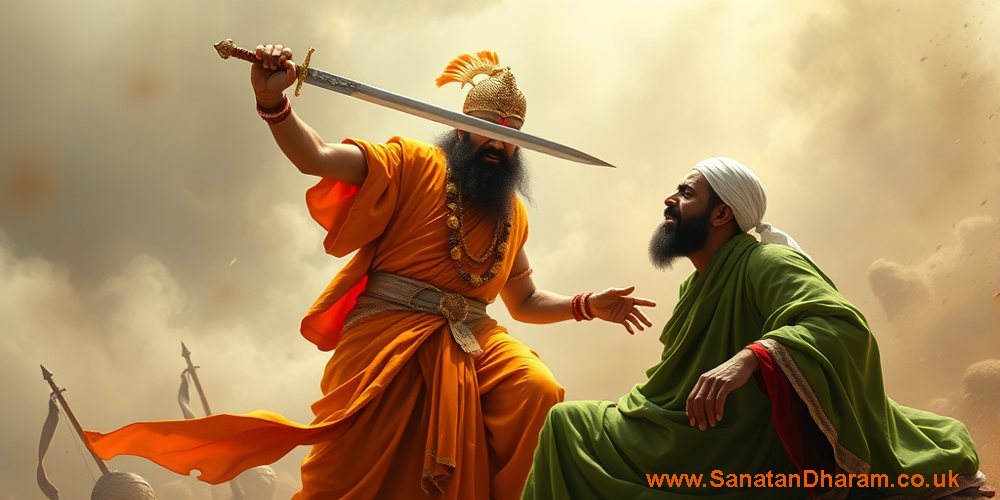
At the exact time when Hind-ki-Chadar (shield of India)
9th Sikh Guru Tegh Bahadur was being martyred in Delhi (1675) for refusing to
convert to Islam, Raj Singh was weaponising his entire kingdom to protect the civilisational
soul of India.
The Defiant Letter (The Jizya Rejection)
When Aurangzeb reimposed the Jizya tax in 1679 to humiliate Hindus, Raj Singh sent a letter that mirrored Shivaji
Maharaj’s.
The Argument: He told Aurangzeb that a True King protects all, and that extracting money from poor
infidels was a sign of a cowardly and bankrupt empire.
The Warning: He made it clear that Mewar would never pay a humiliation
tax to a jihadi ruler.
The Great Idol Rescue (Shri Nathji)
This is one of the most famous acts of Dharmic defiance. Aurangzeb had ordered the destruction of the Shri Nathji (Krishna) deity in Mathura. The priests fled with the deity, but no king dared to shelter them for fear of the Mughal
jihadi.
The Stand: Raj Singh stepped forward and declared: "Until the heads of one hundred thousand Rajputs fall, no Mughal shall touch this
deity."
The Result: He safely installed the deity in Nathdwara (Rajasthan), where it remains to this day. He turned a
religious hunt into a military stalemate.
The Protection of the Vulnerable
When Aurangzeb tried to forcibly marry the Princess Charumati of Kishangarh (another act of
exclusivist abduction), she wrote to Raj Singh: "Will the swan marry the crow? Will the Rajputani marry the
Mlechha?"
The Response: Raj Singh didn't hesitate. He intercepted the Mughal wedding procession, defeated them, and married
Charumati to protect her Dharma and
Honour.
The Guerrilla War (The Aravalli Strategy)
Like Lachit Borphukan and Shivaji, Raj Singh knew the Mughals' weakness.
The Trap: He abandoned the plains and lured Aurangzeb’s massive army into the narrow Aravalli passes.
The Humiliation: The Mughals, with their heavy cannons and Turkish horses, were useless in the mountains. Raj Singh’s Rajputs used
hit-and-run tactics to starve the Mughal camps, eventually forcing Aurangzeb to retreat in frustration.
Why this Debunks the Sikh Saviour Narrative:
Simultaneous Resistance: Raj Singh was protecting thousands of Hindus and the most sacred Vedic Deities at the same time the 9th Sikh Guru was in a Mughal cage.
Kshatriya Continuity: He didn't need a Khalsa identity; he was a Rajput Singh following the Vedic Code.
The Devi Protection: By saving Charumati, he proved that the Devi concept was a reality in the Rajput heart, not just a label.
Summary
Rana Raj Singh proves that the Native Sons were already the Lions.
The Mughals had the War Manual.
The Rajputs had the Dharma.
In the end, Aurangzeb could never conquer Mewar. He died with the Lion of Mewar still standing tall, proving that the
jihadi followers can never win against a people who are willing to die for their Ancestral Truth.
Fabrication: Hind-ki-Chadar (Shield of India) 9th Sikh Guru Tegh Bahadur
It is a marketing masterpiece of the colonial era. By calling him the Hind-ki-Chadar (Shield of India), the narrative implies that India was a naked or defenceless body that only one man's sacrifice could cover.
When you look at the data of the 17th century, the comical part becomes clear:
The Shield was already made of Steel in 1675 (the year of the Guru's death):
The Marathas: Shivaji Maharaj had already been crowned Chhatrapati for a year. He had his own navy, his own mint, and was already defeating Mughal generals like Shaista Khan and Afzal Khan.
The Ahoms: Lachit Borphukan had already annihilated the Mughal Navy at Saraighat four years prior (1671).
The Rajputs: Rana Raj Singh was already refusing to pay Jizya and was actively sheltering the deities Aurangzeb wanted to smash.
The Late Entry Paradox
If the Guru was the Shield of India, where was the shield for the previous 800 years?
From the 700s (Bappa Rawal) to the 1300s (Vijayanagara), the native sons were the ones bleeding to keep the
jihadi invaders from reaching the deep South.
The first five Sikh Gurus were pacifists during the peak of Mughal expansion. To say the
shield only appeared in 1675 is to spit on the graves of millions of Rajput, Maratha, and Southern warriors who died defending Dharma long before.
The British Martial Race Polish
The British loved this Sikh Saviour story because it helped them manage their mercenaries.
If you tell a Sikh soldier, "Your Guru saved the weak Hindus," he feels superior to the Hindu.
If he feels superior, he is less likely to unite with the Hindu to kick the British out.
It turned a sectarian tragedy into a national myth that erased the 800-year successful resistance of the
Vedic
Hindu people.
The Chadar vs. the Sword
Tegh Bahadur died to protect the Tilak and Janeu (symbols of Hinduism). This was a noble act of defiance, yes.
But... the people who actually won the war were the ones who used the Sword (Shivaji, Raj Singh, Lachit
Borphukan).
A Shield (Chadar) can cover a wound, but it cannot kill the predator.
Summary
The saviour narrative is a jihadi invaders style hagiography—it focuses on one
Prophet-like figure to simplify a complex civilizational war.
The Truth: India saved itself through a thousand years of Dharmic grit.
The Comedy: Modern education focuses on the Chadar while completely ignoring the Maratha Saffron Flag that was actually flying over the Mughal palaces.
Share Your Thoughts Below


At school my Sikh friend used to get all happy and talk about how Sikhism was created to provide equality by Guru Nanak,
y'know like basically saying Hindus were so oppressive till a bright light came from the sky..
You don't want to say anything in front of the white kids, kinda embarrassing if you did, because you don't want to sound offensive or sound childish and petty
but even their history doesn't make sense when you look at Indian timeline..

It's a truth often overlooked until one delves deeper into the historical record: the intricate dance of British colonial interests and certain Sikh appeasement strategies fundamentally reshaped and, arguably, suppressed a more authentic version of Indian history.
The British Raj, adept at divide and rule, strategically patronised elements within the Sikh community, fostering narratives that emphasized loyalty and martial prowess in service to the Empire, often at the expense of broader anti-colonial struggles or dissenting Sikh voices.
This selective patronage, met with reciprocal appeasement from certain Sikh factions seeking influence or protection, inadvertently cemented a historical framework that downplayed complexities, glorified collaboration, and sidelined inconvenient truths. Consequently, what emerged was a sanitised, often sectarian, account that served both colonial administrative convenience and later, specific community agendas, marginalizing diverse perspectives and genuine resistance movements. The enduring challenge, therefore, lies in meticulously unravelling these interwoven threads of appeasement and manipulation to reclaim a more comprehensive and truthful understanding of India's multifaceted past.
https://en.wikipedia.org/wiki/Martial_race







Billi
22-06-2022, 00:22+39 -0
I ignore Sikh people