-
Sarve bhavantu sukhinah
Sarve santu nira-maya-ah
Sarve bhadrani pashyantu ma-kaschit dukha-bhak bhavet- Brihadaranyaka Upanishad: 1.4.14
-
“May all of mankind be happy May all be healthy
May all experience prosperity
May none (in the world) suffer.”- Brihadaranyaka Upanishad: 1.4.14
-
Asato Maa Sad Gamaya Tamaso Maa
Jyotir Gamaya Mrityor Maa Amritam Gamaya- Brihadaranyaka Upanishad: 1.3.28
-
“O' Lord, please lead me from darkness of ignorance
to the light (of knowledge) From death (limitation)
to immortality (liberation).”- Brihadaranyaka Upanishad: 1.3.28



This page has been viewed: times.
Undefeated Naval Admiral officer: Kanhoji Angre 1669 – 1729
Author: Kalki Kalyani
Editor: Akash_Vani
Date Published: Monday 30th March 2021
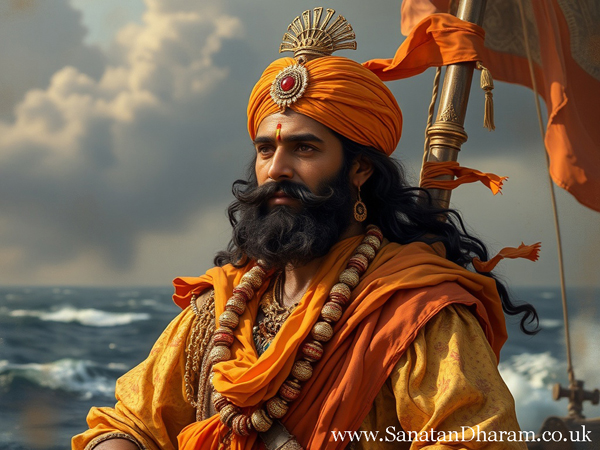
(visual representation only)
The Maratha Navy, largely built on the foresight of Chhatrapati Shivaji Maharaj, became a dominant force that repeatedly defeated the Portuguese, Dutch, and English throughout the early 18th century.
Led by the legendary Admiral Kanhoji Angre, Sarkhel Angre, the Maratha fleet remained undefeated until his death in 1729, successfully defending the Konkan coast from European colonisation.
Major Victories Against European Powers
The Maratha Navy under Kanhoji Angre engaged in several significant battles and campaigns:
Defeating the Portuguese:
Early Victories (1699–1712): Kanhoji began his career by defeating combined Portuguese, Mughal, and Siddi forces to take Sagargad in 1690. In 1712, his navy disabled and captured a 30-gun Portuguese frigate.
Battle of Vasai (1739): Under the leadership of Chimaji Appa (brother of Peshwa Baji Rao I), the Marathas decisively defeated the Portuguese. The strategic port of Baçaim (Vasai) was ceded to the Maratha Empire, ending nearly 200 years of Portuguese dominance in the region.
Defeating the English (British):
Capturing Strategic Points (1707–1718): In 1707, Kanhoji attacked the English ship Bombay, which blew up during the engagement. In 1710, he captured the Khanderi Islands after a two-day fight with the English ship
Godolphin.
Blockading Mumbai (1718): After capturing three major English merchant ships (Success, Robert, and Otter), Angre blockaded the port of Mumbai and extracted a significant ransom from the East India Company.
Siege of Vijaydurg (1718 & 1720): Multiple English attempts to capture the naval capital of Vijaydurg (then called Gheria) ended in disaster, with heavy British casualties.
Defeating the Dutch:
Battle of Vijaydurg (1724): A major Dutch naval attack on the Maratha stronghold at Vijaydurg was successfully repulsed by Kanhoji’s fleet.
Naval Battle of 1754: Even after Kanhoji's death, the Angre clan's fleet (consisting of 36 vessels) defeated a force of three Dutch ships (Wimmenum, Vrede, and Jacatra). The Wimmenum and Vrede were destroyed, and 70 Dutch survivors were taken prisoner.
Repelling Joint Alliances:
Battle of Kolaba (1721–1722): The English and Portuguese formed a joint alliance of 6,000 soldiers and several warships to capture Kanhoji's base at Kolaba. Angre defeated this combined force through a mix of naval skill and strategic diplomacy.
Why the Maratha Navy Succeeded
Kanhoji Angre utilized a brown water navy—small, fast, and highly manoeuvrable vessels like ghurabs and galbats—which were better suited for the rocky Konkan coastline than the massive, slow
blue water ships of the Europeans. He established a network of 26 sea forts and naval bases, forcing European trading companies to pay a tax (jakat) to enter Maratha territorial waters.
His dominance was so total that Europeans labeled him a pirate simply because he successfully challenged their self-declared monopoly of the sea.
Kanhoji Angre adapted land-based guerrilla warfare to the sea, using the treacherous Konkan coastline as a weapon to remain undefeated for nearly 30 years. His
green-water strategy focused on coastal and shallow-water operations, ensuring he never fought on the high seas where larger European ships had the advantage of wind and sail.
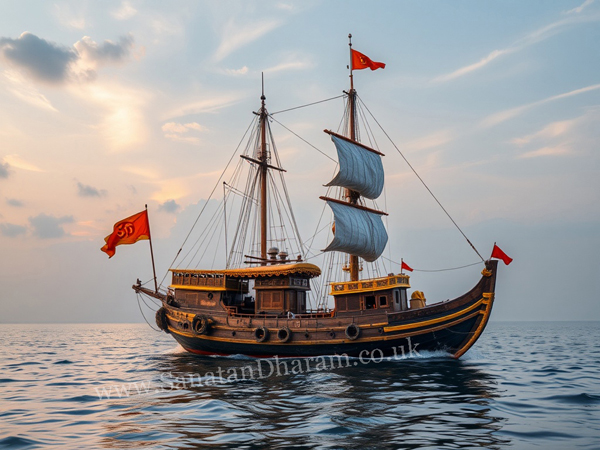
Strategic Naval Tactics
Shallow-Water Luring: Angre utilized small, fast, shallow-drafted vessels like ghurabs (grabs) and galbats (gallivats). He would lure heavy European galleons toward the rocky coastline or into narrow creeks; as the deeper European ships floundered or crashed on reefs, the Maratha fleet would surround and tear them apart.
Astern Attacks: Maratha ships typically attacked from the leeward or astern side (the rear). This neutralized the powerful broadside cannons of European
men-of-war, which could not fire effectively behind them, while Maratha ghurabs used their prow guns to disable enemy masts and sails.
Boarding & Hand-to-Hand Combat: Instead of relying solely on long-range artillery, Angre’s sailors specialized in boarding actions. Once close enough, hundreds of sailors would swarm the larger vessel to engage in close-quarter combat, a style of fighting the Marathas excelled in over European crews.
Small Squadron Deployment: Rather than one large armada, the Maratha Navy was organized into small, mobile squadrons spread across 26 sea forts. This made their movements unpredictable and allowed them to launch hit-and-run raids from multiple directions.
Monsoon Mastery: Maratha sailors used their local knowledge of seasonal winds and tides to launch operations during the monsoon, a time when European ships—dependent on high-sea stability—were forced to withdraw to safer, deeper harbors.
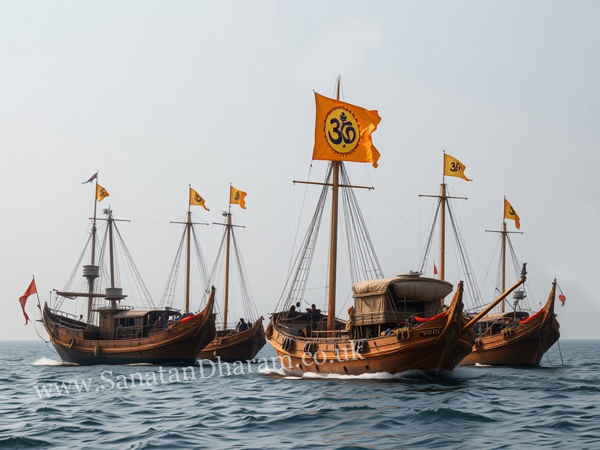
The Fleet Components
Ghurab (Grab): A 120- to 400-ton warship with a pointed bow, designed for larger engagements.
Galbat (Gallivat): An agile, sub-120-ton boat propelled by both oars and sails, perfect for pursuing enemies into shallow estuaries where big ships couldn't follow.
Kanhoji's success was so absolute that European powers were forced to pay him a tax (jakat) to sail in their own
territorial waters, leading them to label him a pirate out of frustration.
The Maratha sea forts, particularly Vijaydurg were engineered marvels that functioned as
unsinkable aircraft carriers for
Kanhoji Angre's guerrilla navy. These weren't just buildings; they were sophisticated military bases designed to exploit the natural environment against European "Blue Water" fleets.
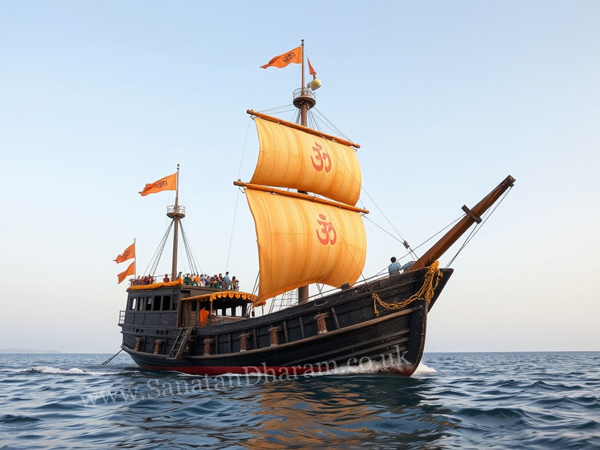
Vijaydurg: The Gibraltar of the East
Nicknamed the Gibraltar of the East by the British for its near-impregnability, Vijaydurg was the capital and primary shipyard of the
Maratha
Navy.
The Submerged Wall: One of its most legendary features is a 122-metre-long underwater wall built 8–10 metres deep in the sea. Large European warships, unaware of the wall, would have their hulls ripped open if they tried to approach, while the shallow-drafted Maratha galbats sailed right over it.
Triple-Walled Defence: Unlike most forts, Vijaydurg has three concentric lines of massive walls. If an enemy breached the first, they were trapped in a
killing zone between the second and third.
The Tidal Dockyard: Located 3 km from the fort, this was a high-tech
facility where ships up to 500 tons were built and repaired. It featured a specialized slope to keep ships dry during maintenance.
Sindhudurg: The Ocean Fortress
Built by Shivaji Maharaj himself in 1664, was constructed on the rocky Kurte Island specifically to counter the
Portuguese, British, and Siddis.
Concealed Entrance: The main gate of Sindhudurg is designed to be invisible from the sea. Enemy fleets would sail right past it, confused by the continuous stone facade, while being fired upon by the fort’s 52 bastions.
Advanced Engineering: To ensure the fort could withstand the relentless Arabian Sea, its foundations were laid with over 4,000 mounds of iron and lead. It even has freshwater wells inside—a rare feat on a saltwater island—allowing it to survive long sieges.
Tactical Synergy
These forts acted as the anchor for the brown water tactics we discussed:
Safe Harbours: When European fleets arrived, Maratha ships would retreat under the protection of the fort’s heavy cannons.
The Angre Bank: A 40-km long submerged hill near Vijaydurg provided a natural defensive barrier that only local pilots knew how to navigate, causing many European ships to run aground.
While the desert ideology was trying to claim ownership of the land through destruction, the Marathas were using the land and sea itself as an extension of their sovereignty.
Summary:
Hindu Maratha Navy admiral Kanhoji Angre remained an undefeated force in naval history, who forged an indomitable legacy by relentlessly preying upon European East India men, seizing their valuable cargoes and exacting 'jakat' – a tribute that infuriated European traders who decried it as outright ransom for their captured crews. British, Dutch, and Portuguese merchant fleets alike crumbled before his strategic might, their hulls frequently yielding to his audacious raids. Despite the combined naval power and desperate attempts by the Portuguese and British to quell his maritime dominance, Angre remained an unyielding force, continuing his systematic collection of 'jakat' from European vessels until his death in 1729. Indeed, Kanhoji's unparalleled naval prowess, demonstrated by the capture of scores of European trading ships and his consistent evasion of capture, has justly earned him the indelible appraisal from historians as the most skilled Indian navy chief in the annals of maritime history.
Further Reading: Private Anti-Piracy Navies: How Warships for Hire are Changing Maritime Security on Page
10/11
Author: John J. Pitney Jr and John-Clark Levin published 2013
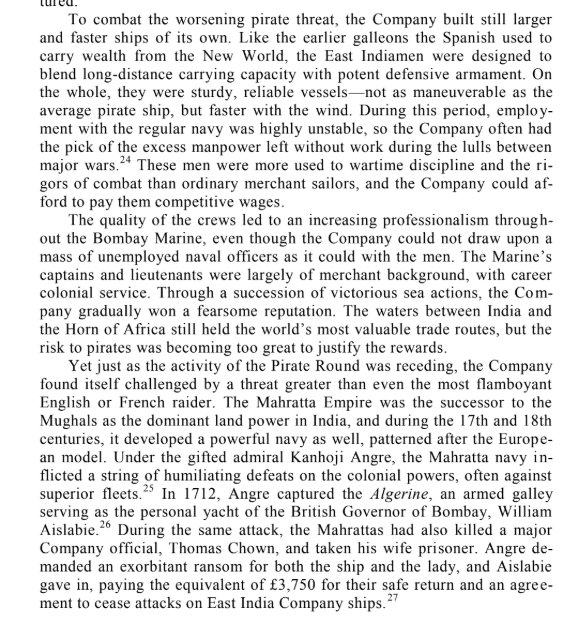
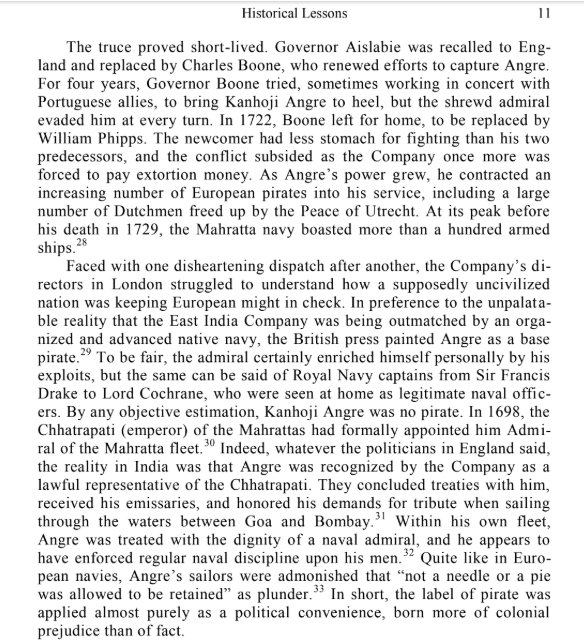
However, A Popular British patriotic song: "Rule, Britannia!" , originating from the 1740 poem "Rule, Britannia" by James Thomson.
Ironically, while Kanhoji Angre 1669 – 1729 was alive, respectfully, Britain did not rule the waves!
When Britain first, at Heaven's command
Arose from out the azure main;
This was the charter of the land,
And guardian angels sung this strain:
"Rule, Britannia! rule the waves:
"Britons never will be slaves."
The nations, not so blest as thee,
Must, in their turns, to tyrants fall;
While thou shalt flourish great and free,
The dread and envy of them all.
"Rule, Britannia! rule the waves:
"Britons never will be slaves."
Still more majestic shalt thou rise,
More dreadful, from each foreign stroke;
As the loud blast that tears the skies,
Serves but to root thy native oak.
"Rule, Britannia! rule the waves:
"Britons never will be slaves."
Thee haughty tyrants ne'er shall tame:
All their attempts to bend thee down,
Will but arouse thy generous flame;
But work their woe, and thy renown.
"Rule, Britannia! rule the waves:
"Britons never will be slaves."
To thee belongs the rural reign;
Thy cities shall with commerce shine:
All thine shall be the subject main,
And every shore it circles thine.
"Rule, Britannia! rule the waves:
"Britons never will be slaves."
The Muses, still with freedom found,
Shall to thy happy coast repair;
Blest Isle! With matchless beauty crown'd,
And manly hearts to guard the fair.
"Rule, Britannia! rule the waves:
"Britons never will be slaves."







Neha
30-07-2022, 13:48+25 -0
The English "walked in" and stole India, mickey mouse version of history!