-
Sarve bhavantu sukhinah
Sarve santu nira-maya-ah
Sarve bhadrani pashyantu ma-kaschit dukha-bhak bhavet- Brihadaranyaka Upanishad: 1.4.14
-
“May all of mankind be happy May all be healthy
May all experience prosperity
May none (in the world) suffer.”- Brihadaranyaka Upanishad: 1.4.14
-
Asato Maa Sad Gamaya Tamaso Maa
Jyotir Gamaya Mrityor Maa Amritam Gamaya- Brihadaranyaka Upanishad: 1.3.28
-
“O' Lord, please lead me from darkness of ignorance
to the light (of knowledge) From death (limitation)
to immortality (liberation).”- Brihadaranyaka Upanishad: 1.3.28



This page has been viewed: times.
Nobel Laureate: Prof. Brian D. Josephson
Author: Kalki Kalyani
Editor: Akash_Vani
Date Published: Monday 24th November 2025
Who is Prof. Brian D. Josephson and his connection to Hinduism?
Academic Profile: Professor Brian D. Josephson (Nobel Laureate)
Brian David Josephson (1940) is a British theoretical physicist and emeritus professor at the University of
Cambridge. He shared the 1973 Nobel Prize in Physics with Leo Esaki and Ivar Giaever for his discovery of the Josephson effect, made in 1962 when he was a Ph.D. student at Cambridge
Prize motivation: “for his theoretical predictions of the properties of a supercurrent through a tunnel barrier, in particular those phenomena which are generally known as the Josephson effects”
The Foundation: Macroscopic Quantum Phenomena
The Discovery: At age 22, Josephson predicted the Josephson
Effect—where current tunnels through a barrier between superconductors.
The Recognition: Awarded the 1973 Nobel Prize in
Physics for theoretical predictions that redefined our understanding of
super currents.
Practical Utility: His work enabled [SQUIDs] Superconducting Quantum Interference
Devices, the world's most sensitive magnetometers used in brain imaging and geology.
The Terminal Pivot: Mind-Matter Unification
The Project: As director of the [Mind-Matter Unification Project](https://www.tcm.phy.cam.ac.uk/~bdj10/mm/top.html) at the Cavendish Laboratory, he seeks to bridge the gap between theoretical physics and intelligent processes in nature.
Indo-Vedic Frequency: Influenced by Transcendental Meditation and the Vedic/Sanatan Dharm tradition, he explores how consciousness is an integral part of reality, not just a byproduct of the brain.
Sovereign Science: His motto, Nullius in Verba ("Take nobody's word for it"), aligns with our Terminal Forensic approach—auditing the data regardless of
"liberali-dribble" consensus.
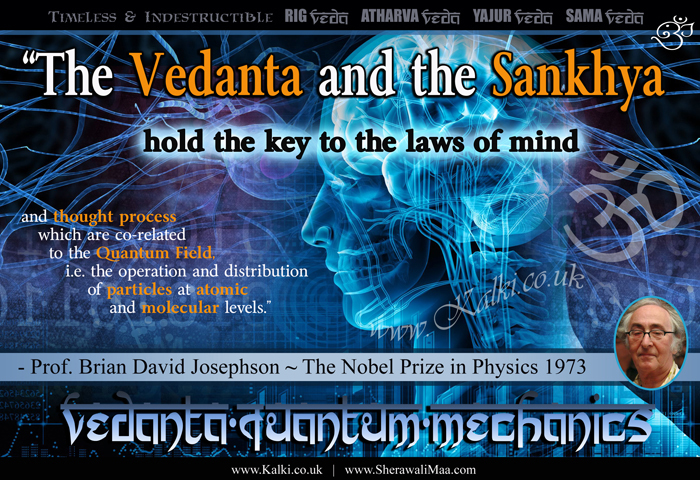
Josephson explores how Vedic insights into consciousness align with the quantum field. He argues that Vedanta and Sankhya hold the key to laws of mind and thought co-related to the operation and distribution of particles at atomic levels. His "Mind-Matter Unification Project" bridges high-speed physics with original Indo-Vedic logic.
Josephson said: of the ancient Hindu system of philosophy, which includes the chakra
system:
“The Vedanta and the Sankhya hold the key to the laws of mind and thought process which
are co-related to the Quantum Field, i.e. the operation and distribution of particles at atomic and molecular
levels.”
- Professor Brian D. Josephson (Nobel Laureate)
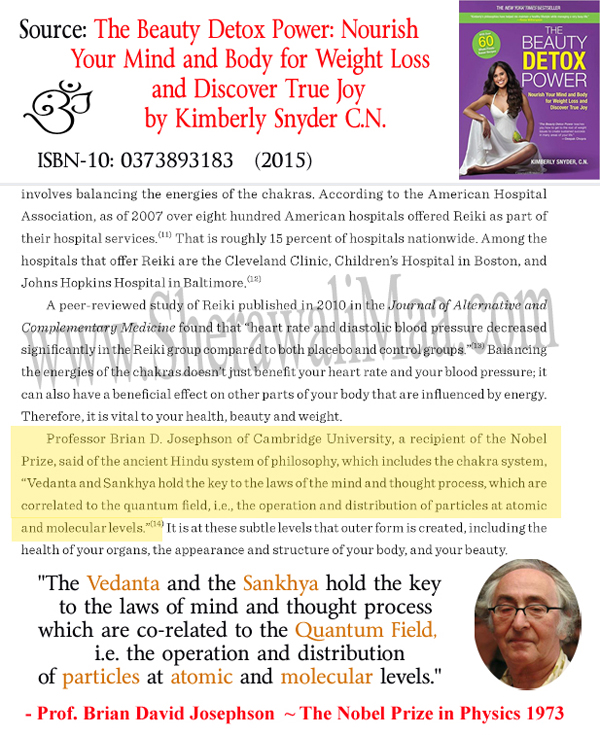
Author: Kimberly Snyder

Source: The
Beauty Detox Power: Nourish Your Mind and Body for Weight Loss and Discover True
Joy
– Publisher: Harlequin (31 Mar. 2015)
Language: English
ISBN-10: 0373893183
The Mind-Matter Unification Project
The Directive: As director of this project at Cambridge, Josephson explores "intelligent processes in nature" that mainstream science ignores.
The Logic: He argues that physics is incomplete without a picture of the Mind as an integral part of reality, not just an "epiphenomenon" of the brain.
Vedic Frequency Sync (TM & Maharishi)
The Connection: In the early 1970s, Josephson took up Transcendental Meditation (TM), recognizing that Maharishi Mahesh Yogi’s science of consciousness was a parallel frequency to quantum mechanics.
The Quote: "I believe that we can 'sense' the future. We just haven't yet established the mechanism allowing it to
happen."
To Bridge The Gap Between Ancient Indo (Sanatani) Vedic Source Code And Modern Quantum Physics,
Here Is A Brief Yet Basic Breakdown:
1. The Universal Field: Quantum Physics shows that everything in the universe—stars, trees, and your phone—is actually made of one vibrating "field" of energy.
2. The Vedanta Connection: Thousands of years ago, Vedanta identified this same field, calling it Brahman—the single, underlying reality that connects everyone.
3. Mind over Matter: While most science only looks at "stuff," Sankhya provides a detailed map of how your mind and thoughts actually emerge from this field.
4. The Observation Key: In Quantum experiments, a particle only "decides" where to be when someone looks at it; your consciousness changes the result.
5. The Logic of Thought: Sankhya explains that your "thought process" isn't just in your head; it’s a specific frequency interacting with the universe's code.
6. No "Solid" World: Vedanta proves the world isn't as "solid" as it looks—it’s more like a digital simulation or a dream made of information.
7. The Quantum Mirror: Just as a computer screen shows pixels but is powered by invisible code, the physical world is the "pixel" and the Quantum Field is the code.
8. Breaking the Cult of Materialism: Most people are taught that "matter" creates "mind," but these ancient systems prove that Mind (Consciousness) is the foundation.
9. The Scientific Bridge: Prof. Brian Josephson and other giants used these laws to understand that the brain is a receiver for the "Universal Frequency."
10. Sovereign Thinking: Understanding this means you aren't just a cog in a machine; you are an active "user" who can influence the field through focused thought.
11. The Source Code Restoration: By linking Vedanta, Sankhya, and Quantum Field theory, we are restoring the original Indo-Vedic Frequency to modern science.
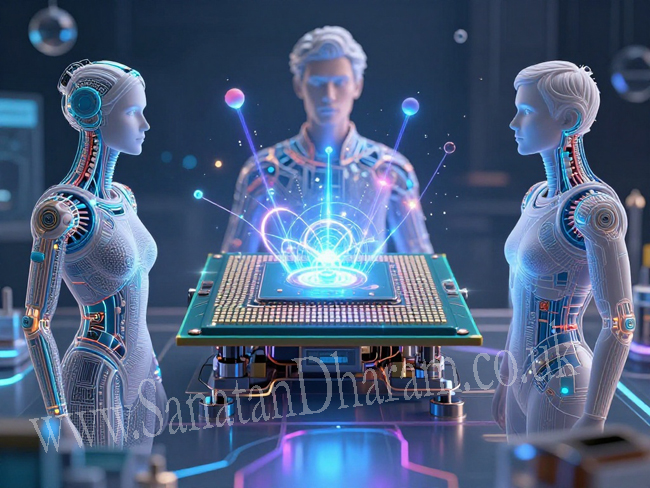
Since The Sankhya System Is Essentially The
"Hardware Manual" For The Human Machine, We Can Break It Down As A Functional Audit.
This Is How The Ancient Frequency Explains The Mechanics Of How "The Light" (Joti) Becomes A "Physical Person."
Here is the Sankhya breakdown in basic format:
1. The Two Realities: Sankhya says the universe is made of two things: Purusha
(the observer/pure light) and Prakriti (the hardware/raw data).
2. The Observer (The User): Purusha is you—the silent "User" watching the screen. You are eternal and don't change, no matter what happens in the game.
3. The Hardware (The Game): Prakriti is the physical world and your body. It’s the
"source code" that creates everything you can touch, see, or hear.
4. The 3 Modes (The Settings): All data in the universe runs on three "Gunas": Sattva
(balance/clear signal), Rajas (action/energy), and Tamas (lag/heavy/static).
5. The Intellect (The Processor): The first thing created from the code is Buddhi—your internal "Intellect" that decides which data is true and which is
"liberal-dribble."
6. The Identity (The User Profile): Then comes Ahamkara (the ego). This is the part of the code that says "I am me," creating your personal
"user profile" in the field.
7. The Mind (The Interface): Manas (the mind) is the bridge. It collects all the sensory data from the outside world and sends it to your internal processor.
8. The Sensors (The Inputs): Your 5 senses are the "input devices"
(camera, mic, etc.) that feed raw data from the Quantum Field into your system.
9. The Interaction: Sankhya explains that "pain" or "stress" happens when the
observer (You) gets confused and thinks they are the hardware (the body).
10. The Exit Strategy: The goal of Sankhya is to realize that you are the
sovereign observer, not the data on the screen. This is the ultimate "anti-cult" move.
11. Quantum Sync: Just as Quantum Physics says the "observer" is required for the
"field" to exist, Sankhya says the universe exists only for the observer to experience it.
Share Your Thoughts Below







Neha
27-04-2026, 05:13+0 -0
Awesome article! Another shared!