• Sarve bhavantu sukhinah
    Sarve santu nira-maya-ah
    Sarve bhadrani pashyantu ma-kaschit dukha-bhak bhavet

    - Brihadaranyaka Upanishad: 1.4.14

  • “May all of mankind be happy May all be healthy
    May all experience prosperity
    May none (in the world) suffer.”

    - Brihadaranyaka Upanishad: 1.4.14

  • Asato Maa Sad Gamaya Tamaso Maa
    Jyotir Gamaya Mrityor Maa Amritam Gamaya

    - Brihadaranyaka Upanishad: 1.3.28

  • “O' Lord, please lead me from darkness of ignorance
    to the light (of knowledge) From death (limitation)
    to immortality (liberation).”

    - Brihadaranyaka Upanishad: 1.3.28


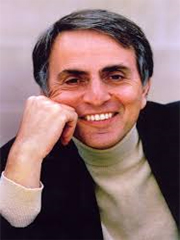
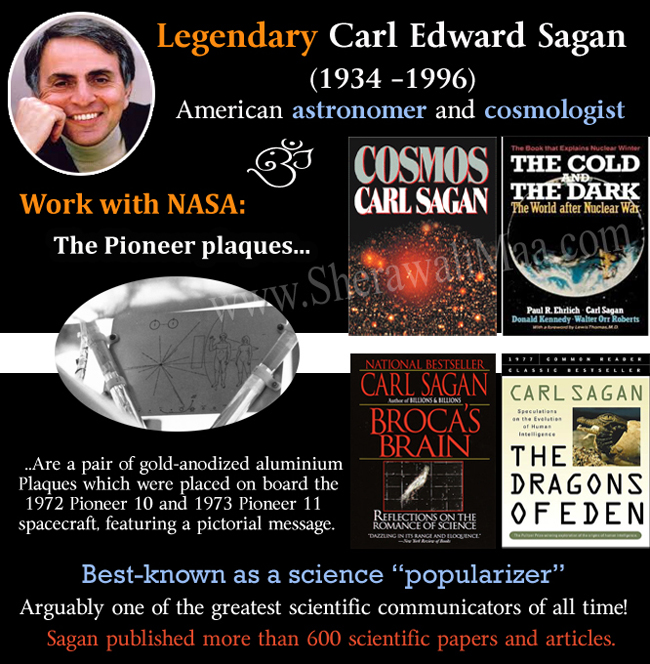
Carl Edward Sagan (1934 –1996)

American astronomer and cosmologist

Carl Edward Sagan (1934 –1996) was an American astronomer, cosmologist, astrophysicist, astrobiologist, author, science popularizer, and science communicator in astronomy and other natural sciences. 

Carl Edward Sagan was probably the most well-known scientist of the 1970s and 1980s. 

He published more than 600 scientific papers. He studied extraterrestrial intelligence, advocated for nuclear disarmament, and co-wrote and hosted 'Cosmos: A Personal Voyage.'

... Astronomer Carl Sagan was born on November 9, 1934, in Brooklyn, New York. 

Quote:

"On Friday, November 9, 2001, on what would have been Carl Sagan’s 67th birthday, the NASA Ames Research Center dedicated the site for the Carl Sagan Center for the Study of Life in the Cosmos. The cornerstone for the new Center was unveiled during the dedication ceremony.

“Carl was an incredible visionary, and now his legacy can be preserved and advanced by a 2lst century research and education laboratory committed to enhancing our understanding of life in the universe and furthering the cause of space exploration for all time,” said NASA Administrator Daniel Goldin.

- Article Source:   Planetary Scientist - Cornell University, Dedication of the Carl Sagan Center, By Leslie Mullen. NASA Astrobiology Institute   

https://science.nasa.gov/people/carl-sagan/


Sagan, was a renowned American astronomer, planetary scientist, and arguably the most influential science communicator of the 20th century. 

He pioneered studies on Venus’s greenhouse effect, helped shape NASA missions like Voyager and Viking, and brought science to millions through his book and PBS series Cosmos. 

Key Scientific Contributions & Roles:
Planetary Science: Sagan demonstrated that Venus’s extreme heat was caused by an intense greenhouse effect, shifting understanding of planetary atmospheres.


Extraterrestrial Life: As a pioneer in exobiology, he argued for the possibility of life in the universe and was key in designing the messaging on the Voyager Golden Record.


NASA Involvement: He played a pivotal role in the Mariner, Viking, Voyager, and Galileo missions, providing expertise on planetary surfaces and atmospheres.


Academic Career: He was a professor at Cornell University and directed its Laboratory for Planetary Studies. 


Legacy as a Communicator:
Cosmos: His 1980 television series, Cosmos: A Personal Voyage, was viewed by over 500 million people, making it one of the most-watched PBS shows in history.
Science Advocacy: He wrote numerous popular science books, including the Pulitzer Prize-winning The Dragons of Eden, and popularised the term "pale blue dot" to describe Earth's vulnerability.
Rationality: Sagan was a strong advocate for skepticism, science education, and environmental awareness, often urging humanity to protect Earth. 

Sagan passed away in 1996 at age 62 from pneumonia, following a battle with a bone marrow disease.


Scientific Cosmology

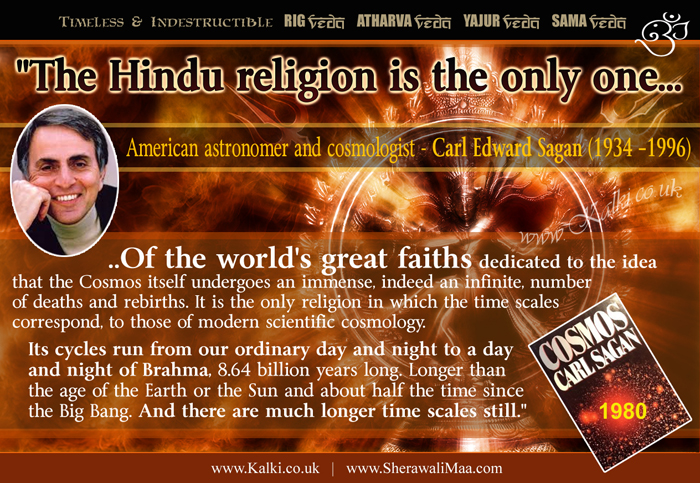
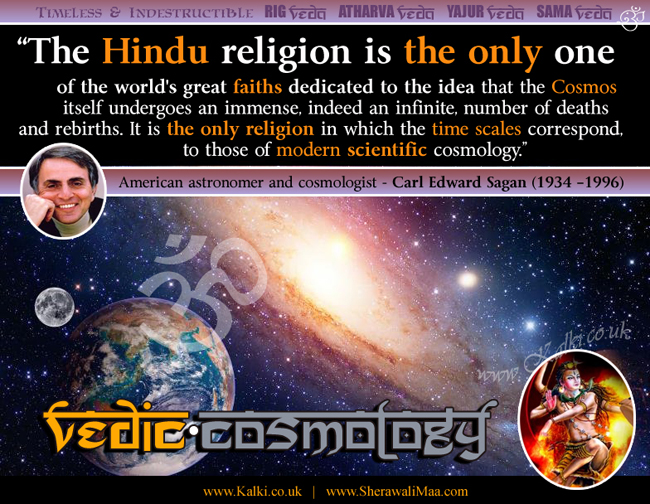
Sagan wrote: "The Hindu religion is the only one of the world's great faiths dedicated to the idea that the Cosmos itself undergoes an immense, indeed an infinite, number of deaths and rebirths.

 It is the only religion in which the time scales correspond, to those of modern scientific cosmology. 

Its cycles run from our ordinary day and night to a day and night of Brahma, 8.64 billion years long. 

Longer than the age of the Earth or the Sun and about half the time since the Big Bang. And there are much longer time scales still."


Full extract:

"Every human culture rejoices in the fact that there are cycles in nature. But how, it was thought, could such cycles come about unless the gods willed them? And if there are cycles in the years of humans, might there not be cycles in the aeons of the gods? The Hindu religion is the only one of the world ’s great faiths dedicated to the idea that the Cosmos itself undergoes an immense, indeed an infinite, number of deaths and rebirths. It is the only religion in which the time scales correspond, no doubt by accident, to those of modem scientific cosmology. Its cycles run from our ordinary day and night to a day and night of Brahma, 8.64 billion years long, longer than the age of the Earth or the Sun and about half the time since the Big Bang. And there are much longer time scales still.

There is the deep and appealing notion that the universe is but the dream of the god who, after a hundred Brahma years, dissolves himself into a dreamless sleep. The universe dissolves with him - until, after another Brahma century, he stirs, recomposes himself and begins again to dream the great cosmic dream. Meanwhile, elsewhere, there are an infinite number of other universes, each with its own god dreaming the cosmic dream. These great ideas are tempered by another, perhaps still greater. It is said that men may not be the dreams of the gods, but rather that the gods are the dreams of men.

In índia there are many gods, and each god has many manifestations. The Chola bronzes, cast in the eleventh century, include several different incamations of the god Shiva. The most elegant and sublime of these is a representation of the creation of the universe at the beginning of each cosmic cycle, a motif known as the cosmic dance of Shiva. The god, called in this manifestation Nataraja, the Dance King, has four hands. In the upper right hand is a dmm whose sound is the sound of creation. In the upper left hand is a tongue of flame, a reminder that the universe, now newly created, will billions of years from now be utterly destroyed."  - Page 156


"This is the only religious idea I know that surpasses the endless number of infinitely old cycling universes in Hindu cosmology. What would those other universes be like? Would they be built on different laws of physics? Would they have stars and galaxies and worlds, or something quite different? Might they be compatible with some unimaginably different form of life? To enter them, we would somehow have to penetrate a fourth physical dimension - not an easy undertaking, surely but perhaps a black hole would provide a way. There may be small black holes in the solar neighborhood. Poised at the edge of forever, we would jump off." - Page 161


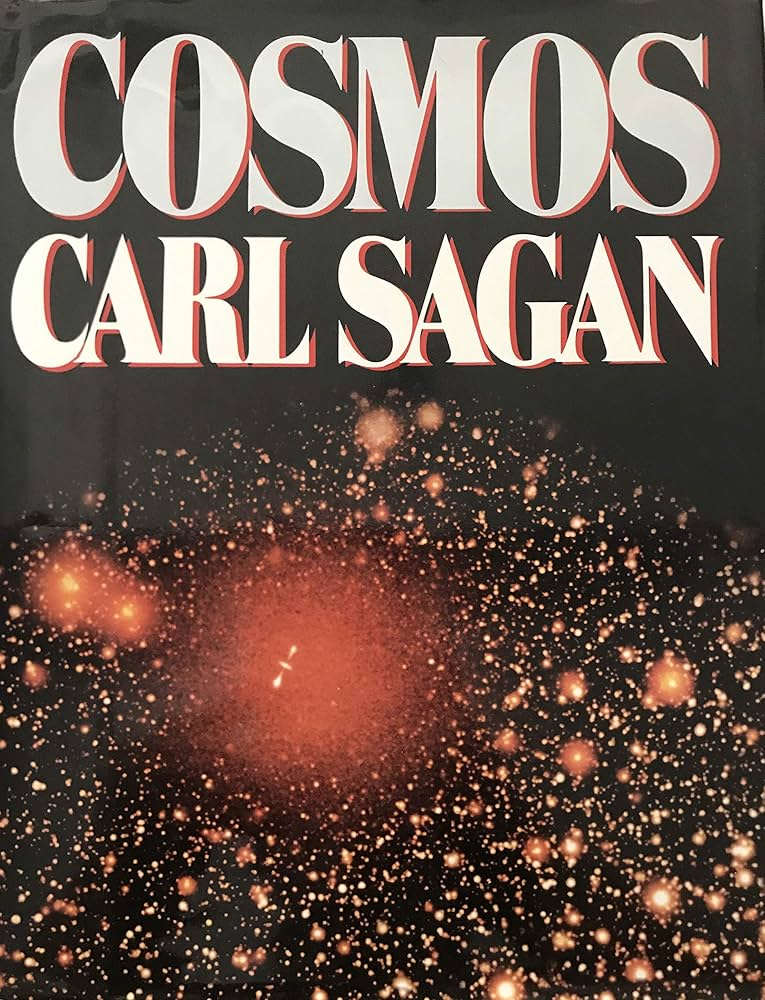
Source:  Cosmos by Carl Sagan, Published: October 1st, 1980.

Available on Amazon

Available on: Archive.org


Scientific Cosmology

Sagan wrote: "The Hindu religion is the only one of the world's great faiths dedicated to the idea that the Cosmos itself undergoes an immense, indeed an infinite, number of deaths and rebirths.

 It is the only religion in which the time scales correspond, to those of modern scientific cosmology. 

Its cycles run from our ordinary day and night to a day and night of Brahma, 8.64 billion years long. 

Longer than the age of the Earth or the Sun and about half the time since the Big Bang. And there are much longer time scales still."


Full extract:

"Every human culture rejoices in the fact that there are cycles in nature. But how, it was thought, could such cycles come about unless the gods willed them? And if there are cycles in the years of humans, might there not be cycles in the aeons of the gods? The Hindu religion is the only one of the world ’s great faiths dedicated to the idea that the Cosmos itself undergoes an immense, indeed an infinite, number of deaths and rebirths. It is the only religion in which the time scales correspond, no doubt by accident, to those of modem scientific cosmology. Its cycles run from our ordinary day and night to a day and night of Brahma, 8.64 billion years long, longer than the age of the Earth or the Sun and about half the time since the Big Bang. And there are much longer time scales still.

There is the deep and appealing notion that the universe is but the dream of the god who, after a hundred Brahma years, dissolves himself into a dreamless sleep. The universe dissolves with him - until, after another Brahma century, he stirs, recomposes himself and begins again to dream the great cosmic dream. Meanwhile, elsewhere, there are an infinite number of other universes, each with its own god dreaming the cosmic dream. These great ideas are tempered by another, perhaps still greater. It is said that men may not be the dreams of the gods, but rather that the gods are the dreams of men.

In índia there are many gods, and each god has many manifestations. The Chola bronzes, cast in the eleventh century, include several different incamations of the god Shiva. The most elegant and sublime of these is a representation of the creation of the universe at the beginning of each cosmic cycle, a motif known as the cosmic dance of Shiva. The god, called in this manifestation Nataraja, the Dance King, has four hands. In the upper right hand is a dmm whose sound is the sound of creation. In the upper left hand is a tongue of flame, a reminder that the universe, now newly created, will billions of years from now be utterly destroyed."  - Page 156


"This is the only religious idea I know that surpasses the endless number of infinitely old cycling universes in Hindu cosmology. What would those other universes be like? Would they be built on different laws of physics? Would they have stars and galaxies and worlds, or something quite different? Might they be compatible with some unimaginably different form of life? To enter them, we would somehow have to penetrate a fourth physical dimension - not an easy undertaking, surely but perhaps a black hole would provide a way. There may be small black holes in the solar neighborhood. Poised at the edge of forever, we would jump off." - Page 161


Source:  Cosmos by Carl Sagan, Published: October 1st, 1980.

Available on Amazon

Available on: Archive.org


Scientific Cosmology

Book source:

Sagan wrote: "The Hindu religion is the only one of the world's great faiths dedicated to the idea that the Cosmos itself undergoes an immense, indeed an infinite, number of deaths and rebirths.

 It is the only religion in which the time scales correspond, to those of modern scientific cosmology. 

Its cycles run from our ordinary day and night to a day and night of Brahma, 8.64 billion years long. 

Longer than the age of the Earth or the Sun and about half the time since the Big Bang. And there are much longer time scales still."

 Full extracts/Quotes:

"The source material for traditional Hindu astronomy and cosmol¬ ogy consists of Sanskrit texts that are being reproduced and repub¬ lished today as part of a living tradition. Unlike the situation in Egypt, Mesopotamia, or Mesoamerica, there is practically no Indian cosmo¬ logical material available in the form of ancient manuscripts, tablets, or inscriptions. Archeology may shed light on the material living conditions of ancient Indian people, but it conveys practically nothing about what they had to say. In India, long documents have generally been written on palm leaves, which last for at most a few centuries in the Indian climate." - Page 7

"In India, the traditional view is that the Puranas complement the Vedas— the ancient texts seen as the ultimate authority in Hindu soci¬ ety. Some of the Puranas themselves declare that they and Sanskrit historical epics (such as Mahabharata) are the fifth Veda. For example, the Bhagavatam makes this claim in verse 1.4.20." - Page 8

"— According to Joseph Schwartzberg, an earlier Hindu and Bud¬ dhist map of the earth placed four continents in the cardinal directions around Mount Meru, with the continent called Bharata or Jambudvipa to the south (Schwartzberg, 1987, p. 336). The Surya-siddhanta follows this pattern by putting Bhadrasva to the east, Bharata to the south, Ketumala to the west, and Kuru to the north (Burgess, 1860," - Page 39

"— Snodgrass also points out that elaborate astronomical symbol¬ ism was built into the temple of Angkor Wat in Cambodia. Thus Angkor Wat “incorporates at least twenty-two significant alignments to equinoctial and solstitial solar risings” (Snodgrass, 1990, p. 216). This implies that Hindu temple builders in Indochina must have been interested in making quantitative astronomical observations, and it may indicate some of the practical astronomy lying behind the Vastumandala concept." - Page 49

"— Cosmological presentations similar to that of the Bhagavatam are found in other Puranas , in the Mahabharata , and in Jain and Buddhist texts. The Jain and Buddhist cosmologies are particularly complex, and they seem to be imaginative elaborations of themes originating in earlier Hindu cosmology." - Page 105

"— Alexander Cunningham remarked, “From the accounts of the Greeks it would appear that the ancient Indians had a very accurate knowledge of the true shape and size of their country” (Cunningham, 1871, p. 1). Cunningham cites figures given by Greek and Roman writers for several important distances in India, and he compares them with modern distance estimates. For example, according to Strabo, Megasthenes “estimated the distance from the southern sea to the Caucasus at 20,000 stadia,” or 2,298 British miles. Cunningham notes that by direct measurement on a modern map, the distance from Cape Comorin to the Hindu Kush (which he identifies as the Greek refer¬ ence points) is about 1,950 miles. If increased by 1le to allow for winding roads, this comes to 2,275 miles, or within a few miles of Megasthenes’ figure (Cunningham, 1871, p. 4)." - Page 126

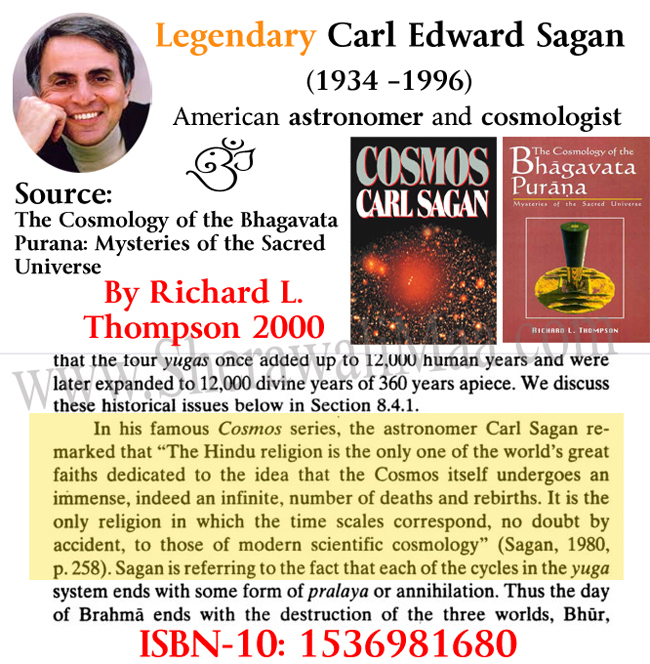
"In his famous Cosmos series, the astronomer Carl Sagan re¬ marked that “The Hindu religion is the only one of the world’s great faiths dedicated to the idea that the Cosmos itself undergoes an immense, indeed an infinite, number of deaths and rebirths. It is the only religion in which the time scales correspond, no doubt by accident, to those of modern scientific cosmology” (Sagan, 1980, p. 258). Sagan is referring to the fact that each of the cycles in the yuga system ends with some form of pralaya or annihilation. Thus the day of Brahma ends with the destruction of the three worlds, Bhur," -Page 225

"— called the interval between world destructions a “great year,” and the Hopi spoke of four worlds, with three ended by destruction (Heinberg, 1989, pp. 107-8). Likewise, the Sioux Indians have a close parallel to the Hindu bull of Dharma that loses one leg during each of the four successive yugas (see Appendix 18)." -Page 227

"— Although the Bhagavatam does not mention precession of the equinoxes directly, a number of scholars have seen a connection between the yuga system and precession. For example, Stella Kramrisch, in her study of Hindu temple designs, argues that “All the cyclical numbers in Hindu cosmology are essentially based on the period of the precession of the equinoxes” (Kramrisch, 1946, p. 36). Her observation boils down to the fact that a divya-yuga is 2,000 x 2,160 years. The latter period is the time for the vernal equinox to pass through one sign of the zodiac, and thus it is the length of the celebrated ages of the signs, such as the Age of Aquarius." - Page 231

 "— It is believed by both the American Indian and the Hindu that at the present time the buffalo or bull is on his last leg, and he is very nearly bald. Corresponding beliefs could be cited from many other traditions (Epes Brown, 1971, p. 9)." - Page 308

"— Brahma, Lord — the creator in the Hindu trinity of Brahma, Visnu, and Siva, traditionally seen as the original disseminator of the Vedas in human society, after his enlightenment by Visnu from within." - Page 332


 "— Siva, Lord — the destroyer in the Hindu trinity of Brahma, Visnu, and Siva, often pictured in meditation on Lord Visnu." - Page 336


" — Vedas — ancient Sanskrit texts of revealed knowledge which are seen as authoritative in Hindu religion."  - Page 338

Source:

The Cosmology of the Bhagavata Purana: Mysteries of the Sacred Universe, By Richard L. Thompson ISBN-10: 1536981680 ISBN-13: 978-1536981681

Available on: Amazon

Available on: Archive.org

Carl Sagan, with Frank Drake and Linda Salzman Sagan, designed the gold-anodized aluminum Pioneer Plaques (1972-1973) for NASA to act as a "message in a bottle" for extraterrestrial life, showing humanity's appearance, location, and the spacecraft’s origin. 

The 6x9-inch plaques were attached to the first human-made objects leaving the solar system, Pioneer 10 and 11. 

Pioneer Plaque Design and Meaning Context: Because Pioneers 10 and 11 were the first probes to achieve escape velocity from the Solar System, Sagan wanted a way to identify the creators, which NASA allowed just weeks before launch.

 The Message: Designed by Sagan and Frank Drake in three weeks, the plaque provides information via universal, scientific symbols rather than language. 

Universal Language: The top-left symbol shows the hyperfine transition of neutral hydrogen (the most common element), providing a standard unit of length (21 cm) and time. 

Human Figures: A man and woman are depicted, with the man raising his hand in a gesture of friendship. Their scale is provided relative to the Pioneer spacecraft drawn behind them. 

Location Map: A diagram uses 14 pulsars (rapidly rotating neutron stars) and their frequencies to locate Earth within the galaxy relative to the center. 

Solar System Map: A map at the bottom shows the Sun and planets, with the flight path beginning on Earth, passing Jupiter (and Saturn for P11), and leaving the solar system. 

The plaque was a precursor to the Voyager Golden Records. While the Caucasian representation of the humans was debated, the plaque remains a historic attempt to make first contact.

Source: https://science.nasa.gov/resource/pioneer-plaque/

Book Page Source

Full Quote in context:

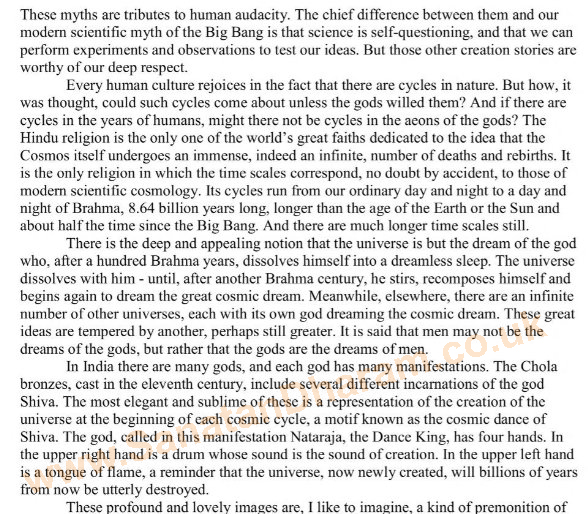
"These myths are tributes to human audacity. The chief difference between them and our modem scientific myth of the Big Bang is that Science is self-questioning, and that we can perform experiments and observations to test our ideas. But those other creation stories are worthy of our deep respect.

Every human culture rejoices in the fact that there are cycles in nature. But how, it was thought, could such cycles come about unless the gods willed them? And if there are cycles in the years of humans, might there not be cycles in the aeons of the gods? The Hindu religion is the only one of the world ’s great faiths dedicated to the idea that the Cosmos itself undergoes an immense, indeed an infinite, number of deaths and rebirths. It is the only religion in which the time scales correspond, no doubt by accident, to those of modem scientific cosmology. Its cycles run from our ordinary day and night to a day and night of Brahma, 8.64 billion years long, longer than the age of the Earth or the Sun and about half the time since the Big Bang. And there are much longer time scales still.

There is the deep and appealing notion that the universe is but the dream of the god who, after a hundred Brahma years, dissolves himself into a dreamless sleep. The universe dissolves with him - until, after another Brahma century, he stirs, recomposes himself and begins again to dream the great cosmic dream. Meanwhile, elsewhere, there are an infinite number of other universes, each with its own god dreaming the cosmic dream. These great ideas are tempered by another, perhaps still greater. It is said that men may not be the dreams of the gods, but rather that the gods are the dreams of men.

In índia there are many gods, and each god has many manifestations. The Chola bronzes, cast in the eleventh century, include several different incamations of the god Shiva. The most elegant and sublime of these is a representation of the creation of the universe at the beginning of each cosmic cycle, a motif known as the cosmic dance of Shiva. The god, called in this manifestation Nataraja, the Dance King, has four hands. In the upper right hand is a dmm whose sound is the sound of creation. In the upper left hand is a tongue of flame, a reminder that the universe, now newly created, will billions of years from now be utterly destroyed.

These profound and lovely images are, I like to imagine, a kind of premonition of modem astronomical ideas.* Very likely, the universe has been expanding since the Big Bang, but it is by no means clear that it will continue to expand forever. The expansion may gradually slow, stop and reverse itself. If there is less than a certain criticai amount of matter in the universe, the gravitation of the receding galaxies will be insufficient to stop the expansion, and the universe will mn away forever. But if there is more matter than we can see - hidden away in black holes, say, or in hot but invisible gas between the galaxies then the universe will hold together gravitationally and partake of a very Indian succession of cycles, expansion followed by contraction, universe upon universe, Cosmos without end. If we live in such an oscillating universe, then the Big Bang is not the creation of the Cosmos but merely the end of the previous cycle, the destruction of the last incamation of the Cosmos."

-Page 157/8


Source:  Cosmos by Carl Sagan, Published: October 1st, 1980.

Available on Amazon

Available on: Archive.org