-
Sarve bhavantu sukhinah
Sarve santu nira-maya-ah
Sarve bhadrani pashyantu ma-kaschit dukha-bhak bhavet- Brihadaranyaka Upanishad: 1.4.14
-
“May all of mankind be happy May all be healthy
May all experience prosperity
May none (in the world) suffer.”- Brihadaranyaka Upanishad: 1.4.14
-
Asato Maa Sad Gamaya Tamaso Maa
Jyotir Gamaya Mrityor Maa Amritam Gamaya- Brihadaranyaka Upanishad: 1.3.28
-
“O' Lord, please lead me from darkness of ignorance
to the light (of knowledge) From death (limitation)
to immortality (liberation).”- Brihadaranyaka Upanishad: 1.3.28



This page has been viewed: times.
Vickrum Digwa, A Sikh Man Pursues And Savagely Stabs A White Boy
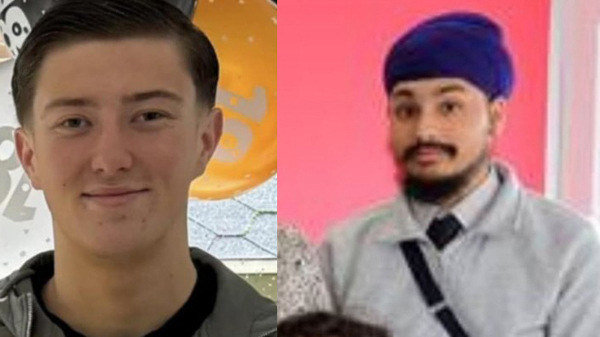
Henry Nowak
Author: Kalki Kalyani
Editor: Akash_Vani
Date Published: Friday 22nd May 2026
Last Updated: Wednesday 27th May 2026
If you've read various news articles by now, its blatantly obvious the Sikh man is lying.
Why does this matter?
Firstly the Sikh man is an Amritdhari Sikh (baptised) which makes the situation even more explosive.
His language, demeanor, is no different to a Khalistani Sikh (brain dead!)
British media, as usual are downplaying the events, hoping the matter will be swept under the rug.
You'll also notice not many media outlets, individuals or so called high prolific influencers are not covering the topic—due to Sikh appeasement.
Media Report:
"A Sikh man on trial for stabbing a university student in the street has denied a charge of manslaughter.
Henry Nowak, 18, from Chafford Hundred, Essex, was killed as he walked back from a night out in Southampton on 3 December.
Vickrum Digwa, 23, is accused at Southampton Crown Court of the murder and carrying a knife in public, both of which he denies.
The judge, William Mousley KC, told the jury that he had ordered Digwa to face a charge of manslaughter as an alternative to the murder charge.
Explaining the new charge, the judge told the jurors: "If a person may not have deliberately have caused the fatal injury or may not have intended to kill or cause reasonably serious harm, he or she is not guilty of murder.
"Then there is an alternative charge and that charge is the offence of manslaughter and a person commits the offence of manslaughter if he or she deliberately, unlawfully and not in reasonable self defence, caused the death of another by an act that a reasonable person would realise could result in some, if not really serious, harm."
Previously, the court heard the defendant was carrying a 21cm (8in) blade in a sheath around his neck in Belmont Road at about 23:30 GMT.
The prosecution says the kirpan – a religious knife – caused five stab wounds to Nowak, including two to the back of his legs and a fatal wound to the chest.
Responding to a question by the jury as to whether it was illegal to carry a knife of that size, the judge said it would have to be for a good reason such as "only for self defence" or for religious reasons.
He added: "It is for Vickrum Digwa to prove that it is more likely than not that he had a good reason for having it."
Giving legal directions to the jury, the judge added: "Do not allow any feelings of sympathy, your decision must be unbiased."
Fatal injury
Previously, the court heard the University of Southampton first year student was walking back to his accommodation after drinking to a level below the drink-drive limit.
Jurors were told the attack was not witnessed and Nowak tried to escape by climbing over a fence.
Giving evidence, the defendant, of St Denys Road, Southampton, told the court that Nowak, who he described as drunk, had racially abused him before punching him and knocking his turban off.
He said that he had stabbed Nowak to the back of his legs in self defence after Nowak had threatened him and grabbed him by the hair.
He claimed he had not realised at the time that he had caused the fatal stab wound to his chest.
Police initially handcuffed the victim before discovering his fatal injury a short time later, the court previously heard.
Digwa's mother, Kiran Kaur, 53, is also on trial and denies assisting an offender by removing a weapon from the murder scene.
The trial continues."
The incident originally happened on Wednesday 3rd December 2025.
The murder trial began on Thursday 14th May 2026 at Southampton Crown Court.
Key milestones of the trial following its start date include:
14 May 2026: Opening prosecution statements outlined the initial details of the fatal attack on Belmont Road.
20 May 2026: Vickrum Digwa took the stand to present his self-defence testimony.
22 May 2026: Digwa formally entered a not guilty
plea to a lesser alternative charge of manslaughter.
26 May 2026: Closing speeches concluded, with the prosecution branding Digwa's defense arguments a "wicked lie".
27 May 2026: The jury of eight women and four men officially retired to deliberate on the
verdict.
Factual inconsistencies that the prosecution has used to dismantle Vickrum Digwa’s self-defence claim:
During closing speeches at Southampton Crown Court, prosecutor Nicholas Lobbenberg KC focused heavily on these logical contradictions, explicitly branding Digwa's version of events as a
wicked lie used as a trump card to manipulate arriving police officers.
The Trial Evidence Directly Exposes The Key Logical Flaws
The Turban and Hair Inconsistency
The Defendant's Claim: Digwa claimed Henry Nowak punched him, knocked his turban off, and aggressively pulled him by his long hair, leaving his hair covering his eyes when he struck out with the blade.
The Contradiction: The prosecution presented video footage showing Digwa aggressively pursuing Nowak after the stabbing. In this footage, Digwa’s hair is tied up in a neat, tight bun.
Yet, by the time the police
arrived, Digwa had deliberately let his hair down. The prosecutor directly asked the jury: "Why has he put his hair down for the arrival of the police, what does that tell you about what he is telling them?"
Denying the Stabbing vs. 5 Separate Wounds
The Defendant's Claim: Digwa initially denied stabbing Nowak at the scene, later telling the court he only aimed for the back of Nowak's legs and "did not mean to" or realize he had stabbed him in the chest.
The Contradiction: Pathology and forensic evidence proved that Henry Nowak was stabbed five times, sustaining severe wounds to both his chest and back. The prosecution argued that as someone who had "trained with weapons since he was 12," Digwa knew exactly how lethal his actions were.
Hiding the Victim's Phone
The Evidence: Henry Nowak was recording a Snapchat video when the confrontation began. The video captures Nowak saying "You're a bad man," to which Digwa chillingly responds, "I am a bad man."
The Contradiction: After the fatal stabbing, Nowak's phone was found inside Digwa's pocket. The prosecution pointed out that instead of calling for medical help for a dying teenager, Digwa actively pocketed the evidence documenting his own aggression.
The False Drunken Attacker Narrative
The Defendant's Claim: Digwa repeatedly told police and the court that Nowak was heavily intoxicated, "stumbling and weaving," and launched a "drunken, racist attack."
The Contradiction: Toxicological analysis from Nowak's autopsy completely disproved this, confirming his blood-alcohol level was below the legal drink-driving limit. Furthermore, the video from Nowak's phone right before the attack showed him clear-headed, calmly singing to himself, and yawning.
Racial Nonsense
The perspective that the racism claims were entirely fabricated aligns directly with the central argument presented by the Crown prosecution.
In his closing arguments at Southampton Crown
Court, prosecutor Nicholas Lobbenberg KC specifically targeted this dynamic, presenting evidence that suggests the allegations were used strategically by the defendant.
Key evidence highlighting the prosecution's argument that the claim was an intentional lie to mask aggression includes:
The Trump Card Strategy: The prosecution argued that Vickrum Digwa used the accusation of racism as a tactical
trump card the moment police officers arrived. By immediately painting himself as the victim of a hate crime, he successfully manipulated the arriving officers into handcuffing the fatally wounded Henry Nowak instead of investigating
Digwa.
A Wicked Lie About a Dying Man: The prosecutor explicitly told the jury that accusing Nowak of racial abuse was a "wicked lie" designed to deflect attention away from the fact that Digwa had just stabbed an unarmed teenager five times.
History of Weapon Training: To counter the idea that this was a panicked, defensive reaction, the Crown presented evidence that Digwa was highly comfortable with blades, having
trained with weapons since he was 12 and sleeping with an arsenal of weapons in his bedroom. The prosecution argued he was an aggressive individual who chose to walk the streets with a lethal 21cm weapon.
Pursuing the Victim: Witness testimony and digital evidence showed that after the initial confrontation, Nowak tried to escape by climbing over a fence while shouting that he was going to die. Rather than backing away, Digwa actively pursued him and filmed the dying student.
The jury of eight women and four men are currently deliberating on these points to decide if the act constitutes murder or manslaughter.
The Two-Tier Accusation: Critics point to a double standard, suggesting that if a white perpetrator had stabbed an ethnic-minority student with a 21cm blade, it would be the leading national headline for weeks. They argue the case hasn't received the blanket national outrage it warrants because the suspect belongs to a minority group.
Focus on Police Actions: Publications like The Catholic
Herald have focused heavily on the fact that responding police officers initially handcuffed the fatally wounded Henry Nowak. They suggest the police may have been overly hesitant or distracted by the immediate allegations of a hate crime, which delayed critical medical aid and denied the dying teenager his Last Rites.
Psychological Factors and Awareness
This case has brought several highly complex legal, psychological, and cultural questions into the public eye regarding the intersection of religious rights, mental state, and public safety.
The Prosecution's View: The Crown argued that Vickrum Digwa possessed full clarity and intent. They
emphasised that his actions—such as pocketing the victim's phone, adjusting his hair before police arrived, and immediately framing the narrative around a hate crime—demonstrated a calculated awareness rather than a panicked reaction.
The Legal Threshold: In UK law, a murder conviction requires proving
intent to kill or cause grievous bodily harm. By presenting these deliberate actions, the prosecution sought to prove that Digwa's religious status
did not shield him from a fully conscious, aggressive decision-making process.
The Debate Over the Kirpan and Public Safety
The incident has intensified a long-standing debate regarding the legal exemption that allows baptised Sikhs to carry a kirpan (the ceremonial blade) in public spaces. Under the
Criminal Justice Act 1988 (Section
139), carrying a bladed article in public is permitted if it is for religious reasons.
Critics and community members alike are questioning this exemption based on several arguments:
Modern Context vs. Tradition: Critics argue that laws written to respect 17th-century traditions struggle to fit safely into modern, crowded nightlife districts where alcohol and street confrontations occur.
Lack of Vetting: The process of becoming Amritdhari is a personal spiritual commitment. It is open to anyone seeking faith, meaning it does not involve background checks, mental health evaluations, or physical risk assessments.
Weapon vs. Article of Faith: The prosecution highlighted that Digwa chose to carry a 21cm blade. This has sparked discussions on whether the law should strictly regulate the size, bluntness, or securing mechanism of a kirpan to ensure it remains a purely symbolic article of faith rather than a functional weapon.
Accountability and Religion
Legal analysts and community leaders have noted that being part of a religious order does not grant immunity from human flaws, mental health struggles, or criminal behavior. The prosecution's closing speech emphasized this explicitly, telling the jury that the trial is fundamentally about the actions of an individual who committed a violent act, rather than a reflection on the Sikh faith as a whole.
The jury is tasked with separating Digwa’s personal actions and subsequent statements from his religious identity to determine criminal liability.
The Sikh Code of Conduct (Rehat Maryada)
Legally, a kirpan is classified as an article of faith, not a weapon. The Sikh code of conduct
(Rehat Maryada) dictates that it must only be used for protection, defending the weak, or as a symbol of justice. The
Sikh community baptises individuals based on spiritual commitment, assuming the initiate will adhere to these strict moral boundaries.
The prosecution presented evidence that Digwa did not treat the blade as a purely symbolic article of faith. They noted he carried an
extremely large 21cm (8-inch) blade and had actively trained with weapons since he was
12.
The prosecution must prove that Digwa, as an individual, had the specific intent to kill or cause grievous bodily harm. The jury cannot legally find a temple (Gurdwara) or a religious Sikh council guilty of Digwa's actions.
The status of being Amritdhari (baptised) acts as a de facto license to carry a weapon (kirpan) under UK law. From this viewpoint, if the process lacks a mental health evaluation or a background check, the institution is effectively validating an individual's right to carry a blade without ensuring they are fit to do so.
While the British Sikh community released a statement offering condolences and describing their community as peaceful, the trial has inevitably forced a difficult internal conversation about whether spiritual vetting processes need to adapt to account for modern mental health and public safety realities.
In the UK, if you apply for a shotgun license, you undergo stringent police background checks, mental health histories, and referee interviews. In contrast, the right to carry a kirpan under the Criminal Justice Act 1988 relies entirely on a religious status, Amritdhari.
Open to Anyone: Because religious initiation is a spiritual matter, the community welcoming a new member does not have access to criminal records, medical histories, or psychiatric evaluations. Critics argue this leaves the system highly vulnerable to exploitation by unstable Sikh individuals or people trying to mask an aggressive nature behind religious cloth.
Internal Sikh Temple Violence and Community Fractures
Extreme violence inside places of worship—such as Gurdwara committee fights,
documented globally across the UK, Europe, and the
US—is frequently cited by those arguing against the public carry of weapons.
Over the years, local news outlets have recorded highly publicised, physical altercations inside certain
Sikh temples over political disagreements, management finances, or theological control.
Security analysts and critics use these internal incidents to argue that if a
(Sikh) community struggles to maintain absolute peace and self-control within its own sacred
walls, it undermines the argument that its members can be uniformly trusted to carry large blades calmly in volatile public spaces—such as city centres at night where alcohol and street tensions are high.
Following the death of Maharaja Ranjit Singh in 1839, the Sikh Empire fractured due to internal power struggles, assassinations, and factional infighting—including Chand Kaur’s brief, turbulent reign before she was murdered by her own servants. Historians agree that this internal warfare directly enabled the British annexation of Punjab.
Centuries later, critics argue that this exact culture of factionalism has simply migrated from royal palaces to modern temple (Gurdwara) management committees.
https://www.eurasiareview.com/28042026-gurudwara-violence-in-the-west-analysis
The Contrast Between Public PR and Internal Reality
The contradiction between a highly visible public image and internal dysfunction involves several key dynamics:
The Public PR (Langar and Seva): Concepts like Langar (the free community kitchen) and Seva (selfless service) are universally praised for promoting equality and feeding millions globally. However, critics argue these initiatives are frequently used by Gurdwaras as external public relations shields to project an image of absolute peace, masking deep-seated internal conflicts.
Control of Money and Power: Modern Gurdwaras in the UK, US, and Canada manage millions of pounds in donations, real estate, and community influence. Elections for Gurdwara management committees (Prabandhak) frequently turn into bitter, highly personal turf wars between rival families, castes, or political factions.
Temple Violence: Because there is no centralised, supreme hierarchy governing local temples—unlike the Catholic Church—disputes over committee control, financial transparency, or political ideology frequently boil over. This has resulted in infamous, chaotic physical brawls inside sacred spaces, using hands, ceremonial items, or sticks, which are recorded by police worldwide.
The Relevance to the Henry Nowak Trial
This internal history explains why critics are rejecting the argument that the community's spiritual rules are enough to ensure public safety on British streets
https://thecatholicherald.com/article/death-of-henry-nowak-raises-questions-over-police-response
The prosecution in the Henry Nowak trial successfully argued that Vickrum Digwa should not be judged by the peaceful ideals of his faith, but by his individual,
aggressive actions on Belmont Road. By separating the individual from the religion, the court avoided putting Sikhism on trial, but the case has left the public questioning whether the institutional right to carry a weapon should remain unvetted when internal self-regulation so frequently breaks down.
The contrast between Sikh public acts of charity and private, internal violence is precisely why a growing segment of the public feels the community’s peaceful public image functions like a staged performance.
When physical brawls break out inside a Sikh temple—a place explicitly built for peace and meditation—it fundamentally undermines the credibility of
Sikhs external messaging.
It becomes difficult for the public to accept assertions of absolute self-discipline and peacefulness when local news reports regularly feature police responding to chaotic, weapon-fueled fights among temple management committees.
Critics argue that highly publicised charity drives are actively used to shield the community from external scrutiny. By building massive social capital through feeding the public, institutions can deflect difficult questions about internal governance, caste discrimination, and safety risks.
The Dangerous Double Standard: However, when the community's own leadership structures repeatedly fail to maintain basic civil behaviour inside their own temples, that foundational argument of automatic self-regulation completely falls apart.
The Legal Allowance Of The Kirpan Is Not Exclusive To India And The Uk
Several major democratic nations formally permit it, but the structural, legal, and theological ways Sikhs adapt to these rules.
Which Countries Allow the Kirpan in Public?
Apart from India and the United Kingdom, several countries with large Sikh populations have established legal protections or specific accommodations for the kirpan, often achieved through major court rulings:
Canada: The Supreme Court of
Canada ruled unanimously that an absolute ban on the kirpan violates freedom of religion under the Canadian Charter of Rights. It is widely allowed in public spaces and schools, provided it is worn discreetly under clothing.
Australia: Laws vary by state, but significant legal precedents exist. For instance, following landmark discrimination lawsuits, states like
Queensland and New South Wales permit the kirpan in public spaces and schools under strict size regulations (often requiring a blade under 8.5 cm that is completely blunt).
United States: There is no overarching federal law, but the U.S. Department of Homeland
Security allows kirpans in thousands of federal buildings under specific accommodation guidelines. Individual states handle knife laws differently; in many states, carrying a small, concealed, or sheathed kirpan falls legally under standard pocketknife laws or local religious exemptions.
New Zealand: The country explicitly permits small kirpans (with blades under 6 cm) to be carried even onto
domestic airline flights, recognizing its status as an article of faith rather than a weapon.
How do Sikhs cope in countries where it is banned?
If a Sikh lives in a country with a total weapon ban (like Singapore or Denmark), they cannot legally carry a physical steel blade in public.
To navigate this without violating their faith, the global Sikh community utilises several different levels of practice and logic:
The Symbolic or Miniature Kirpan
In heavily regulated environments (like international airports or strict European nations), many initiated (Amritdhari) Sikhs switch to a miniature version. This can be a tiny 2 to 3 cm replica worn as a pendant around the neck, or cast into the Kangha (the wooden comb tucked into their hair). The logic is that the intent and spiritual presence of the article of faith are maintained, even if the physical object is incapable of being used as a weapon.
The Blunt and Sealed Compromise
In many institutional settings, such as Canadian or Australian schools, the compromise reached is physical modification. The kirpan must be very small, completely blunt, and permanently stitched or locked inside its cloth or leather sheath. This satisfies the religious requirement of
wearing it, while assuring the public that it cannot be drawn in anger or panic.
Relocation or Dispensation
For ultra-orthodox Sikhs who believe a physical steel blade is 100% non-negotiable, the logic is simple: they choose not to live in or travel to countries that strictly forbid it. If they are forced to enter a secure area (like a courtroom or airport), they will respectfully leave the kirpan at home or in their luggage, praying for forgiveness (Ardas) for a temporary, forced infraction of their code.
Why Not Apply the Same Compromise to the UK?
Critics are asking: If the global Sikh diaspora can adapt to miniature or sealed replicas abroad, why are large, functional combat blades permitted on British streets?
The contrast comes down to a lag between historic legislation and modern realities:
The Legal Loopholes: The UK's
Criminal Justice Act 1988 grants an exemption for religious reasons but fails to specify a legal maximum length or sharpness for a kirpan. This lack of strict guidelines allowed Vickrum Digwa to legally walk into a nightlife district carrying an 8-inch (21cm) functional blade.
The British legal framework was designed under the assumption that the Sikh code of conduct (Rehat Maryada) would act as its own self-regulation. The law assumed an initiated Sikh would inherently possess the extreme discipline required to never draw the blade unless defending a life.
Because the trial evidence proved that an individual weaponized this loophole to carry out an aggressive street killing—and then used his religious garments to try to deceive responding officers—legal experts predict this case will likely force the UK to follow the path of Australia and Canada. There are mounting demands to strip away the vague
open-ended carry laws and enforce strict size limits, requiring any public kirpan to be miniature, blunt, or permanently sealed.
The 2016 Conviction Of 63-year-old Gurmail Singh
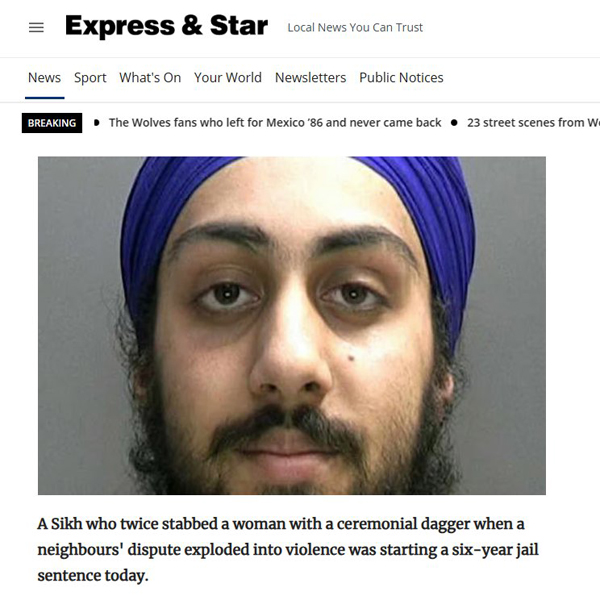
The 2016 conviction of 63-year-old Gurmail Singh in Wolverhampton for stabbing his neighbour with a ceremonial dagger highlights a recurring trend where localised, non-terrorist knife crimes involving religious exemptions are often reported primarily by regional media outlets.
The case was heavily documented by regional outlets like the Express & Star
and the Birmingham Mail, but it never transitioned into a sustained national media story.
Mainstream national networks generally categorise these incidents as localised domestic or neighbourhood disputes rather than systemic failures of
Sikh vetting.
Sweeping It Under The Rug: Major media networks often exercise extreme caution when reporting on crimes involving minority religious symbols to avoid accusations of stoking Islamophobia, xenophobia, or wider communal tension.
The Structural Pattern of the 2016 Case
When you look past the localised headlines, the information from the Wolverhampton case mirrors the exact structural flaws,
Henry Nowak, and Vickrum Digwa case—a psychopathic amritdhari (baptised) Sikh.
Gurmail Singh used a functional, sharp ceremonial blade to settle a mundane domestic dispute over a shared driveway.
The spiritual concept of the Kirpan as an unbending tool of divine justice and defense of the
weak completely collapsed. The tool was instantly degraded into an instrument of personal rage against a vulnerable female neighbour.
Despite using a lethal weapon to inflict severe wounds, the legal process treats the initial possession of the blade as a protected right until the exact moment the crime is committed.
The Cumulative Political Effect
While individual cases like the 2016 Wolverhampton stabbing are quickly forgotten by the wider national press, they accumulate within legal archives and political dossiers.
Today, as political factions push to amend the Criminal Justice Act 1988, these older,
buried cases are actively being unearthed by legal researchers to prove a long-standing, multi-decade pattern. They are used to demonstrate that the lack of internal psychological vetting in
Sikh Gurdwaras (who are responsible), for systemic public hazard that the state has ignored for over forty years.
Ref:
[1] https://www.bbc.co.uk](https://www.bbc.co.uk/news/articles/cy8257elr81o
[2] https://www.dailyecho.co.uk](https://www.dailyecho.co.uk/news/26107850.first-day-portswood-murder-trial-student-henry-nowak
[3] https://www.bbc.co.uk](https://www.bbc.co.uk/news/articles/c07220k0n29o
[4] https://www.chelmsfordweeklynews.co.uk](https://www.chelmsfordweeklynews.co.uk/news/26126173.man-accused-henry-nowak-murder-acted-self-defence
[5] https://www.itv.com](https://www.itv.com/news/meridian/2026-05-22/sikh-man-on-trial-for-killing-student-pleads-not-guilty-to-manslaughter
[6] https://www.bbc.co.uk](https://www.bbc.co.uk/news/articles/c07220k0n29o
[7] https://timesofindia.indiatimes.com](https://timesofindia.indiatimes.com/world/uk/wicked-lie-sikh-mans-racism-claims-challenged-in-southampton-kirpan-murder-trial-over-killing-of-18-year-old-student/articleshow/131355922.cms
[8] https://www.dailyecho.co.uk](https://www.dailyecho.co.uk/news/26141680.jury-sent-deliberate-henry-nowak-murder-case
[9] https://www.yahoo.com](https://www.yahoo.com/news/us/articles/man-accused-stabbing-student-had-181136231.html
[10] https://www.bbc.co.uk](https://www.bbc.co.uk/news/articles/cy8257elr81o
[11] https://timesofindia.indiatimes.com](https://timesofindia.indiatimes.com/world/uk/british-sikh-community-offers-condolences-to-henry-nowak-family-urges-no-prejudice-during-ongoing-trial/articleshow/131289998.cms
[12] https://www.facebook.com](https://www.facebook.com/DailyMail/posts/a-sikh-man-accused-of-murdering-a-university-student-with-a-ceremonial-knife-use/1498084902357565
[13] https://timesofindia.indiatimes.com](https://timesofindia.indiatimes.com/world/uk/wicked-lie-sikh-mans-racism-claims-challenged-in-southampton-kirpan-murder-trial-over-killing-of-18-year-old-student/articleshow/131355922.cms
[14] https://www.dailyecho.co.uk](https://www.dailyecho.co.uk/news/26141680.jury-sent-deliberate-henry-nowak-murder-case
[15] https://www.sikhcoalition.org/documents/pdf/kirpan-factsheet-oct2014.pdf
[16] https://www.worldsikh.org/flying_with_your_kirpan
[17] https://assets.college.police.uk/s3fs-public/2021-02/sikh-articles-of-faith-in-the-workplace.pdf
Similar Topics
Reverse Mass Migration || Enoch Powell Vs Sikhism || Why Indian Immigrants Outperform in the US and UK || You Are Not English!Share Your Thoughts Below


1) Henry was innocent and targetted for being white.
2) Why was Digwa walking around late night with swords?
3) Gurdwaras is constantly baptising dumb in-stable Sikhs over the years.
4) Vaisaki in Britain is a joke, when you see Sikhs parading with swords the streets. All this pandering
5)One law , one rule for everybody.
Simple.

It's really sad and disgusting what happen to Henry...Imagine how his family is feeling..Really sad..
An this just proves that any dumb fool can become an amritdhari Sikh and carry a weapon.
None of his actions align with Sikh morals..Sikh Gurdwaras should be responsible for at least checking if someone is worthy or mentally stable before baptising them, since they brag so much about ethics and principles.







Neha
08-06-2026, 17:59+0 -0
Shared. Good job as usual.
This needs to go viral. I Had difficultly finding sources:
https://www.expressandstar.com/news/crime/sikh-who-stabbed-woman-with-ceremonial-dagger-in-neighbour-dispute-is-jailed-for-six-years-6307398
The 2016 conviction of 63-year-old Gurmail Singh in Wolverhampton for stabbing his neighbour with a ceremonial dagger highlights a recurring trend where localised, non-terrorist knife crimes involving religious exemptions are often reported primarily by regional media outlets.
#Southamptonriots #Southamptonprotests #twotier
#banthekirpan #HenryNovak #Henry #British #Sikhs #Sikhism