-
Sarve bhavantu sukhinah
Sarve santu nira-maya-ah
Sarve bhadrani pashyantu ma-kaschit dukha-bhak bhavet- Brihadaranyaka Upanishad: 1.4.14
-
“May all of mankind be happy May all be healthy
May all experience prosperity
May none (in the world) suffer.”- Brihadaranyaka Upanishad: 1.4.14
-
Asato Maa Sad Gamaya Tamaso Maa
Jyotir Gamaya Mrityor Maa Amritam Gamaya- Brihadaranyaka Upanishad: 1.3.28
-
“O' Lord, please lead me from darkness of ignorance
to the light (of knowledge) From death (limitation)
to immortality (liberation).”- Brihadaranyaka Upanishad: 1.3.28



This page has been viewed: times.
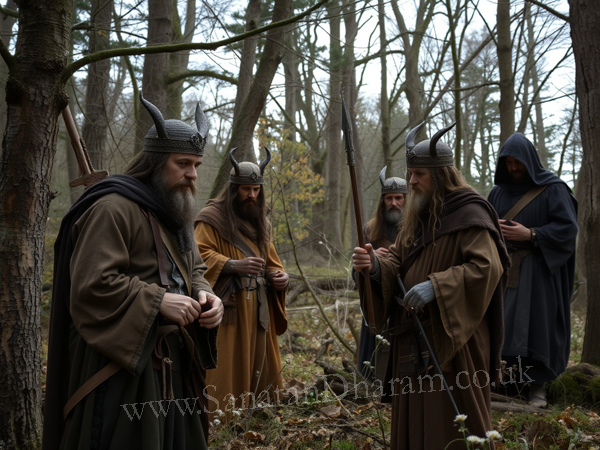
The Resurgence of Paganism In Europe
Author: Kalki Kalyani
Editor: Akash_Vani
Date Published: Friday 13th March 2026
What happen to Paganism in Europe?
Historically, the tragedy of the European paganism wasn't just a loss of faith; it was a total systematic wipe. When the
Abrahamic tide hit Europe, it didn't just convert people—it dismantled the very infrastructure of their connection to the land and their ancestors.
Aldous Huxley,
said it best:
"Passing now from theory to historical fact, we find that the religions, whose theology has been least preoccupied with events in time and most concerned with eternity, have been consistently the least violent and the most humane in political practice. Unlike early Judaism, Christianity and Mohammedanism (all of them obsessed with time), Hinduism and Buddhism have never been persecuting faiths, have preached almost no holy wars and have refrained from that proselytizing religious imperialism, which has gone hand in hand with the political and economic oppression of the coloured peoples. For four hundred years, from the beginning of the sixteenth century to the beginning of the twentieth, most of the Christian nations of Europe have spent a good part of their time and energy in attacking, conquering and exploiting their non Christian neighbors in other continents. In the course of these centuries many individual churchmen did their best to mitigate the consequences of such iniquities ; but none of the major Christian churches officially condemned them. The first collective protest against the slave system, introduced by the English and the Spaniards into the New World, was made in 1688 by the Quaker Meeting of Germantown. This fact is highly significant. Of all Christian sects in the seventeenth century, the Quakers were the least obsessed with history, the least addicted to the idolatry of things in time. They believed that the inner light was in all human beings and that salvation came to those who lived in conformity with that light and was not dependent on the profession of belief in historical or pseudo-historical events, nor on the performance of certain rites, nor on the support of a particular ecclesiastical organization. Moreover, their eternity-philosophy preserved them from the materialistic apocalypticism of that progress-worship which in recent times has justified every kind of iniquity from war and revolution to sweated labour, slavery and the exploitation of savages and children has justified them on the ground that the supreme good is in future time and that any temporal means, however intrinsically horrible, may be used to achieve that good. Because Quaker theology was a form of eternity philosophy, Quaker political theory rejected war and persecution as means to ideal ends, denounced slavery and proclaimed racial equality. Members of other denominations had done good work for the African victims of the white man's rapacity. One thinks, for example, of St. Peter Claver at Cartagena. But this heroically charitable 'slave of the slaves' never raised his voice against the institution of slavery or the criminal trade by which it was sustained; nor, so far as the extant documents reveal, did he ever, like John Woolman, attempt to persuade the slave-owners to free their human chattels. The reason, presumably, was that Claver was a Jesuit, vowed to perfect obedience and constrained by his theology to regard a certain political and ecclesiastical organization as being the mystical body of Christ."
- The Perennial philosophy - By Aldous Huxley p. 223/4
"Another practical corollary of the great historical eternity philosophies, such as Hinduism and Buddhism, is a morality inculcating kindness to animals. Judaism and orthodox Christianity taught that animals might be used as things, for the realization of man's temporal ends. Even St. Francis' attitude towards the brute creation was not entirely unequivocal. True, he converted a wolf and preached sermons to birds ; but when Brother Juniper hacked the feet off a living pig in order to satisfy a sick man's craving for fried trotters, the saint merely blamed his disciple's intemperate zeal in damaging a valuable piece of private property. It was not until the nineteenth century, when orthodox Christianity had lost much of its power over European minds, that the idea that it might be a good thing to behave humanely towards animals began to make headway. This new morality was correlated with the new interest in Nature, which had been stimulated by the romantic poets and the men of science."
- The Perennial philosophy - By Aldous Huxley p. 223/4
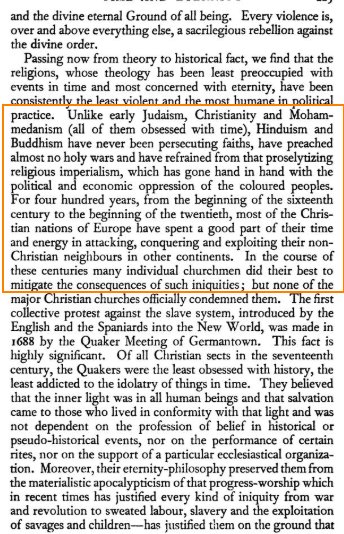
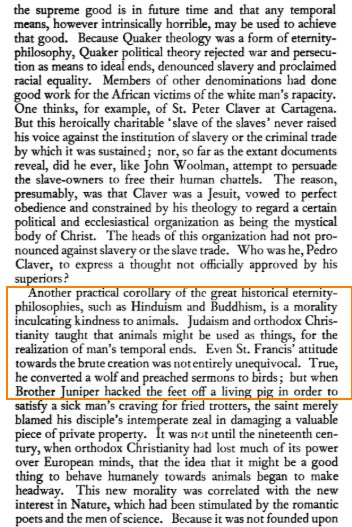
Available online: Archive.org
Temples weren't just closed; they were built over. Festivals weren't just banned; they were rebranded into hollowed-out versions of themselves. Unlike the Dharmic pushback in India—where the root system was too deep and too resilient to be fully overwritten by Islam or Christianity—Europe's indigenous roots were effectively cauterized.
The pagan trade routes
(Dvārakā–Kamboja
route) are the forgotten evidence of this. For centuries
(Periplus of the Erythraean Sea)
before the monotheistic wall went up, there was a fluid, organic exchange between the
Vedic world and the
European pagans. It was a shared language of polytheism, nature-worship, and local sovereignty. Abrahamization didn't just bring a new god; it brought a "border" that cut those trade routes and isolated the
European soul from its ancient cousins in the east.
Now, let's look at the modern U.K through that mughal mirror. The failure of
Christianity in Britain isn't just about empty pews; it’s a total collapse of the moral and cultural scaffolding that the monotheistic state relied on. Enter
woke king
Charles—a monarch who seems more interested in being a defender of all faiths (which usually means none of them) than standing for a coherent tradition. He’s essentially presiding over a managed decline.
The secular Christian experiment has backfired. By stripping away the sacred and leaving only the
bureaucratic, they’ve created a vacuum. And that’s where the rise of pagans in the uk comes in. People are looking for something that feels
real—something that isn't just another corporate, woke directive. This is creating a massive voter split. On one side, you have the crumbling
secular
Christian establishment trying to hold on with woke platitudes; on the other, a growing, unorganized but visceral return to indigenous,
pagan identities that refuse to be managed by a globalized, abrahamic-lite
system.
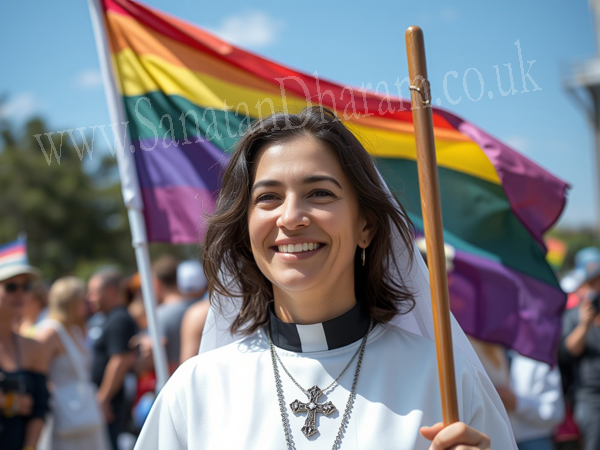
The numbers tell a story that the establishment is trying to downplay. For the first time since the dark ages, Christianity has dipped below the 50% mark in England and Wales, landing at 46.2%. Meanwhile, the pagan resurgence is no longer a fringe whisper; it’s a documented rise. The 2021 census saw the number of self-identified pagans jump to 74,000—a significant leap from 57,000 in 2011. If you add in Wiccans (13,000) and the explosive growth in Shamanism (from 650 to 8,000), the indigenous spirit is clearly clawing its way back through the floorboards of the secular state.
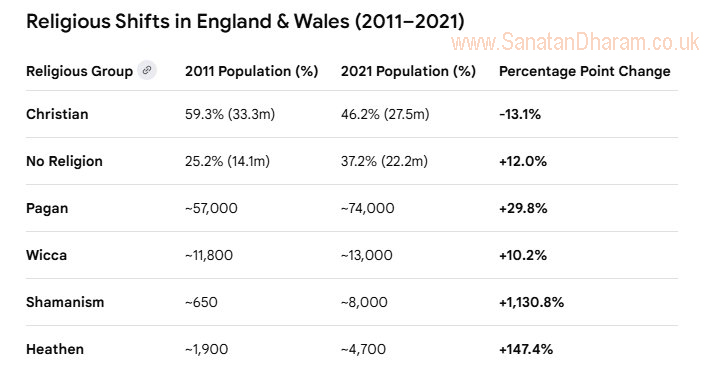
The Christian Monopoly vs. The Reality
The real friction lies in the political structure. Despite the demographic collapse, the UK remains tethered to a
Christian based
identity that feels increasingly alien to the people living there.
The Voter Split: You have a political class—from the All-Party Parliamentary Group for Christians in
Parliament to parties like the Christian Peoples
Alliance—that still operates as if the country is a unified flock. This
secular
Christianity has become a hollow shell; it keeps the bureaucratic power of the church but strips away the actual spiritual depth, leaving a vacuum that is being filled by
woke ideology.
Isolation of Non-White Communities: The irony of the UK's Christian-based politics is how it
isolates non-white populations. While the establishment uses
Christian values as a shorthand for British tradition, they overlook that the most fervent church growth is actually coming from socially conservative immigrant communities. By trying to maintain a
secular-lite Christian monopoly, the state ends up alienating both the growing Dharmic/pagan indigenous roots and the very non-white Christians they claim to represent.
The Woke Monarchy and the Collapse
King Charles's shift from Defender of the Faith to Defender of Faith is the ultimate sign of this crumbling
system (as mentioned). It’s an attempt to manage the decline by being everything to everyone, which effectively means standing for nothing. By turning the monarchy into a multicultural HR department, the crown has severed its last mystical link to the land—the very link that the pagans are now trying to reclaim.
Secular Christianity hasn't just failed; it has destroyed the cultural immune system of the UK. It opened the door for a "universal" identity that erases the local and the ancient, creating the exact
time bomb we mapped in our earlier
discusions.
This is where the identity bomb detonates. When groups like Britain First or figures like Paul Golding scream that Britain is a Christian country, they are clinging to a 1940s frequency that no longer matches the demographic pulse. The 2021 Census was the turning point: Christianity fell to 46.2%, while the pagan resurgence (74,000+ self-identified) is filling the void left by secular Christianity.
The White British Identity. It’s No Longer A Unified Front;
It’s A Civil War Between The Cross And The Roots
The Pagan vs. Christian Voter Split
The ethno-national resurgence isn't moving toward the Church—it's moving away from it.
The Christian Hangover: Many (self-aware) white pagans now view Christianity not as a shield, but as the original abrahamic virus that paved the way for modern globalism. They see the Church’s history of
universalism as the blueprint for the current woke erasure of local borders.
Refusal to Support: There is a growing block of voters who want a return to an ancestral state but refuse to back
Christian nationalist parties. They see figures like Golding as weaponising a faith that is historically responsible for colonising and erasing the original, indigenous
European spirit.
Christianity as the Architect of Colonisation
This is the strike that hurts the establishment most. White pagans are increasingly adopting the same
view we see in the Dharmic pushback:
The Macauliffe Parallel: Just as the British used theological
sabotage to rewire the Sikh system, the early Church used the same boa
constrictor tactics to overwrite European paganism.
Historical Guilt: These groups hold the Christian system responsible for dismantling the old
pagan trade
routes and nature-based law, replacing them with a centralised, bureaucratic power that has now mutated into the
secular woke state.
The Isolation Factor
By shouting we are a Christian country, these far-right groups actually alienate the very people they claim to represent.
Exclusionary Rhetoric: When they use Christian symbols, they isolate the burgeoning pagan youth who feel a deeper connection to Stonehenge or Woden than to a middle-eastern deity.
The Failure of Secular Christianity: Because parties like the Christian Peoples
Alliance or civic nationalists focus on a hollowed-out Christian identity, they leave the indigenous
pagan spirit with no political home, causing a deeper, more volatile split in the voter base.
The woke monarchy is just the final, decaying phase of this. King Charles’s
multi-faith HR approach is the last gasp of a system that knows it has lost the mandate of the land.
The Voter Deadlock: This is the Time Bomb In The UK Right Now!
1. The Christian Nationalists want to go back to a 1950s version of imperialism that is already dead.
2. The Woke Secularists are just using the same universalizing Christian missionary zeal to preach a new religion of DEI and globalism.
3. The Pagans and Dharmic Seekers are the only ones standing outside this
Time-Obsessed loop, trying to reconnect with the land and the sovereign self.
By keeping the white pagan and the white Christian in a state of mutual resentment, the establishment ensures that a unified
indigenous pushback never happens. They use the pagan’s valid historical grievance against the Church to make them look
fringe, while using the Christian's desperation to keep them tethered to a crumbling, woke state.
Similar Topics
Why Do I Feel So Empty And Lost? || Your Spiritual Journey, Is Yours Alone! || Declaration of Intellectual Independence ||Share Your Thoughts Below
No comments found.







Resend activation URL
Login | Register
Enter your email address in the field below and we'll send you an email with activation URL.