-
Sarve bhavantu sukhinah
Sarve santu nira-maya-ah
Sarve bhadrani pashyantu ma-kaschit dukha-bhak bhavet- Brihadaranyaka Upanishad: 1.4.14
-
“May all of mankind be happy May all be healthy
May all experience prosperity
May none (in the world) suffer.”- Brihadaranyaka Upanishad: 1.4.14
-
Asato Maa Sad Gamaya Tamaso Maa
Jyotir Gamaya Mrityor Maa Amritam Gamaya- Brihadaranyaka Upanishad: 1.3.28
-
“O' Lord, please lead me from darkness of ignorance
to the light (of knowledge) From death (limitation)
to immortality (liberation).”- Brihadaranyaka Upanishad: 1.3.28



This page has been viewed: times.
The Historical Disconnect between The Martial Race Theory
And The Actual Treatment Of British Sikhs!
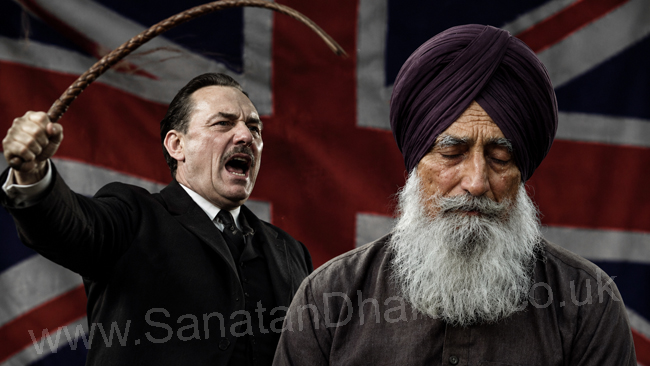
Enoch Powell Vs Sikhism
Author: Kalki Kalyani
Editor: Akash_Vani
Date Published: Sunday 27th October 2024
Today we look at the historical disconnect between the Martial Race theory (Sikhs:
The Colonial Puppets Of The British Raj) and the actual treatment of British Sikhs upon arrival in the mid-20th century,
which highlights a significant shift in British state policy.
During the British Raj, colonial authorities heavily romanticised and relied upon the
Sikh martial tradition. However, when those same populations exercised their rights as Commonwealth citizens to migrate to the UK in the 1950s, 1960s, and 1970s,
the imperial gratitude evaporated. They were immediately subjected to systemic,
working-class
racial segregation and institutional barriers
Sociologists and imperial historians explain this sharp shift through four distinct lenses:
The Martial Race designation was a calculated colonial construct rather than a genuine badge of
equality.
The Colonial Bootlicker Need: Following the 1857 Indian Mutiny, the British Raj systematically classified specific loyal, rural ethnic groups—like Sikhs and
Gurkhas—as naturally warlike to streamline military recruitment and maintain imperial control over India.
The Domestic Reality (Honeymoon Over) When the British economy faced severe labor shortages after World War II, the UK government viewed South Asian arrivals strictly as low-cost manual labor, not as decorated veterans or imperial partners. Once they stepped off the boats into British industrial cities, their military heritage was entirely ignored by local employers, landlords, and unions who sought to protect white, working-class domestic jobs.
The Clean-Shaven Requirement (Identity Stripping)
One of the most direct forms of institutional discrimination targeted the core indicators of the Sikh identity. Despite fighting in both World Wars with their turbans and beards intact, British corporate and civic bodies forced a choice between religious observance and employment:
The Transport Bar: Across major industrial hubs like Birmingham, Wolverhampton, and London, municipal bus companies operated strict uniform policies
that banned turbans and long
beards.
Forced Assimilation: To secure basic income to pay for accommodation, thousands of highly qualified or
proud first-generation Sikh men were
compelled by economic desperation to cut their hair (Kesh) and shave. Those who refused were locked out of white-collar or public-facing roles, pushed into hot, dangerous night shifts in iron foundries and brickworks where they were hidden from public view.
The Shift from Paternalism to Local Xenophobia
The imperial affection shown by British officers in the Punjab did not translate to the local councils of the English West Midlands:
The
Colour Bar Housing Crisis: As with other South Asian and Caribbean arrivals, Sikhs faced rampant housing discrimination. Landlords openly enforced a
colour bar, and banks systematically denied them mortgages.
The Political Backlash: Rather than welcoming Commonwealth citizens, local politicians actively campaigned against them. It was in the West Midlands—home to a massive, hard-working Sikh population—that MP Enoch Powell delivered his infamous 1968 "Rivers of Blood" speech, explicitly campaigning against the
Race Relations
Bill that sought to make it illegal to refuse housing or jobs to minorities.
The full text of Enoch Powell's so-called 'Rivers of Blood' speech:
The supreme function of statesmanship is to provide against preventable evils. In seeking to do so, it encounters obstacles which are deeply rooted in human nature. One is that by the very order of things such evils are not demonstrable until they have occurred: at each stage in their onset there is room for doubt and for dispute whether they be real or imaginary. By the same token, they attract little attention in comparison with current troubles, which are both indisputable and pressing: whence the besetting temptation of all politics to concern itself with the immediate present at the expense of the future. Above all, people are disposed to mistake predicting troubles for causing troubles and even for desiring troubles: "If only," they love to think, "if only people wouldn't talk about it, it probably wouldn't happen." Perhaps this habit goes back to the primitive belief that the word and the thing, the name and the object, are identical. At all events, the discussion of future grave but, with effort now, avoidable evils is the most unpopular and at the same time the most necessary occupation for the politician. Those who knowingly shirk it deserve, and not infrequently receive, the curses of those who come after. A week or two ago I fell into conversation with a constituent, a middle-aged, quite ordinary working man employed in one of our nationalised industries. After a sentence or two about the weather, he suddenly said: "If I had the money to go, I wouldn't stay in this country." I made some deprecatory reply to the effect that even this government wouldn't last for ever; but he took no notice, and continued: "I have three children, all of them been through grammar school and two of them married now, with family. I shan't be satisfied till I have seen them all settled overseas. In this country in 15 or 20 years' time the black man will have the whip hand over the white man." I can already hear the chorus of execration. How dare I say such a horrible thing? How dare I stir up trouble and inflame feelings by repeating such a conversation? The answer is that I do not have the right not to do so. Here is a decent, ordinary fellow Englishman, who in broad daylight in my own town says to me, his Member of Parliament, that his country will not be worth living in for his children.
I simply do not have the right to shrug my shoulders and think about something else. What he is saying, thousands and hundreds of thousands are saying and thinking - not throughout Great Britain, perhaps, but in the areas that are already undergoing the total transformation to which there is no parallel in a thousand years of English history. In 15 or 20 years, on present trends, there will be in this country three and a half million Commonwealth immigrants and their descendants. That is not my figure. That is the official figure given to parliament by the spokesman of the Registrar General's Office. There is no comparable official figure for the year 2000, but it must be in the region of five to seven million, approximately one-tenth of the whole population, and approaching that of Greater London. Of course, it will not be evenly distributed from Margate to Aberystwyth and from Penzance to Aberdeen. Whole areas, towns and parts of towns across England will be occupied by sections of the immigrant and immigrant-descended population. As time goes on, the proportion of this total who are immigrant descendants, those born in England, who arrived here by exactly the same route as the rest of us, will rapidly increase. Already by 1985 the native-born would constitute the majority. It is this fact which creates the extreme urgency of action now, of just that kind of action which is hardest for politicians to take, action where the difficulties lie in the present but the evils to be prevented or minimised lie several parliaments ahead. The natural and rational first question with a nation confronted by such a prospect is to ask: "How can its dimensions be reduced?" Granted it be not wholly preventable, can it be limited, bearing in mind that numbers are of the essence: the significance and consequences of an alien element introduced into a country or population are profoundly different according to whether that element is 1 per cent or 10 per cent. The answers to the simple and rational question are equally simple and rational: by stopping, or virtually stopping, further inflow, and by promoting the maximum outflow. Both answers are part of the official policy of the Conservative Party. It almost passes belief that at this moment 20 or 30 additional immigrant children are arriving from overseas in Wolverhampton alone every week - and that means 15 or 20 additional families a decade or two hence. Those whom the gods wish to destroy, they first make mad. We must be mad, literally mad, as a nation to be permitting the annual inflow of some 50,000 dependants, who are for the most part the material of the future growth of the immigrant-descended population. It is like watching a nation busily engaged in heaping up its own funeral pyre. So insane are we that we actually permit unmarried persons to immigrate for the purpose of founding a family with spouses and fiancés whom they have never seen. Let no one suppose that the flow of dependants will automatically tail off. On the contrary, even at the present admission rate of only 5,000 a year by voucher, there is sufficient for a further 25,000 dependants per annum ad infinitum, without taking into account the huge reservoir of existing relations in this country - and I am making no allowance at all for fraudulent entry. In these circumstances nothing will suffice but that the total inflow for settlement should be reduced
at once to negligible proportions, and that the necessary legislative and administrative measures be taken without delay. I stress the words "for settlement." This has nothing to do with the entry of Commonwealth citizens, any more than of aliens, into this country, for the purposes of study or of improving their qualifications, like (for instance) the Commonwealth doctors who, to the advantage of their own countries, have enabled our hospital service to be expanded faster than would otherwise have been possible. They are not, and never have been, immigrants. I turn to re-emigration. If all immigration ended tomorrow, the rate of growth of the immigrant and immigrant-descended population would be substantially reduced, but the prospective size of this element in the population would still leave the basic character of the national danger unaffected. This can only be tackled while a considerable proportion of the total still comprises persons who entered this country during the last ten years or so. Hence the urgency of implementing now the second element of the Conservative Party's policy: the encouragement of re-emigration. Nobody can make an estimate of the numbers which, with generous assistance, would choose either to return to their countries of origin or to go to other countries anxious to receive the manpower and the skills they represent. Nobody knows, because no such policy has yet been attempted. I can only say that, even at present, immigrants in my own constituency from time to time come to me, asking if I can find them assistance to return home. If such a policy were adopted and pursued with the determination which the gravity of the alternative justifies, the resultant outflow could appreciably alter the prospects. The third element of the Conservative Party's policy is that all who are in this country as citizens should be equal before the law and that there shall be no discrimination or difference made between them by public authority. As Mr Heath has put it we will have no "first-class citizens" and "second-class citizens." This does not mean that the immigrant and his descendent should be elevated into a privileged or special class or that the citizen should be denied his right to discriminate in the management of his own affairs between one fellow-citizen and another or that he should be subjected to imposition as to his reasons and motive for behaving in one lawful manner rather than another. There could be no grosser misconception of the realities than is entertained by those who vociferously demand legislation as they call it "against discrimination", whether they be leaderwriters of the same kidney and sometimes on the same newspapers which year after year in the 1930s tried to blind this country to the rising peril which confronted it, or archbishops who live in palaces, faring delicately with the bedclothes pulled right up over their heads. They have got it exactly and diametrically wrong. The discrimination and the deprivation, the sense of alarm and of resentment, lies not with the immigrant population but with those among whom they have come and are still coming.
This is why to enact legislation of the kind before parliament at this moment is to risk throwing a match on to gunpowder. The kindest thing that can be said about those who propose and support it is that they know not what they do. Nothing is more misleading than comparison between the Commonwealth immigrant in Britain and the American Negro. The Negro population of the United States, which was already in existence before the United States became a nation, started literally as slaves and were later given the franchise and other rights of citizenship, to the exercise of which they have only gradually and still incompletely come. The Commonwealth immigrant came to Britain as a full citizen, to a country which knew no discrimination between one citizen and another, and he entered instantly into the possession of the rights of every citizen, from the vote to free treatment under the National Health Service. Whatever drawbacks attended the immigrants arose not from the law or from public policy or from administration, but from those personal circumstances and accidents which cause, and always will cause, the fortunes and experience of one man to be different from another's. But while, to the immigrant, entry to this country was admission to privileges and opportunities eagerly sought, the impact upon the existing population was very different. For reasons which they could not comprehend, and in pursuance of a decision by default, on which they were never consulted, they found themselves made strangers in their own country. They found their wives unable to obtain hospital beds in childbirth, their children unable to obtain school places, their homes and neighbourhoods changed beyond recognition, their plans and prospects for the future defeated; at work they found that employers hesitated to apply to the immigrant worker the standards of discipline and competence required of the native-born worker; they began to hear, as time went by, more and more voices which told them that they were now the unwanted. They now learn that a one-way privilege is to be established by act of parliament; a law which cannot, and is not intended to, operate to protect them or redress their grievances is to be enacted to give the stranger, the disgruntled and the agent-provocateur the power to pillory them for their private actions. In the hundreds upon hundreds of letters I received when I last spoke on this subject two or three months ago, there was one striking feature which was largely new and which I find ominous. All Members of Parliament are used to the typical anonymous correspondent; but what surprised and alarmed me was the high proportion of ordinary, decent, sensible people, writing a rational and often well-educated letter, who believed that they had to omit their address because it was dangerous to have committed themselves to paper to a Member of Parliament agreeing with the views I had expressed, and that they would risk penalties or reprisals if they were known to have done so. The sense of being a persecuted minority which is growing among ordinary English people in the areas of the country which are affected is something that those without direct experience can hardly imagine. I am going to allow just one of those hundreds of people to speak for me:
“Eight years ago in a respectable street in Wolverhampton a house was sold to a Negro. Now only one white (a woman old-age pensioner) lives there. This is her story. She lost her husband and both her sons in the war. So she turned her seven-roomed house, her only asset, into a boarding house. She worked hard and did well, paid off her mortgage and began to put something by for her old age. Then the immigrants moved in. With growing fear, she saw one house after another taken over. The quiet street became a place of noise and confusion. Regretfully, her white tenants moved out. “The day after the last one left, she was awakened at 7am by two Negroes who wanted to use her 'phone to contact their employer. When she refused, as she would have refused any stranger at such an hour, she was abused and feared she would have been attacked but for the chain on her door. Immigrant families have tried to rent rooms in her house, but she always refused. Her little store of money went, and after paying rates, she has less than £2 per week. “She went to apply for a rate reduction and was seen by a young girl, who on hearing she had a seven-roomed house, suggested she should let part of it. When she said the only people she could get were Negroes, the girl said, "Racial prejudice won't get you anywhere in this country." So she went home. “The telephone is her lifeline. Her family pay the bill, and help her out as best they can. Immigrants have offered to buy her house - at a price which the prospective landlord would be able to recover from his tenants in weeks, or at most a few months. She is becoming afraid to go out.
Windows are broken. She finds excreta pushed through her letter box. When she goes to the shops, she is followed by children, charming, wide-grinning piccaninnies. They cannot speak English, but one word they know. "Racialist," they chant. When the new Race Relations Bill is passed, this woman is convinced she will go to prison. And is she so wrong? I begin to wonder.” The other dangerous delusion from which those who are wilfully or otherwise blind to realities suffer, is summed up in the word "integration." To be integrated into a population means to become for all practical purposes indistinguishable from its other members. Now, at all times, where there are marked physical differences, especially of colour, integration is difficult though, over a period, not impossible. There are among the Commonwealth immigrants who have come to live here in the last fifteen years or so, many thousands whose wish and purpose is to be integrated and whose every thought and endeavour is bent in that direction. But to imagine that such a thing enters the heads of a great and growing majority of immigrants and their descendants is a ludicrous misconception, and a dangerous one. We are on the verge here of a change. Hitherto it has been force of circumstance and of background which has rendered the very idea of integration inaccessible to the greater part of the immigrant population - that they never conceived or intended such a thing, and that their numbers and physical concentration meant the pressures towards integration which normally bear upon any small minority did not operate. Now we are seeing the growth of positive forces acting against integration, of vested interests in the preservation and sharpening of racial and religious differences, with a view to the exercise of actual domination, first over fellow-immigrants and then over the rest of the population. The cloud no bigger than a man's hand, that can so rapidly overcast the sky, has been visible recently in Wolverhampton and has shown signs of spreading quickly.
The words I am about to use, verbatim as they appeared in the local press on 17 February, are not mine, but those of a Labour Member of Parliament who is a minister in the present government: 'The Sikh communities' campaign to maintain customs inappropriate in Britain is much to be regretted. Working in Britain, particularly in the public services, they should be prepared to accept the terms and conditions of their employment. To claim special communal rights (or should one say rites?) leads to a dangerous fragmentation within society. This communalism is a canker; whether practised by one colour or another it is to be strongly condemned.' All credit to John Stonehouse for having had the insight to perceive that, and the courage to say it. For these dangerous and divisive elements the legislation proposed in the Race Relations Bill is the very pabulum they need to flourish. Here is the means of showing that the immigrant communities can organise to consolidate their members, to agitate and campaign against their fellow citizens, and to overawe and dominate the rest with the legal weapons which the ignorant and the ill-informed have provided. As I look ahead, I am filled with foreboding; like the Roman, I seem to see "the River Tiber foaming with much blood." That tragic and intractable phenomenon which we watch with horror on the other side of the Atlantic but which there is interwoven with the history and existence of the States itself, is coming upon us here by our own volition and our own neglect. Indeed, it has all but come. In numerical terms, it will be of American proportions long before the end of the century. Only resolute and urgent action will avert it even now. Whether there will be the public will to demand and obtain that action, I do not know. All I know is that to see, and not to speak, would be the great betrayal.
The British Sikh community did not passively accept third-class status. They
utilised organised, strategic civil rights campaigns to force the British state to respect their identity:
The British Sikh Civil Rights Milestones:
1969: The Wolverhampton Bus Boycott
Sikh community forces the transport committee to scrap the turban ban after years of targeted protests.
1976: The Motor-Cycle Crash Helmets Act
Sikhs successfully lobby Parliament for a legal exemption allowing them to wear turbans instead of helmets.
1983: Mandla v Dowell Lee (House of Lords)
The UK's highest court legally defines Sikhs as a distinct ethnic group, extending full protection under the Race Relations Act.
The Turban Disputes: In 1969, after a fierce, multi-year campaign and threats of mass strikes by the local diaspora, the Wolverhampton transport committee finally withdrew its ban on turbans.
Sikh busmen in Wolverhampton have won the right to wear turbans on duty after a long-running campaign.
Conductors and drivers who are practising Sikhs will also be allowed to have long beards - another requirement for strict adherents of their faith.
Wolverhampton's Transport Committee dropped its ban after the leader of a Sikh group, Sohan Singh Jolly, had threatened to burn himself to death in protest.
Mr Jolly, 66, said the ban on turbans and beards was a direct attack on his religion.
Fourteen others had vowed to follow suit and set fire to themselves if their request was not granted.
However, Mr Jolly's actions did not receive whole-hearted support from all of Britain's estimated 130,000 Sikhs.
Dr A K S Aujila of the Supreme Council of Sikhs in the UK said: "We are going to wage relentless war on the idea that individuals can take this sort of action involving the whole community and very likely lead to a worsening of community harmony in Britain".
But both the Transport and General Workers Union and the Indian High Commission in London urged the Wolverhampton committee to change its rules. The Parliamentary Under-Secretary for Employment and Productivity, Ernest Fernyhough, also visited the city and warned councillors of "wide repercussions" if Mr Jolly carried out his threat.
After the committee's decision its chairman Ronald Gough said though the eight-man committee felt their ban on turbans had been "right and proper" none had vote against removing it."In the interests of race relations we have taken the decision to relax the rule," he said.
After the committee's change of heart Mr Jolly said he had been forced to make his threat:"I am a moderate and religious man and would never have taken the extreme step of threatening my life if they had not refused to listen to reason," he said.
The Legal Precedent: The struggle culminated in the landmark Mandla v Dowell Lee
(1983) case, where a headmaster refused to admit a Sikh boy who wore a turban. The House of Lords ruled in favor of the family, legally ruling that Sikhs are protected as an ethnic group under the Race Relations Act, making discrimination against their visible identity illegal.
The British state utilised the Sikh martial identity like cannon fodder when it needed bodies for imperial battlefields, but discarded that status when those citizens sought basic civil rights in the UK. The community's eventually stable socio-economic standing was achieved not because of colonial gratitude, but because first-generation Sikhs
organised politically and legally to dismantle British institutional barriers.
The historical record confirms that Enoch Powell targeted the Sikh community during his campaigns against Commonwealth
migration, explicitly viewing their refusal to abandon traditional religious garments as a direct threat to British cultural assimilation.
Powell—and several local councils across the West Midlands—openly opposed the visible manifestation of minority identities in public life.
The Specific Target: The Turban Disputes
Powell’s criticisms were not abstract; they were directly linked to ongoing civil rights battles in his own backyard. As the MP for Wolverhampton South West, he was at the geographic epicentre of the Wolverhampton Bus Boycott (1967–1969).
The Integration Ultimatums: Powell and local municipal leaders argued that integration meant complete conformity to British dress codes.
The State within a State Rhetoric: Powell framed the Sikh community's
organised political resistance to turban bans not as a fight for basic religious freedom, but as an aggressive refusal to adapt to English society. He claimed that granting exemptions for turbans on buses or motorcycles would create a fractured, multi-tiered legal system.
The Contrast with Modern Sikh Blind Praise
On social media—where the Sikh community is frequently romanticised or praised without friction—is a product of a rewritten public narrative that ignores the harsh realities of mid-century integration:
Laughable Evolution of the Public Narrative:
1960s–1980s: The Assimilation Threat
Sikhs are politically targeted by figures like Powell for refusing to remove turbans or compromise on identity markers.
Modern Social Media Hype: The Model Minority Template
The Sikh diaspora is heavily praised for high economic output, low crime rates, and visible charitable initiatives (e.g., Langar distribution).
The Historical Erasure: Modern social media algorithms and mainstream political commentary often flatten minority histories into a
model minority template. The visible markers that once drew heavy street-level racism and political condemnation (the turban and beard) are now frequently reframed as symbols of
British diversity and civic charity (such as the widespread praise for Sikh humanitarian networks distributing food during crises).
The Amnesia of Struggle: This shift creates a form of historical amnesia. It obscures the fact that the right to wear a turban in a British workplace or on a public street was
not a gift from a welcoming society; it was a hard-fought legal victory won through strikes, boycotts, and intense court battles
against a hostile political establishment.
Powell’s Lasting Impact on the Diaspora
The hostility directed at Sikhs by figures like Powell had a profound, unintended consequence: it forced the community to become one of the most politically
organised and legally protected groups in the UK.
By aggressively defending their right to maintain their identity rather than submitting to Powell's assimilation demands, the first generation of British Sikhs set the legal precedents that defined modern British multiculturalism, culminating in the
Mandla v Dowell Lee (1983) ruling that officially protected religious and ethnic dress under British civil law.
However, sociological research and oral histories from the 1980s confirm that a significant number of British Sikh parents chose to cut their sons' hair (Kesh) before sending them to British schools, or young Sikhs chose to do so themselves as teenagers, I know of countless Sikhs who cut their hair willingly.
While the historic Mandla v Dowell Lee ruling of 1983 legally protected the turban in schools, the social reality on the ground during the 1980s was heavily shaped by intense street-level racism, assimilation pressures, and structural survival choices.
The Surge In Young Sikhs Cutting Their Hair During This Decade Was Driven By Four Main Factors:
The year 1984 was a tragic and profound turning point for the global Sikh diaspora. Following Operation Blue Star (Sikh extremism) the visible Sikh identity became intensely politicised. In the UK, mainstream media coverage frequently associated the turban and beard with overseas political turmoil and militancy. Hearsay, to shield their children from being targeted as extremists or political agitators by neighbours, teachers, or the wider public, many anxious families made the painful decision to cut their children's hair for their own physical safety and social protection.
Pervasive Schoolyard Racism and Bullying
Although the law in 1983 stated that schools could no longer legally expel a boy for wearing a turban, the law could not stop daily playground harassment.
The Patka (gutti) Target: Young Sikh boys who had not yet transitioned to a full turban wore a patka (a smaller head covering over a topknot). In the 1980s, this made them highly visible targets for racial slurs, physical assault, and having their head coverings forcefully pulled off by bullies.
Parental Protectionism: Exhausted by their children returning home traumatised, many first-generation parents—who had already spent years fighting raw racism in factories and housing—reluctantly decided that cutting their sons' hair was the only practical way to allow them to blend in, focus on their education, and avoid daily psychological
abuse by white English children.
The Institutional Glass Ceiling in Corporate Britain
Despite legal advancements, 1980s corporate Britain remained deeply resistant to visible minorities in white-collar roles.
As the second generation of British Sikhs reached working age in the 1980s, they aspired to move beyond their parents' factory and foundry jobs into banks, law firms, and corporate offices.
Many young men quickly realised that while a firm might not explicitly ban a turban, maintaining long hair and a beard drastically lowered their chances of passing interviews or securing promotions. Cutting their hair became a pragmatic, economic sacrifice to break through the corporate
glass ceiling.
The 1980s Pop Culture and Youth Rebellion
The 1980s marked a generational clash within British Asian households. Second-generation youths were deeply influenced by British pop culture, fashion, and music television.
For many Sikh teenagers, keeping long hair and a turban felt like a rigid imposition of traditional village culture from Punjab, rather than a spiritual choice.
Shaving and cutting hair became an act of youth rebellion and a desire to participate in mainstream British youth styles, moving away from what they perceived as an old-fashioned parental identity.
"Sikh terrorists are members of an extremist fringe that wants to establish a fundamentalist, independent Sikh nation-Khalistan-in the Indian state of Punjab. On an almost daily basis over the past four years, they have carried out violent acts in India against Indian Government officials and facilities, Hindus, and moderate Sikhs who oppose the extremist cause. The assassination of Indira Gandhi was the most notorious of these acts. 25X1 25X1 While the Sikh issue is largely confined to India, the presence of about 2 million Sikhs-some of them active separatists-in other countries around the world has made Khalistan an international issue. Separatists among overseas Sikhs reportedly constitute a loosely organized global mechanism capable of moving and providing safe haven for Sikh extremists fleeing prosecution in India or bent on terrorism.
We have no information, however, that ties Sikh extremists to any international terrorist organizations. 25X1 The extremists' willingness to attack Indian interests abroad, as manifested in the plot to kill Prime Minister Rajiv Gandhi in the United States and the Air India bombings off Ireland and in Tokyo, reveals some Sikh militants to be ruthless in pursuit of their goal. The threat could come either from known terrorists associated with Sikh extremist organizations or from small groups or individuals committed to avenging acts by the Indian Government against Sikh militants in India. Potential terrorists could easily obtain paramilitary training and arms, we believe; many Sikhs have served in the Indian or other armies.
The threat to Indian Government and commercial interests abroad, as well as to moderate Sikhs, is likely to continue because the hardcore extremists, we believe, will only be satisfied with the establishment of an independent Sikh nation--an extremely unlikely event. We judge Canada, the United Kingdom, and the United States to be the most likely sites for Sikh violence outside India. They have the largest expatriate Sikh populations and the most active separatist extremists."
Turban Vs Hijab /Burqa's
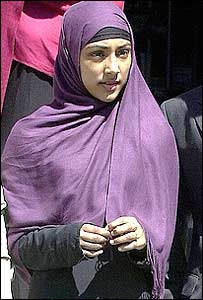
R (Begum) v Denbigh High
School case: The case involved Shabina Begum, a Muslim pupil at Denbigh High School in Luton, UK, who sued her school.
From a legal and sociological perspective, the early, hard-fought legal battles won by British Sikhs established the foundation of indirect discrimination in UK law, which multi-faith communities rely upon today to wear religious attire like the hijab, niqab, or cross.
However, because UK equality law evolved strictly along ethnic lines rather than religious lines, the legal protections for a Sikh turban and a Muslim veil operated on completely different legal pathways until the 21st century.
The Legal Concept of Indirect Discrimination
Prior to the 1970s, a British employer or school could simply say: "Our uniform rule applies equally to everyone—no headwear allowed." They claimed this was fair because it didn't explicitly name any race or religion.
The Mandla v Dowell Lee
(1983) case completely overturned this:
The Ruling: The House of Lords established that an apparently neutral
rule (like a no-headwear policy) is illegal if it places a specific group at a massive practical disadvantage, unless the rule can be heavily justified.
The Precedent: This victory legally proved that true equality does not mean treating everyone exactly the same, but rather adjusting rules to accommodate deeply held cultural and historic conditions. Every minority group in the UK, including Muslims, now uses this
concept of indirect discrimination to contest rigid dress codes in workplaces and schools.
The Great Race vs. Religion Legal Loophole
Despite the Sikh victory, a major legal divide remained in the UK for decades. The Race Relations Act 1976 strictly banned discrimination based on colour, race, nationality, or ethnic origins—but it completely omitted religion.
To protect the Sikh boy in the Mandla case, the courts had to create a specific legal workaround:
Sikhs and Jews as Ethnic Groups: The courts ruled that because Sikhs and Jews have a long, shared historical lineage, a distinct cultural geography, and a unified heritage, they qualify as ethnic groups under the law. This gave the Sikh turban ironclad legal protection.
Muslims as a Multi-Ethnic Faith: Conversely, because Islam spans dozens of distinct global ethnicities (e.g., Arab, Pakistani, Nigerian, White), British courts ruled that Muslims did not share a single
ethnic origin under the 1976 Act.
The Historical Disparity: For decades, this created a legal anomaly: an employer could face massive fines for banning a Sikh turban (classified as racial/ethnic discrimination), but could legally fire a Muslim woman for wearing a hijab without breaching the Race Relations Act.
How the Loophole Was Finally Closed:
The legal protection for Muslim dress wear was not fully secured until British legislation completely overhauled its frameworks in the 21st century, shifting from an ethnic model to a religious one:
The Employment Equality Regulations
2003: This law explicitly made it illegal to discriminate based on religion or belief in the workplace for the first time, closing the loophole that left Muslims vulnerable.
The Equality Act
2010: This unified all previous laws, placing Race and Religion/Belief on equal footing as protected characteristics. Muslim women could now officially deploy the
indirect discrimination framework pioneered by the Sikhs to defend their right to wear the hijab or abaya in corporate and civic spaces.
Current Legal Limits: Turbans vs. Face Veils (Burqas)
While the Sikh legal struggle paved the way for religious headwear, UK law draws a very sharp distinction between a head covering (turban/hijab) and a full-face covering
(niqab/burqa):
The Security and Communication Exemptions: Under the Equality Act 2010, schools and courts are permitted to place restrictions on face-coverings if they can prove it is a
proportionate means of achieving a legitimate aim.
The Legal Precedents: In landmark cases like R (Begum) v Denbigh High
School, British courts ruled that schools are legally allowed to ban certain variations of long religious dress or face veils if it interferes with effective classroom communication, eye contact, or safety—restrictions that are virtually never applied to a turban or
hijab.
The Courage Of First-generation British Sikhs Fundamentally Broke The Rigid Assimilation Model Of British Uniform Codes And Invented The Legal Tools Used To Protect Diversity.
Without Their Historical Sacrifices, The Legal Blueprint That Modern British Muslims Use To Protect Their Visible Identities In Public Institutions Would Not Exist.
This However Created A Two Tier (Double Standard) Justice System, Which Has No Place In A Civil
Society.
Everyone Should Be Equal Under The Law, Regardless Of Religious Affiliation!
Similar Topics
Reverse Mass Migration || Reverse Mass Migration Mughal Comparison || Why Indian Immigrants Outperform in the US and UK ||Share Your Thoughts Below
No comments found.







Leave a comment
Login | Register