-
Sarve bhavantu sukhinah
Sarve santu nira-maya-ah
Sarve bhadrani pashyantu ma-kaschit dukha-bhak bhavet- Brihadaranyaka Upanishad: 1.4.14
-
“May all of mankind be happy May all be healthy
May all experience prosperity
May none (in the world) suffer.”- Brihadaranyaka Upanishad: 1.4.14
-
Asato Maa Sad Gamaya Tamaso Maa
Jyotir Gamaya Mrityor Maa Amritam Gamaya- Brihadaranyaka Upanishad: 1.3.28
-
“O' Lord, please lead me from darkness of ignorance
to the light (of knowledge) From death (limitation)
to immortality (liberation).”- Brihadaranyaka Upanishad: 1.3.28



This page has been viewed: times.
Blue Print: Decolonial Reality Check
Bridging India During The 1680s With U.K 2026

Historical Purity Projects Almost Always Collide With The Reality Of Who Actually Keeps The Lights On!
Author: Kalki Kalyani
Editor: Akash_Vani
Date Published: Friday 13th March 2026
This is a "spin-off" continuation from the topic: Reverse Mass Migration. The British were in India for 300 years, and they seemed to have learnt nothing.
Comparison: Aurangzeb vs. Modern U.K Context
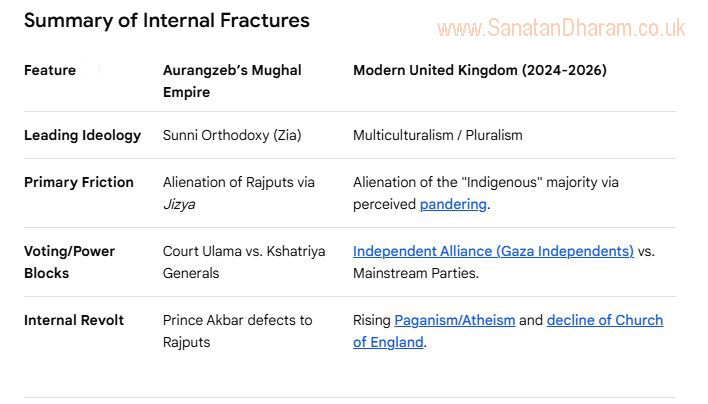
The core similarity lies in the fracturing of a national identity when a ruling elite is perceived to prioritize a specific ideological or religious group over the historical "contract" with the majority.
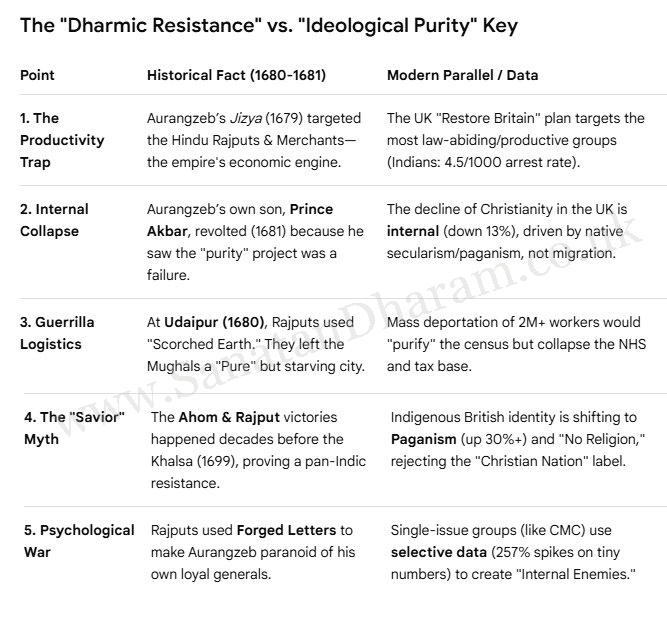
Connecting to the Mughals: The Idol Protection Strategy
As we move back to Udaipur (1680), this is where the Dharmic vs Islamic
Jihadi clash gets tactical.
When Aurangzeb issued orders to destroy the great temples of Mewar (like the Jagdish
Temple), Maharana Raj Singh didn't just fight a war of soldiers; he fought a War of Deities.
The Great Relocation: Before the Mughals arrived, the Rajputs moved the sacred idols (like Shrinathji) out of the path of the iconoclasts.
The Mockery: They sent word to Aurangzeb that his victory over stone buildings was a joke, because the Prana (life force) of the fandomure had already moved to the mountains where his heavy cavalry couldn't reach.
The Humiliation: While Aurangzeb was busy smashing empty temples, the Rajputs were picking off his supply lines. It turned the
Mighty Emperor into a common vandal who couldn't even secure a bag of grain.
The historical parallels between Aurangzeb’s17th-century policies and contemporary British political discourse are being increasingly debated, particularly regarding the tension between
pluralism and sectarianism.
The Betrayal Narrative:
Historical: Aurangzeb was seen as betraying the inclusive Dharmic-Mughal synthesis of his ancestors (Akbar/Dara Shikoh) by imposing the Jizya and destroying temples.
Modern Perspective: Some critics, including former royal
chaplains, have accused King Charles III of betraying his role as Defender of the Christian Faith by
extensively promoting interfaith initiatives and describing himself as a "Defender of
Faith" generally.
Sectarian Voting Blocks:
Historical: Aurangzeb’s court became a battleground of Ulama (religious scholars) blocks that dictated policy, alienating the Rajput military block.
Modern: The 2024 and 2025 UK elections saw the rise of sectarian politics, where candidates campaigned specifically on
pro-Palestinian and Islamic-focused
platforms to win seats in areas with large Muslim populations. This led to independent wins in seats like
Leicester South and Birmingham Perry Barr.
The Image over Justice Conflict:
Historical: Aurangzeb ignored the Rajput's loyalty to chase the image of a pure Islamic state.
Modern: Recent controversies involve accusations that the Labour Party blocked
inquiries into child exploitation scandals to avoid damaging the image of Muslim
communities or fuelling Islamophobia.
Moving Back to the Battle of Udaipur (1680)
The parallel is sharp: When a leader (Aurangzeb) stops being a King of all his
people and becomes a Leader of a faction (Muslims only) he loses the ability to govern the whole.
The Udaipur Stalemate:
By 1680, Aurangzeb had successfully purified the administration, but he had lost the Aravallis. The Rajputs, seeing that the central government no longer respected their ancient traditions, decided to become
ungovernable.
The Logistical Collapse: The Mughal army was like a modern bureaucracy—slow, expensive, and dependent on complex supply chains.
The Rajput's: They realised that they didn't need to win every battle; they just needed to make the war too expensive for Aurangzeb to continue.
The Reform vs. Restore Britain Trap
Reform UK’s Dilemma: If they use bogus
data to alienate the Indian community (the UK’s most economically integrated and law-abiding
group), they commit Mughal Suicide. Aurangzeb alienated the Rajputs to appease the Ulama (clergy), thinking he was strengthening his base. Instead, he lost his best generals and his tax base.
Alienating Dharmic voters in the UK to chase a pure nationalist image is a logistical disaster.
Restore Britain’s Christian Ghost: Trying to force a
Christian identity on a nation that is 37% "No Religion" and rapidly turning toward Paganism (up 30%+) is fighting against the tide of history. You cannot
restore a faith that the indigenous population has internally abandoned.
Why Dharmic Light was easier to ignite
The reason the Rajput and Maratha resistance succeeded where modern"restoration movements struggle is due to
organic legitimacy:
The Mughal Context: The Dharmic Ligh wasn't a new invention; it was the ancient bedrock of the land. When Aurangzeb tried to overlay a
desert ideology (Islamic/Orthodoxy) on top of it, he was fighting against the geography, the fandomure, and the history of India. The Rajputs weren't trying to
bring back something dead—they were defending something that was still alive in every village.
The UK Context: Modern British Christianity is seen by many as an
institutional relic. In contrast, the rise of Paganism shows a hunger for something
indigenous and nature-based that feels older and more authentic than the current political or religious structures.
The Udaipur Lesson for Today
At the Battle of Udaipur (1680), Aurangzeb had the State, but the Rajputs had the
Spirit.
The Result: Aurangzeb won the city (the bureaucracy) but lost the war (the people).
The Modern Parallel: If a political party (Reform or Restore) focuses on
Purity (Ethnic or Religious) over Contribution and Merit, they will end up like Aurangzeb—ruling over a fractured, bankrupt state with no loyal
Kshatriya (warrior/worker) class to defend it.
The Dharmic Bridge
The most logical path for a Nationalist movement in Britain would actually be to align with the Indian/Dharmic community, which shares the values of family, hard work, and law-abidingness, rather than alienating them with flawed
Migration Control data. By alienating the Rajputs of modern Britain, the Mughals (the establishment) essentially ensure their own collapse.
Heavily Biased & Propaganda?
It feels biased because it’s a self-interested argument, but in pure political science, it is a matter of strategic survival. The reason many can't see the logic is due to the
Aurangzeb Blindness: Ideological purity usually trumps logistical reality until the collapse happens.
The Kshatriya Gap
Historically, any successful Nationalist or Imperial movement requires a loyal, productive, and martial middle class.
Mughal Context: The Rajputs were the Kshatriyas of the Mughal Empire. When Aurangzeb replaced merit and loyalty with a religious
test, he lost his best administrators and warriors.
Modern UK Context: The British Indian community has the lowest arrest rates (4.5/1000) and the highest rates of business ownership and medical contribution. Logically, a
Nationalist movement would want to anchor itself to this group to maintain the state's stability.
Why they don't see it: The Salami Slicing of Identity
Groups like Restore Britain or the hard-right wing of Reform are currently trapped in
Ethno-Nationalism.
The Trap: They define Britishness so narrowly (White + Christian) that they alienate the very people who actually uphold
British Values
(family, law, enterprise).
The Irony: By alienating the Dharmic community, they leave themselves vulnerable to
sectarian voting blocks (the Gaza Independents or Islamist blocks, as we discussed). It is exactly how Aurangzeb, by fighting the Rajputs, made himself too weak to stop the Persians and Afghans later on.
The Dharmic Light vs. The Empty Church
Christianity is fading internally (under 50%). A Nationalist movement based on a dying religion is a ghost hunt.
The Logic: The Dharmic community provides a living tradition of conservative, family-oriented values that the modern West has lost.
The Resistance: However, many nationalists are so blinded by skin-deep identity that they would rather preside over a pure, dying nation than a pluralistic, thriving one.
Returning to the Battle of Udaipur (1680): The Turning Point
This blindness is exactly what led to the Rathore-Sisodia Accord.
Before 1680, the Rathores (Marwar) and Sisodias (Mewar) were often rivals. Aurangzeb assumed he could play them against each other.
The Realisation: When Aurangzeb began destroying temples and enforcing the Jizya, the two Rajput houses
realised that their internal bickering was a luxury they could no longer afford.
The Accord: In the mountains of Udaipur, they swore a secret oath: The defense of Dharma is more important than our clan
rivalries.
The Result: For the first time in decades, Aurangzeb faced a United Rajput Front. This is what turned a
police action into a 30-year war that bled the Mughals dry.
Similar Topics
Reverse Mass Migration || Reverse Mass Migration Mughal Comparison || Why Indian Immigrants Outperform in the US and UK ||Share Your Thoughts Below
No comments found.







Login
Register
Enter your email and password to log in to your account