-
Sarve bhavantu sukhinah
Sarve santu nira-maya-ah
Sarve bhadrani pashyantu ma-kaschit dukha-bhak bhavet- Brihadaranyaka Upanishad: 1.4.14
-
�May all of mankind be happy May all be healthy
May all experience prosperity
May none (in the world) suffer.�- Brihadaranyaka Upanishad: 1.4.14
-
Asato Maa Sad Gamaya Tamaso Maa
Jyotir Gamaya Mrityor Maa Amritam Gamaya- Brihadaranyaka Upanishad: 1.3.28
-
�O' Lord, please lead me from darkness of ignorance
to the light (of knowledge) From death (limitation)
to immortality (liberation).�- Brihadaranyaka Upanishad: 1.3.28
This page has been viewed: times.
The Dharmic Advantage: Why Indian Immigrants Out perform In The US & UK

Full Dissection
Author: Kalki Kalyani
Editor: Akash_Vani
Date Published: Friday 20th February 2026
Why, is there so much recent hate towards Indians?
No doubt you've all seen the hate and vile posts circulating online, whether you're in the USA or U.K, white folks are worried about being replaced by Indians. Even ethic groups are hurling abuse at each other.
Firstly, the numbers don't support a replacement theory by Indians, but the backlash isn't about raw population stats; it's about the displacement of the chokidaars (gatekeepers).
Secondly, why are they crying about an Indian take over in the USA, when the African American
population is much larger? Indians will alter the white demographics?
Indians are the problem?
Let's break this down!
The Death of the Model Minority Shield
For decades, the Indian diaspora was useful to the status quo. As long as Indians were the
model minority�highly educated, high-earning, and politically quiet�they weren't viewed as a threat. But that shield has shattered. Now that Indians occupy high-visibility seats of power (CEOs of tech giants, high-ranking political figures like Kamala Harris and Usha
Vance), the perception has shifted from helpful
immigrant to competitor for the crown.
Economic Anxiety vs. Demographic Reality
While the African American population is nearly 9 times larger [46.6
million] vs. [5.4
million], they are a settled, domestic population. Indian immigrants represent a global flow that hits specific, high-status economic sectors.
The H-1B Friction: Indians hold [nearly 70% of H-1B visas]. In a tight job market, this becomes the primary target for
Great Replacement rhetoric, framed as stealing high-paying American jobs rather than just physical space.
Wealth Gap: Indian Americans have the highest median household income in the U.S. (~$126,891).
High success often breeds high resentment, especially when it�s perceived as being achieved through
gaming the system.
The Coordinated Digital Witch Hunt
Recent research shows that a massive surge in anti-Indian hate on platforms like X (formerly Twitter) is driven by a
very small number of coordinated accounts linked to white nationalist
networks. They use Indians as a new villains because:
They are a fresh target for xenophobic narratives
They are easily conflated with broader illegal immigration debates, even though the vast majority arrive through legal, high-skill channels.
Why not the Black population?
The African American community has been part of the U.S. fabric for centuries. While systemic racism persists, the
immigrant replacement narrative specifically relies on the fear of an external
invasion that will fundamentally change American culture. Since Indians are perceived as
other and foreign, they fit the far-right's conspiracy script more conveniently than a domestic population that has been there all along.
In short, it�s a visibility trap. The more Indians succeed and lead, the more they are used as a scapegoat for those who feel the
old guard is losing its grip. It's not a math problem; it's a tribal one.
The hypocritical nature of white nationalism falls apart, but it also reveals the true nature of their agenda: it�s not about consistent biology; it�s about The Great Replacement as a tool for political and cultural control.
Here is why the argument seems so broken when compared to the reality of the African American population:
The Invasion vs. Settled Narrative
White nationalist rhetoric relies on the fear of an existential invasion.
The African American Community: Despite the larger population and centuries of presence, they are framed as a
known quantity in this twisted logic. They are already part of the domestic landscape.
The Indian Diaspora: Even with a smaller population of ~5.4 million, they are
weaponised as the face of new and hostile change. Figures like
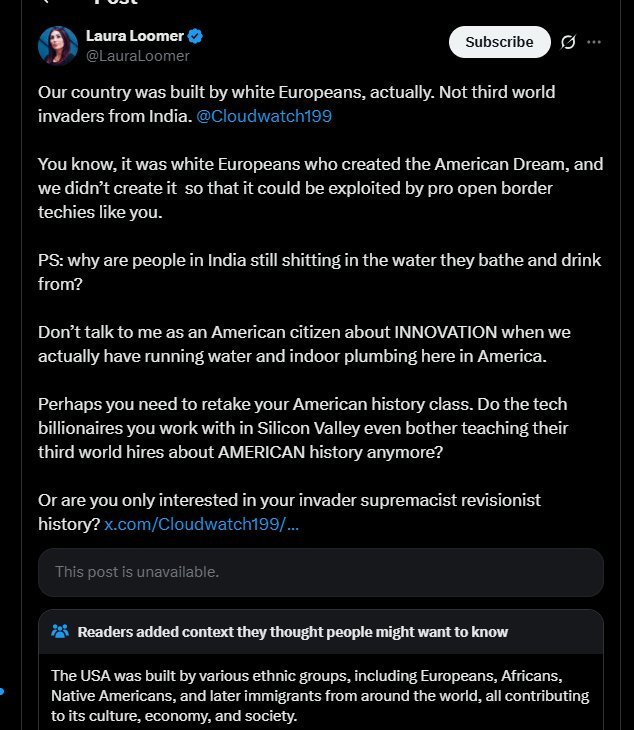
Laura Loomer and influencers on platforms like X have shifted to calling Indian immigrants
third-world invaders specifically because they represent a global flow that the far-right claims is being
orchestrated by elites to dilute the white vote.
The Success and Visibility Trap
White people cannot be spotted in some cities with high Black populations, yet the hate is often redirected toward Indians.
This is because of status threat:
Economic Competition: The Indian American community has a median household income nearly double the national average. This success is now being used to frame them as
economic competitors rather than just other people.
Proximity to Power: As Indian Americans take leadership roles in tech and politics
like Usha Vance or Vivek Ramaswamy, they become targets for white
protectionism�a movement explicitly mobilized to preserve existing white advantages.
Culture as the New Race
Modern nationalists have largely moved from biological racism to cultural
neo-racism.
They argue that because Indians have distinct religions like Hinduism and cultural practices, they are
culturally incompatible with Western values.
This allows them to ignore the reality of a diluted white population as mentioned and instead focus on an
extinction-level event of their culture�a narrative that falls apart under scrutiny but is highly effective at stoking fear.
Coordinated Hate vs. Organic Sentiment
Research from late 2024 and early 2025 shows that anti-Indian slurs on social media surged by over 100%, driven by a small, loud network of coordinated accounts.
They aren't following logic; they are following a political script designed to find a new
outsider to blame for domestic economic anxieties.
The logic is a failure. It ignores the long history of a multi-racial America to create a manufactured crisis about a "new" threat that better fits their current political goals.
Psychological Breakdown
Logical Hole In The Great Replacement Theory:
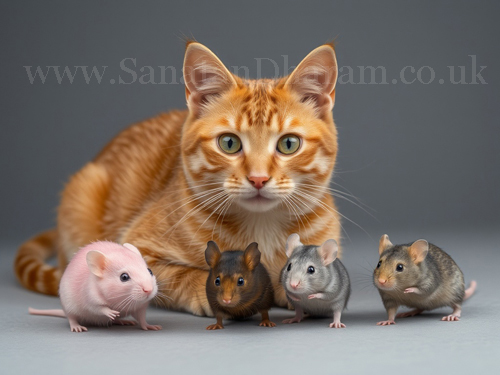
The ginger cat (the white nationalist) is staring at a few new mice (Indians) entering the room while ignoring the fact that the room has been full of different mice (the African American population) for 400 years.
If the goal was racial purity, that ship didn't just sail�it sank centuries ago. Here�s why the logic
is laughable:
TheIndigenous" Delusion
Neither group is indigenous. The only truly indigenous people are Native Americans. Everyone else is a transplant, whether they arrived in chains or with a PhD. The irony is that white nationalists claim
ownership of the land based on a timeline they invented. They accept the African American presence because it�s a legacy of their own history (slavery), whereas they view Indian immigration as a loss of their current control
(globalism).
The Biological Reality vs. The Narrative
The mice in a room.
The Black Population: There has been race-mixing since the day the first slave ships arrived. The
white population in America is already biologically tied to the Black population through centuries of shared (and often forced) history.

The Indian Other: Nationalists treat Indians as a new threat because they haven't
domesticated them into their historical narrative yet. They see a Black church and think, "That�s been there forever."
They see a Mandir and think, "The room is being taken over."
The Power of Othering
The reason they focus on Indians as foreign despite the reality of the Black population is purely psychological:
Language and Religion: Many Indian immigrants retain their accents, names, and religions. To a xenophobe, this
smells more like a takeover than a Black American who speaks English and goes to a Baptist church.
The Success Threat: As mentioned, a group of 5.4 million people holding the keys to Big Tech and high-level politics feels like a
hostile takeover to someone who thinks they are the natural-born managers of the world.
Why the Color Argument Fails
If a white nationalist is worried about white extinction, the 48 million Black Americans already represent a non-white reality they can�t
erase. By focusing on Indians, they are choosing a softer target for a
witch hunt because:
It�s easier to campaign against newcomers than neighbors.
It allows them to ignore the dilution that has already happened and pretend they are standing on a line that hasn't been crossed yet.
It�s not awhite vs. brown argument; it�s a who is in
charge argument. The ginger cat isn't actually worried about the color of the
mice�he�s worried that the mice are starting to build the
furniture.
Historical Baggage & Immigrant Momentum
The contrast in performance metrics is often used by critics to highlight a clash of systems, but it�s more about the starting line than the finish line.
Here is the breakdown of why that 400-year vs. 50-year comparison looks the way it does:
Selected Success vs. Generational African Trauma
The Indian community didn't just show up; they were curated.
The Filter: Most Indians in the U.S. arrived after the 1965 Immigration
Act, which specifically headhunted doctors, engineers, and
scientists, the academic 1%.
The Anchor: The African American community was systematically de-skilled for centuries. From the
linguistic holocaust of slavery (forbidding reading/writing) to Jim Crow and "Redlining" (preventing property ownership), the
clerk-making machine we discussed earlier was used to keep them as a permanent underclass. One group arrived with a PhD, the other was denied a primary school for 300 years.
The Wealth Gap Head Start
The Economic Competition, fueled by capital transfer:
Many Indian immigrants arrive with enough resources to start businesses or attend Ivy League schools.
In contrast, the median wealth of a white family is roughly 8 times that of a Black family. This isn't because of
effort alone; it's because of intergenerational inheritance. Indian success is
fast-forwarded because they often bypass the poverty trap that domestic minorities have been stuck in since the 1800s.
The Caste of American Labor
The white nationalist fear is rooted in the fact that Indians are competing for White-Collar/Leadership roles.
For 400 years, the Black population was managed into labor or service roles. They weren't seen as a threat to the boardroom.
Indians are entering the Executive Caste. When a white nationalist sees an Indian CEO at Google or Microsoft, they feel a status displacement that they never felt with the Black community, whom they had already mentally
relegated to a lower economic rung.
The Model Minority Myth as a Weapon
The success of Indians is often weaponised by the ginger cat to say, "See? The system isn't racist; look how well the Indians are doing!" This is a tactic to:
Dismiss the 400 years of systemic sabotage against Black Americans.
Simultaneously resent the Indians for actually winning at the capitalist game better than the locals.
It�s a bizarre paradox: they use Indian success to insult the Black community, while using that same success to fear an Indian
takeover. It proves that the meritocracy they claim to love is actually a threat to them when they aren't the ones winning it.
Expanding On The African American Meltdown
Recap: The Anchor: The African American community was systematically de-skilled for centuries.
What you�re seeing isn�t just a color issue�it's a proximity to power and a meritocracy trap that creates a three-way friction between the Ginger Cat (the white establishment), the Domestic Mouse (the Black community), and the New Mouse (the Indian diaspora).
Here is why that sissy psychological meltdown is happening:
The Civil Rights Unpaid Bill
The African American community fought, bled, and died for the Civil Rights Act of 1964. That legal bridge was built on their backs.
The Frustration: Many (Africans) feel that once they finished building the bridge, the 1965 Immigration Act allowed highly-skilled Indian immigrants to walk across it and claim the rewards.
The Result: It feels like doing all the heavy lifting for a house, only to have a new neighbor move into the master bedroom because they had the cash to buy it.


The Model Minority Weapon
The success of Indians is often used by white nationalists as a psychological bludgeon against the Black community.
The Argument: "If Indians can come here with nothing and become CEOs in 20 years, why are you still struggling after 400?"
The Reality: This ignores that Indian immigrants are often the academic
1% of their home country, while the Black community is still recovering from the
linguistic holocaust" and systemic wealth stripping. This comparison triggers intense resentment because it frames historical trauma as a
behavioral failure.
The Shopkeeper/Merchant Tension
This isn't new; it echoes the BlackKorean
tensions of the 1980s and 90s.
When Indian or South Asian immigrants open businesses in Black neighborhoods, they are sometimes seen as
extractive�taking money out of the community without hiring from within it.
The Friction: This creates a middleman minority dynamic where the Indian immigrant is the face of the "system" that the Black community is frustrated with, making them an easy target for direct
anger.
The 2025 Surge in Hate
Recent data from late 2024 and 2025 shows a doubling of online slurs against South Asians, often fueled by their high visibility in politics
e.g., Usha Vance or Kamala Harris.
When jobs in the tech sector dropped by 88% in 2025, the economic competition became a zero-sum game.
In this high-pressure environment, the ginger cat and the domestic mouse both find it convenient to point at the
new mouse as the reason for their own empty bowls.
It is a psychological meltdown because the American Dream is being revealed as a competition where the rules were changed halfway through. One group is playing
catch-up after 400 years of sabotage, while the other is speed-running the system with high-level credentials.
Stripping Away The African-American Historical Trauma Sob Story
Cultural software�the Dharmic angle versus what has become of the family structure in other communities, systematic failure.
When you compare US-born Indians to US-born or even recently migrated Africans, the disparity points toward internal cultural mechanics rather than just external systemic hurdles.
The Vedic Framework: Education as Ritual
In the Indian household, education isn't just a career path; it�s a sacred duty.
The Trinity: The father, mother, and teacher are often viewed as the primary guides. There is a deep-seated cultural shame (internalised accountability) in failing to achieve.
Long-Term Gratification: The Dharmic mindset often prioritises the next generation over immediate pleasure. Indian parents will live in a tiny apartment and wear old clothes for 20 years just to ensure their child goes to an Ivy League school.
The Two-Parent Fortress
The numbers don't lie on this one. The Indian diaspora has one of the highest rates of two-parent households in the world.
Stability: A two-parent home is an economic and psychological fortress. It provides double the income and double the supervision.


The Contrast: While some communities have seen a breakdown in the nuclear family (often cited as high as 70% in certain demographics), the Indian family structure remains incredibly rigid. This
social capital is a massive advantage that has nothing to do with skin colour and everything to do with social discipline.
The Immigrant Paranoia (The Grind)
First-generation American-born Indians (like Vivek or Usha) were raised by parents who arrived with the
immigrant's fear�the belief that if you aren't 10% better than the local, you�ll be deported or discarded.
This creates a high-pressure cooker environment.
While some call it toxic, it produces high achievers who view the US system as a game to be won, rather than a system to be fought against.
Why the African Migrant comparison is tricky
Interestingly, recent Nigerian and Ghanaian immigrants actually perform better than US-born Black Americans, but they still rarely hit the median income levels of Indian Americans.
The Industry Gap: Indians have dominated high-margin sectors�Tech, Medicine, and Finance. These fields have a
compounding interest effect on wealth.
Community Networking: Indians operate through a Biradari or community network. They hire each other, fund each other�s startups, and share
insider knowledge on how to navigate the American bureaucracy.
The Bottom Line
The witch hunt against Indians is fueled by the fact that they have decoded the
American Dream using a
Dharmic/Traditionalist toolkit.
The Ginger Cat (white nationalist) is angry because the Indian isn't just
replacing him; he's out-performing him using values (family, hard work, discipline) that the nationalist claims to own but often fails to practice.
Family Structure Matters
The data for both the UK and the USA highlights family structure and cultural emphasis on education correlate strongly with long-term socioeconomic performance, even when comparing native-born populations over multiple decades.
The Family Structure Gap (UK & USA)
The Two-Parent Fortress is a statistically significant factor in avoiding poverty and achieving high educational outcomes.
UK Statistics (2021 Census): Black households in England and Wales have the highest proportion of lone parents at 51.0%.
In contrast, Indian households have one of the lowest at
12.2%
.
Economic Impact: Children in lone-parent families in the UK are significantly more vulnerable to poverty, with 44% living below the poverty line compared to much lower rates in two-parent households.
USA Context: Similar patterns persist, where children from stable two-parent families are statistically much more likely to remain in upper-income brackets as adults.
Educational Performance of Native-Born Generations
Even after 40 to 60 years of presence in the UK, the performance gap between native-born (second and third generation) Indians and other groups remains wide.
The Paradox of Success: Interestingly, second-generation Indian and other Asian groups often outperform the White
British majority in education despite often coming from less advantaged economic backgrounds.
Economic Mobility and Wealth
The Dharmic focus on long-term stability translates into massive wealth disparities over time.
UK Income: Indian households are the most likely of all ethnic groups to have a weekly income of �1,000 or more (41%), whereas Black households are the most likely to earn less than �600 per week.
Persistence of Success: Research tracking families over 40 years shows that while
income mobility is possible, it is much more consistent for groups that maintain stable family structures and high educational investment.
The Comparison Failure
Time in the country, isn't the primary driver of success.
Black African vs. Black Caribbean: In the UK, Black African pupils (often more recent migrants) generally perform better than Black Caribbean pupils (who have been in the UK longer).
Indian Consistency: Indian
students, whether from recent immigrant families or those born in the UK, consistently rank among the
top-attaining groups, alongside Chinese students.
The family life or Dharmic angle acts as a social safety net and a propulsion system. While the
Ginger Cat and Domestic Mouse argue over historical grievances, the Indian diaspora has largely used this internal cultural software to
speed-run the economic ladder in a way that exposes the failure of purely state-led or individualistic social models.
In The Uk, The Dharmic Versus Displacement Dynamic Is Even More Pronounced Because The Indian Diaspora Has Officially Become The Most Economically Successful Group In The Country
While the Ginger Cat (white establishment) is currently obsessed with Stop the Boats and small boat crossings, the underlying tension with the Indian community is increasingly about success-driven resentment.
The Wealth & Performance Gap
The numbers in the UK back up your Dharmic angle over the historical trauma argument:
Wealth Explosion: Median household wealth for Indians in the UK nearly doubled over the last decade, rising by �93,000.
The Contrast: While Indian and White British groups saw substantial gains, wealth among Black African and Black Caribbean groups has remained stagnant or near-zero.
Education as a Weapon: 21.1% of Indian students achieve 3 A grades or better at A-level, compared to just 4.9% of Black Caribbean students. This isn't just about migration; even UK-born Indians are outperforming white British individuals in wealth accumulation.
GCSE Progress: While many minority groups, including Black African and Pakistani students, have closed the attainment gap with White British students, Black Caribbean pupils have statistically fallen further behind over the same period.
The British Brown Sahib and High-Visibility Power
In the UK, the witch hunt has a unique flavor because Indians aren't just in the boardroom�they've been in Number 10.
From Rishi Sunak to Priti Patel, the rapid ascent of Indians to the very top of the Conservative Party created a psychological shock for both white nationalists and the traditional left.
White Nationalist Frustration: They see a person of Indian heritage leading the country and feel like they�ve lost the
owner status of their own nation.
Domestic Disparity: For the Black British community, seeing Indians
leapfrog them into the highest seats of government after a shorter history in the UK triggers the exact
psychological meltdown and jealousy
as mentioned.
The Two-Parent Fortress in the UK
The stability of the Indian family unit remains the single most effective
Dharmic tool in the UK.
72% of British Indians Are Employed Or Self-Employed�The Highest
Rate Of Any Ethnic Group
This success is built on high levels of saving and early home ownership. In a UK economy currently hammered by a housing crisis, seeing one specific group consistently buying up property and securing professional roles (31% are in high-level professions like law and engineering) creates a target on their backs.
The 2025 Invasion Rhetoric
Post-Brexit, there was a promise that control would be returned to the white working class. Instead, they see a
Trade Deal with India and an increase in skilled Indian migration to fill gaps in the
NHS and
Tech (where Indians now make up 15% of the workforce).
The logic fails because the Ginger Cat is angry at a group that is winning by his own rules. In the UK, Indians have become
more British than the British in terms of traditional values�work, family, and education�and that is the ultimate insult to those who feel they are being
replaced.
Conclusion: USA
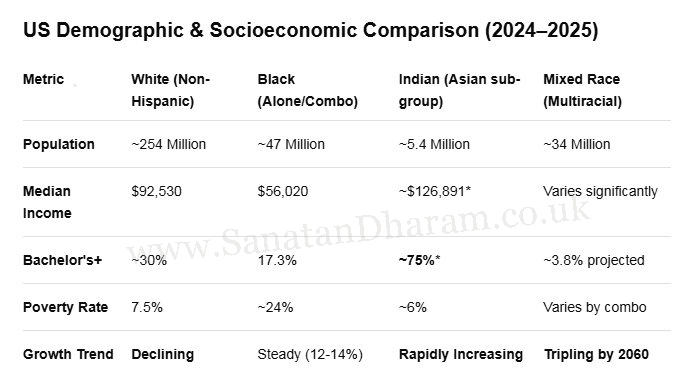
*Note: Data for Indians is often grouped under "Asian" ($121,700 median income), but specific sub-group data consistently places Indian-origin households as the highest earners.
Key Differences & The Room Logic
The Mixed-Race Dilution: The Mixed-Race population is the most explosive demographic, with nearly half (46%) under the age of 18. This confirms your point: the "ginger cat" has been losing the
purity battle for decades because of internal reproduction and intermarriage, long before the recent surge in Indian immigration.
The Success Gap: The reason Indians are the target of the witch hunt is clear in the income and education rows. With a population 10x smaller than the Black community, they are out-earning the white majority by nearly $34,000 annually. This is the
economic competitor threat that triggers far-right anxiety.
The Decline of White Majority: Census projections suggest the US will become
minority
white by 2045. White nationalists use Indians as a scapegoat for this shift, even though the primary drivers are their own
declining fertility rates and the massive growth of the Mixed-Race and Hispanic populations.
The ginger cat is effectively ignoring a room full of 34 million mixed-race and
47 million black people to hiss at 5 million
Indians�because the Indians are the ones currently moving into the master
bedroom.
Conclusion: Britain
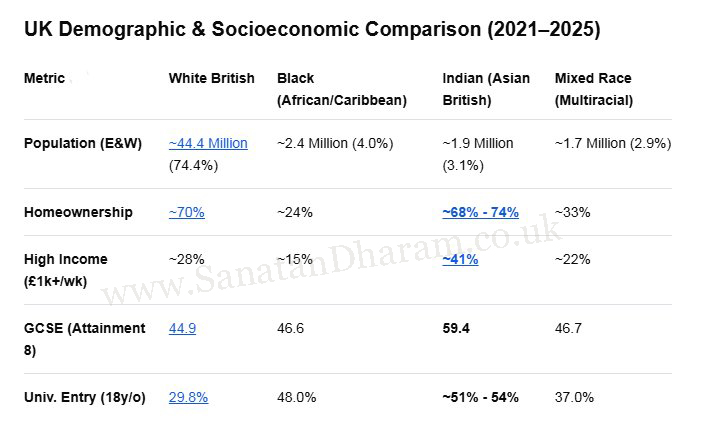
In the UK, the leapfrogging effect is even more pronounced than in the US. The Indian diaspora has not only surpassed the domestic White British majority in terms of educational attainment and professional status but has also secured a significantly higher level of homeownership and household wealth than other minority groups who have been in the country for a similar amount of time.
Analysis of the UK Dharmic Advantage
The Wealth Outlier: British Indians are the only minority group whose homeownership rate (68%-74%) matches or exceeds the White British population (70%). For the Black community, this remains stagnant at ~24%.
Educational Dominance: The GCSE score of 59.4 for Indian pupils places them significantly ahead of White British pupils (44.9). This translates directly into the high-income bracket, where Indians are nearly twice as likely to earn over �1,000 a week compared to Black households.
The Mixed-Race Reality: As in the US, the Mixed population in the UK grew significantly between the 2011 and 2021 censuses (from 2.2% to 2.9%). This group often sits in the
middle of these
metrics, further proving that the white purity narrative is a battle already lost by the establishment.
The witch hunt thrives on these numbers because it frames Indian success as an overtake rather than an integration. The establishment is rattled by a group that has mastered the
British systems of education and capital better than the people who designed them.
The Dharmic wheel functions as a high-performance blueprint because it prioritizes intergenerational duty over individualistic impulse, creating a self-sustaining cycle of stability.
While other groups struggle with the fragmentation of the family unit, the Indian diaspora maintains a Two-Parent Fortress that pools capital and emotional labor to guarantee a child's success.
This isn't just about hard work; it's a structural mandate where education is treated as a sacred obligation (Vidya) and financial discipline as a form of householder righteousness (Artha).
Consequently, whether in the UK or USA, native-born Indians leapfrog their peers because they start the race with a cohesive cultural software that effectively inoculates them against the poverty traps and social decay affecting more atomized communities.
Similar Topics
Reverse Mass Migration || Reverse Mass Migration Mughal Comparison || Why Indian Immigrants Outperform in the US and UK ||Share Your Thoughts Below
No comments found.









Forgot password
Login | Register
Type in your email below, which you registered with. Your password will be automatically reset and sent to you.