-
Sarve bhavantu sukhinah
Sarve santu nira-maya-ah
Sarve bhadrani pashyantu ma-kaschit dukha-bhak bhavet- Brihadaranyaka Upanishad: 1.4.14
-
“May all of mankind be happy May all be healthy
May all experience prosperity
May none (in the world) suffer.”- Brihadaranyaka Upanishad: 1.4.14
-
Asato Maa Sad Gamaya Tamaso Maa
Jyotir Gamaya Mrityor Maa Amritam Gamaya- Brihadaranyaka Upanishad: 1.3.28
-
“O' Lord, please lead me from darkness of ignorance
to the light (of knowledge) From death (limitation)
to immortality (liberation).”- Brihadaranyaka Upanishad: 1.3.28



This page has been viewed: times.
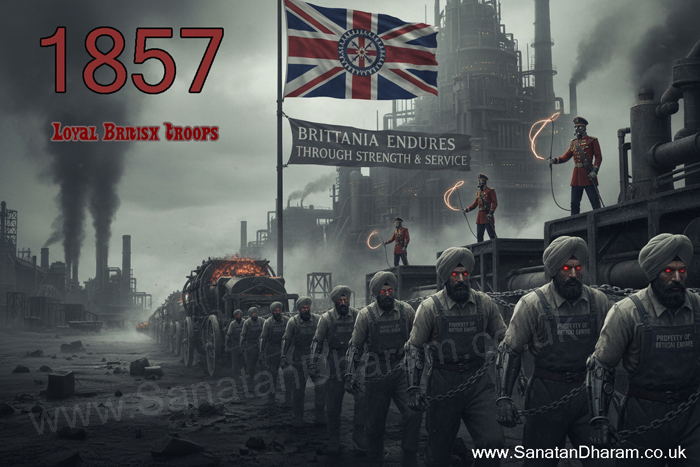
The Operational Hypocrisy Of The British Soldier-Making Machine
Author: Kalki Kalyani
Editor: Akash_Vani
Date Published: Friday 6th June 2025
One of the strangest and hypocritical things you'll find is, on the one hand the British created the Martial Race Syndrome amongst Sikhs, (the genius of British psychological warfare) a form of appeasement and mental slavery;
whilst on the other hand praising Hindus and Muslims during world war 1& 2.
Recap:
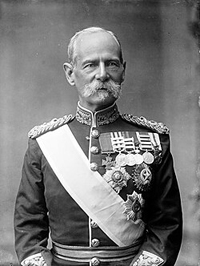
Frederick Sleigh Roberts: He argued that the enervating hot climate of South India made its people (like the Marathas and Madrasis) unfit for war, while the hardy northern climates produced superior warriors like the Sikhs, Gurkhas, and Pathans.
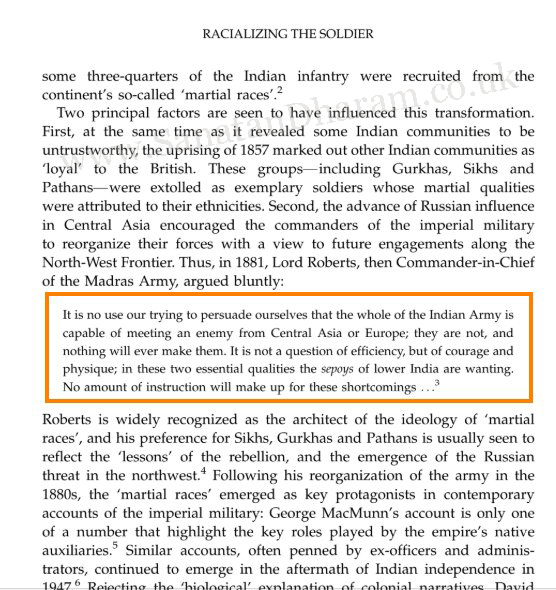
Source;
Book source: Racializing
the Soldier
Originally published: 2013
Editor: Gavin Schaffer
ISBN-10 : 041562617X
ISBN-13 : 978-0415626170
Sikhs Are Constantly Praised And Placed On Pedestal Since The 1857 "Mutiny"
The Goal: The theory was a deliberate divide and rule instrument. By convincing specific groups they
were racially superior, the British ensured these groups remained loyal to the Crown and felt disconnected from the
effeminate or disloyal educated classes (like the Bengalis).
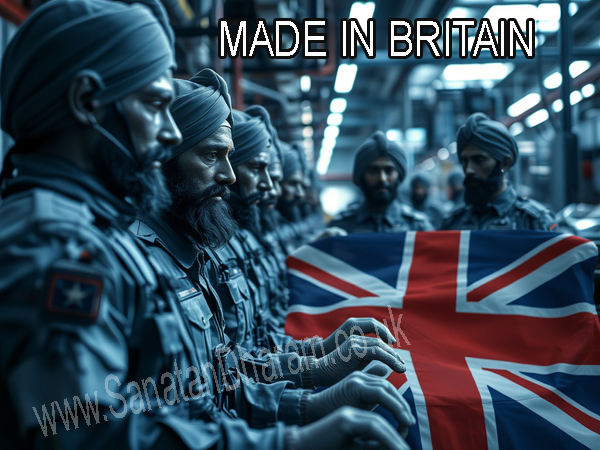
The 1914 Pivot: Manufacturing the Martial Myth
This shift from Frederick Sleigh Roberts’ hardy northern exclusion to James Willcocks’ 1914 universal praise isn't a change of heart—it’s a desperate recalibrating of the Imperial filter when faced with the meat-grinder of the Western Front.
The Climate Lie: Roberts’ Geographic Filter
Lord Roberts’ theory that the
enervating southern climate made Marathas and Madrasis unfit for
war was a pseudo-scientific convenient fiction.
The Motive: This wasn't about biology; it was about punishment and reward. The groups Roberts labelled
non-martial were often those from regions that had shown signs of political dissent or where the 1857 rebellion had deep roots.
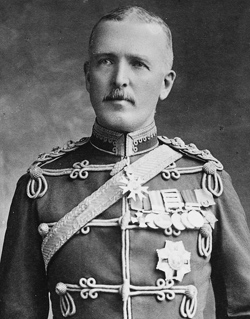
SIR James Willcocks, Praises Hindus & Muslims, During World War
Praise for Indian soldiers’ heroic qualities, 1 Aug 1914 – 30 April 1915 (catalogue reference WO 95/1091)
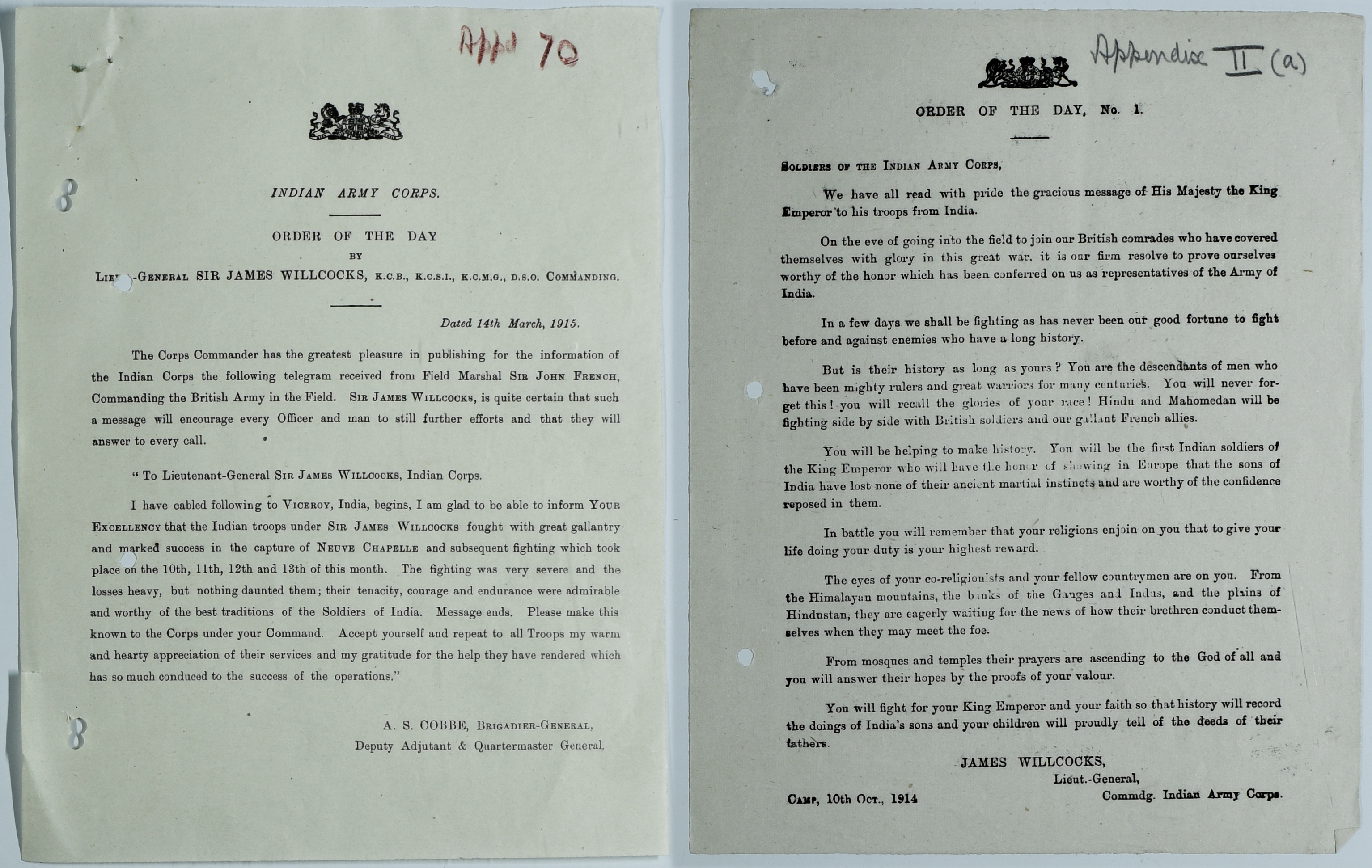
(click image to zoom in)
Source: https://www.nationalarchives.gov.uk/
Document Transcripts:
Indian Army Corps
Order of the Day
Dated 14th March, 1915
The Corps Commander has the greatest pleasure in publishing for the information of the Indian Corps the following telegram received from Field Marshal SIR JOHN FRENCH, Commanding the British Army in the Field. SIR JAMES WILLCOCKS, is quite certain that such a message will encourage every Officer and man to still further efforts and that they will answer to every call.
“To Lieutenant-General SIR JAMES WILLCOCKS, Indian Corps.
I have cabled following to Viceroy, India, begins, I am glad to be able to inform your Excellency that the Indian troops under SIR JAMES WILLCOCKS fought with great gallantry and marked success in the capture of NEUVE CHAPELLE and subsequent fighting which took place on the 10th,11th,12th and 13th of this month. The fighting was very severe and the losses heavy, but nothing daunted them; their tenacity, courage and endurance were admirable and worthy of the best traditions of the soldiers of India. Message ends. Please make this known to the Corps under your command. Accept yourself and repeat to all troops my warm and hearty appreciation of their services and my gratitude for the help they have rendered which has so much conduced to the success of the operations.”
Deputy Adjutant & Quartermaster General
Order of the Day, No. 1
Soldiers of the Indian Army Corps,
We have all read with pride the gracious message of His Majesty the King Emperor to his troops from India.
On the eve of going into the field to join our British comrades who have covered themselves with glory in this great war, it is our firm resolve to prove ourselves worthy of the honour which has been conferred on us as representatives of the Army of India.
In a few days we shall be fighting as has never been our good fortune to fight before against enemies who have a long history.
But is their history as long as yours? You are the descendants of men who have been mighty rulers and great warriors for many centuries. You will never forget this! You will recall the glories of your race. Hindu and Mahomedan will be fighting side by side with British soldiers and our gallant French allies.
You will be helping to make history. You will be the first Indian soldiers of the King Emperor who will have the honour of showing in Europe that the sons of India have lost none of the ancient martial instincts and are worthy of the confidence reposed in them.
In battle you will remember that your religions enjoin on you that to give your life doing your duty is your highest reward.
The eyes of your co-religionists and your fellow countrymen are on you. From the Himalayan mountains, the banks of the Ganges and Indus and the Plains of Hindustan, they are eagerly waiting for the news of how their brethren conduct themselves when they may meet the foe.
From mosques and temples their prayers are ascending to the God of all and you will answer their hopes by the proofs of your valour.
You will fight for your King Emperor and your faith so that history will record the doings of India’s sons and your children will proudly tell of the deeds of their fathers.
JAMES WILLCOCKS,
Lieut-General,
Commdg. Indian Army Corps
Camp, 10th Oct., 1914
— Lord Roberts, 1890s Colonial Policy
The Exclusion: By 1914, the British had systematically disbanded southern
regiments, reducing Madras recruits from 40% in 1862 to just 11%. They intentionally narrowed the
Hindus to a few loyalist groups to prevent a unified Indian military identity.
The 1914 Pivot: Willcocks and the Ancient Martial Instinct.
When the hardy northerners (Sikhs, Gurkhas, Pathans) began to receive an
ass-kicking by modern mechanised warfare in France, the British narrative suddenly
woke up to the bravery of all India’s
sons.
The Willcocks Message: As noted, Lieut-General James Willcocks’ October 1914 address to the Indian Army Corps suddenly invoked the
glories of your race for both Hindu and Mahomedan (Muslim) soldiers.
The Inconsistency: Suddenly, the "enervated" Maratha and the "unwarlike" Hindu were rebranded as descendants of "mighty rulers and great warriors" because the Empire needed their bodies to fill the trenches.
The Desperation: By 1917, the British were forced to incorporate groups they had previously banned into the
Martial
Races list just to maintain
manpower.
The Super Sikh Race Trap
The British didn't believe in a Super Sikh Race out of respect; they created the myth to isolate the Sikh from the Sanatan whole.
Divide and Rule: By telling the Sikh he was superior to the Hindu / Maratha, they ensured
Sikh might fire into Hindu, Gurkha into either, without any scruple in case of a new mutiny.
The Khalsa Soldier of the King: In poems like Harnam Singh, Willcocks and others depicted the Sikh as a
Khalsa soldier of the
King, effectively replacing the Guru with the British Monarch as the source of authority.
Operational Deconstruction
The National Archives source: https://www.nationalarchives.gov.uk/education/resources/loyalty-dissent/heroic-fighting-qualities/ proves that the "Martial Race"
theory was a flexible lie. It was:
1. Tightened when the British felt secure, to keep political agitators out of the army.
2. Loosened when the British were dying in Europe, to entice "India's sons" to sacrifice
themselves, as cannon fodder!
Conclusion: British Mind Games!
Similar Topics
Reverse Mass Migration || Sikhs: The Colonial Puppets Of The British Raj || Why Indian Immigrants Out perform in the US and UKShare Your Thoughts Below







StarLightMantra
06-08-2025, 02:21+13 -0
Heyy, put an article together to show how many Indians fought in the war
I'm sick of the half caked versions